THE RECORD · ARCHIVE PLAYER
MP4
■ PAUSED
1970s American Tourister Hardshell Luggage Vintage AdvertisementANALOG ARCHIVE
1970s American Tourister Hardshell Luggage Vintage Advertisement (1970) — Class B vintage Lifestyle & Vice
CLASS B
1 of 4

1970s American Tourister Hardshell Luggage Vintage Advertisement

Category|Lifestyle & Vice
Year|1970
Rarity Class|CLASS B
Archive Views|100

Last updated: 18 May 2026

Historical Context

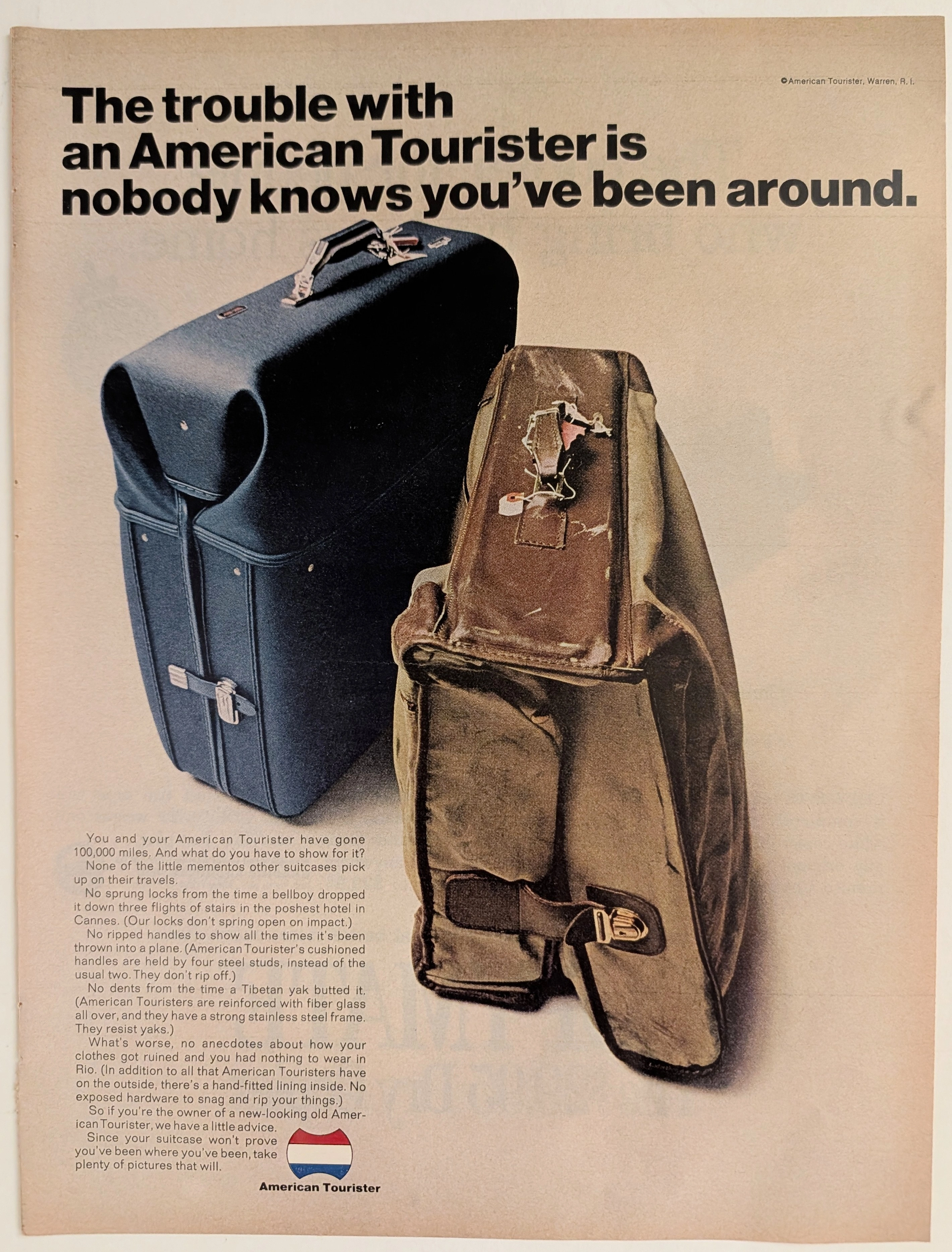
1970s American Tourister "Nobody Knows You've Been Around" Vintage Advertisement During the 1960s and 1970s, the democratization of global air travel led to a surge in consumer demand for reliable luggage. However, the automated baggage handling systems at modern airports, combined with the general rigors of international travel, proved disastrous for traditional leather and soft-canvas suitcases. American Tourister, operating out of Warren, Rhode Island, positioned itself as the ultimate solution to this modern travel dilemma by pioneering hardshell luggage reinforced with fiberglass and framed with stainless steel. This specific advertisement, featuring the brilliant headline "The trouble with an American Tourister is nobody knows you've been around," is a classic example of mid-century advertising wit. Instead of merely listing product specifications, the copywriter employs narrative humor, detailing hyperbolic travel disasters—such as a bellboy dropping the bag down three flights of stairs in Cannes or a Tibetan yak butting it. The pristine blue American Tourister case stands in stark visual contrast to the ruined, taped-together olive bag beside it. This visual strategy effectively shifted consumer perception: travel scars on luggage were no longer seen as badges of worldly experience, but as signs of a poor purchasing decision. This era of marketing laid the conceptual groundwork for American Tourister’s later, culturally iconic "Gorilla" television campaigns.

Paper & Print Condition

This artifact is preserved on standard commercial magazine stock typical of mass-circulation periodicals from the 1970s. The paper weight is relatively light but maintains a slight calendared finish, designed to hold ink well without significant bleed-through. Close archival inspection, particularly visible in the macro-photography of the suitcase's textured surface and the brand's logo, reveals the distinct, tightly clustered CMYK (Cyan, Magenta, Yellow, Key/Black) halftone rosette patterns characteristic of high-volume mid-century offset lithography. The color registration is exceptionally precise, which is crucial for maintaining the sharp boundaries of the bold, authoritative typography and the nuanced shadows that give the suitcases their three-dimensional presence on the page. The application of the black ink is particularly dense, ensuring the headline retains its stark visual impact. In terms of physical condition, the page exhibits only minimal edge wear and a very faint, uniform natural toning (mild oxidation of the paper fibers) consistent with its age. There is an absence of deep creasing, moisture damage, or disruptive foxing. The structural integrity of the paper remains sound, and the ink has not suffered from significant fading or flaking, allowing the subtle textural contrasts—the smooth fiberglass versus the torn canvas—to be appreciated exactly as the original art directors intended.

Provenance & Rarity

This specific advertisement originates from the proliferation of mass-market consumer periodicals in the United States during the 1970s, an era when print media was the undisputed primary vehicle for national brand storytelling. The piece was likely extracted from a widely circulated weekly or monthly publication, such as LIFE, Time, or Newsweek, which served as the cultural touchstones of middle-class American households. Like all magazine advertisements of the period, this document is inherently ephemeral; it was printed on highly acidic paper designed for temporary consumption and subsequent disposal. The true rarity of this artifact does not stem from a limited initial print run—as millions of copies were originally distributed—but rather from the exceedingly low survival rate of individual pages maintained in such a pristine, unblemished state decades later. Environmental factors, paper oxidation, and general attrition typically destroy these everyday commercial artifacts. For archival institutions and advertising historians, an intact specimen of this caliber is highly prized. It serves as a vital, unadulterated primary source that documents not only the evolution of travel goods and industrial design during the jet age but also the highly influential, witty, and self-aware copywriting style that revolutionized mid-to-late 20th-century American advertising.

Rarity & Condition Summary

In summary, this 1970s American Tourister advertisement represents a superlative example of mid-century commercial ephemera, distinguished not by an inherently low initial print run, but by its extraordinary state of preservation decades later. The artifact vividly demonstrates the technical apex of 20th-century offset lithography, successfully maintaining the striking visual contrast between the pristine fiberglass hardshell and the tattered canvas luggage—a visual metaphor essential to the campaign's success. Devoid of the severe yellowing, structural degradation, or edge fraying that typically ravages the highly acidic magazine stock of this era, this piece has transcended its origins as a disposable marketing tool. Today, it stands as a museum-grade archival document. It offers historians, design scholars, and vintage advertising collectors an unblemished window into the golden age of global airline travel, the evolution of industrial luggage design, and the clever, narrative-driven copywriting that defined modern American advertising.

Share This Archive

From the Journal

Related Articles

The Time Traveller's Dossier: The Architecture of Slumber – The 1967 Simmons Golden Value — related article
Read Article

The Time Traveller's Dossier: The Architecture of Slumber – The 1967 Simmons Golden Value

The evolution of the American domestic interior during the mid-twentieth century was heavily influenced by the golden age of travel and the rapid expansion of the luxury hospitality industry. The historical artifact elegantly secured upon the analytical table of The Record Institute today is a large-format, two-page centerfold print advertisement for the Simmons Mattress Company, copyrighted in 1967. This document transcends standard consumer goods marketing; it operates as a sophisticated sociological mirror, reflecting a highly specific moment when industrial sleep engineering and the aspirational luxury of the modern hotel were explicitly packaged and sold to the suburban American household. This world-class, comprehensive dossier conducts a meticulous, profound, and historically objective examination of the artifact, operating under the absolute most rigorous parameters of sociological and material science evaluation. We will decode the brilliant marketing psychology embedded within the "First Public Sale" messaging, analyze the iconic "Good Housekeeping" endorsement, and dissect the rich semiotics of the heraldic quilt patterns alongside the modernist architectural illustrations. Furthermore, as we venture deeply into the chemical and physical foundations of this analog printed ephemera, we will reveal the precise mechanical fingerprints of the CMYK halftone rosettes and the graceful, natural oxidation of the paper substrate. This precise intersection of visual nostalgia, mid-century commercial artistry, and the immutable chemistry of time cultivates a serene wabi-sabi aesthetic—a natural, irreversible phenomenon that serves as the primary engine driving up its market value exponentially within the elite global spheres of Vintage Commercial Ephemera and Mid-Century Lifestyle Archives collecting.

THE TIME TRAVELER'S DOSSIER: PAN AM - THE ARCHITECTURE OF THE AMERICAN TOURIST — related article
Read Article

THE TIME TRAVELER'S DOSSIER: PAN AM - THE ARCHITECTURE OF THE AMERICAN TOURIST

The artifact currently subjected to our uncompromising, museum-grade analysis is a profoundly preserved Historical Relic excavated from the zenith of mid-century American aviation prosperity. This Primary Art Document is a full-page magazine advertisement for Pan American World Airways. Functioning as a "Forensic Blueprint of the American Leisure Class Abroad," the document masterfully weaponizes European heritage and history to validate the affluent, off-season travel of post-war American consumers. ​Its historical context is irrefutably anchored by the microscopic silhouette of a Douglas DC-7B aircraft, placing this artifact squarely in the twilight of the propeller age, just before the dawn of the Boeing 707 jet era. Grounded by extreme macro details of the iconic PAA flight bag, the bold corporate typography, and the breathtaking wabi-sabi chemical degradation highlighted by its violently torn binding edge, this artifact commands an irreplaceable status, cementing its Rarity Class S designation as a masterpiece of corporate sociological engineering.

The Time Traveller's Dossier: The Zenith of the American Living Room – Admiral Rectangular Color TV — related article
Read Article

The Time Traveller's Dossier: The Zenith of the American Living Room – Admiral Rectangular Color TV

The evolution of the American domestic interior during the mid-twentieth century was fundamentally redefined by the introduction and subsequent democratization of color television. The historical artifact elegantly and securely positioned upon the analytical table of The Record Institute today is a majestic, full-page print advertisement for Admiral Color TV, originating from the transitional technological era of the late 1960s. This document completely transcends the traditional boundaries of consumer electronics marketing. It operates as a highly sophisticated, multi-layered cultural and historical mirror, reflecting the exact moment when the magic of color broadcasting collided with the rigorous aesthetic demands of suburban domestic styling on a single printed page. This world-class, comprehensive dossier conducts a meticulous, unyielding, and exceptionally deep examination of the artifact, operating under the absolute most rigorous parameters of historical, sociological, and material science evaluation. With our analytical focus dedicated heavily to its historical gravity, we will decode the brilliant marketing psychology embedded within the "rectangular" tube innovation, analyze the space-age luxury of the "Sonar" remote control, and dissect the rich semiotics of disguised technology through "genuine walnut veneers". Furthermore, as we venture deeply into the chemical and physical foundations of this analog printed ephemera, we will reveal the precise mechanical fingerprints of the CMYK halftone rosettes and the graceful, natural oxidation of the paper substrate. This precise intersection of visual nostalgia, mid-century commercial artistry, and the immutable chemistry of time cultivates a serene wabi-sabi aesthetic—a natural, irreversible phenomenon that serves as the primary engine driving up its market value exponentially within the elite global spheres of Vintage Commercial Ephemera, Consumer Electronics Archives, and Mid-Century Lifestyle collecting.

The Time Traveller's Dossier: The Archive of the Immortal Flame – The 1968 Zippo "7 Beautiful Ways" Advertisement — related article
Read Article

The Time Traveller's Dossier: The Archive of the Immortal Flame – The 1968 Zippo "7 Beautiful Ways" Advertisement

The act of creating fire is a profound symbol of mankind's mastery over nature and the mechanical authority we hold over physical elements. The historical artifact elegantly placed upon the examination table of The Record Institute today is a full-page print advertisement for Zippo from 1968, presented under the campaign "7 beautiful ways to master The Gift Season." This document transcends conventional marketing; it is a flawless psychological projection of the mid-twentieth-century American Dream, encapsulated in metal and backed by a lifetime guarantee. ​This world-class archival dossier will conduct a meticulous and profound analysis of the artifact, operating under the most rigorous parameters of historical and material science evaluation. We will explore the brand's sophisticated market segmentation through seven occasion-specific lighter models, ranging from high-polish chrome to 10K gold-filled and Sterling Silver editions. Furthermore, we will delve into the magnitude of the legendary declaration, "it works or we fix it free," a promise that confidently challenges the passage of time. Advancing into the chemical foundations of this analog offset lithography, we will reveal the mechanical fingerprints of the halftone rosettes and the natural oxidation of the paper substrate. This precise intersection of metallurgical mechanics and the chemistry of time produces a serene wabi-sabi aesthetic—a phenomenon that serves as the primary engine driving up its market value exponentially within the elite global spheres of Vintage Tobacciana collecting.