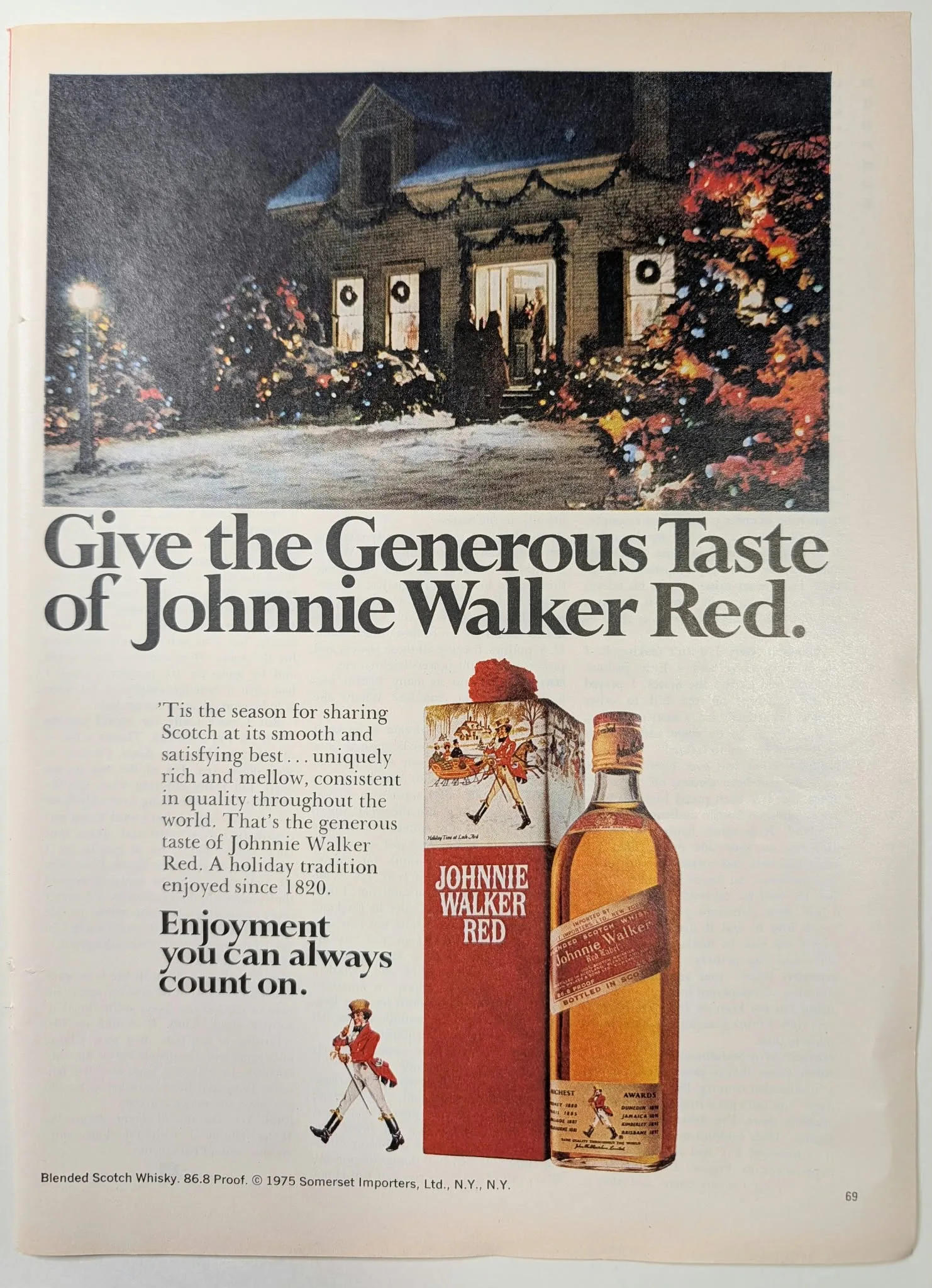
1975 Johnnie Walker Red Label Holiday Vintage Advertisement
During the mid-1970s, premium spirit brands frequently relied on highly atmospheric, emotive imagery to connect with consumers during the competitive winter holiday market. This 1975 Johnnie Walker Red Label advertisement exemplifies this approach, utilizing a prominent photographic element depicting a snow-covered suburban home at night. The residence is heavily adorned with festive string lights and traditional Christmas wreaths hung on the windows and front door. Silhouetted figures are seen crossing the illuminated threshold, perfectly capturing the mid-century American ideal of holiday hospitality, warmth, and reunion. Beneath this inviting scene, the bold headline "Give the Generous Taste of Johnnie Walker Red." serves as a direct call to action, positioning the whisky not merely as
Category: Alcohol
Year: 1975
Rarity Class: B
Paper & Print Condition
Archival micro-analysis of this 1975 advertisement reveals the intricate application of mid-century four-color halftone lithography, a standard yet highly effective technique for premium 1970s editorial publications. The unbleached magazine paper stock exhibits a uniform, natural age-toning, presenting a warm off-white patina that is characteristic of 50-year-old archival ephemera without succumbing to severe oxidation or brittleness. Color registration remains exceptionally precise; the deep cr
Provenance & Rarity
Originally published as a full-page promotional spread, this artifact was carefully extracted from page 69 of a prominent American editorial publication circulated during the 1975 winter holiday season. The piece possesses substantial historical provenance as a primary document of mid-century imported spirits marketing in the United States, specifically commissioned under the distribution authority of Somerset Importers, Ltd., New York. Its rarity is significantly elevated by its survival as an
Rarity & Condition Summary
An excellently preserved Class B artifact that provides clear archival insight into the visual language and consumer gifting norms of mid-century American holiday advertising. Its pristine condition, free from the typical degradation and edge-tearing associated with vintage periodicals, ensures its enduring value as a museum-grade historical document representing 1970s consumer culture.