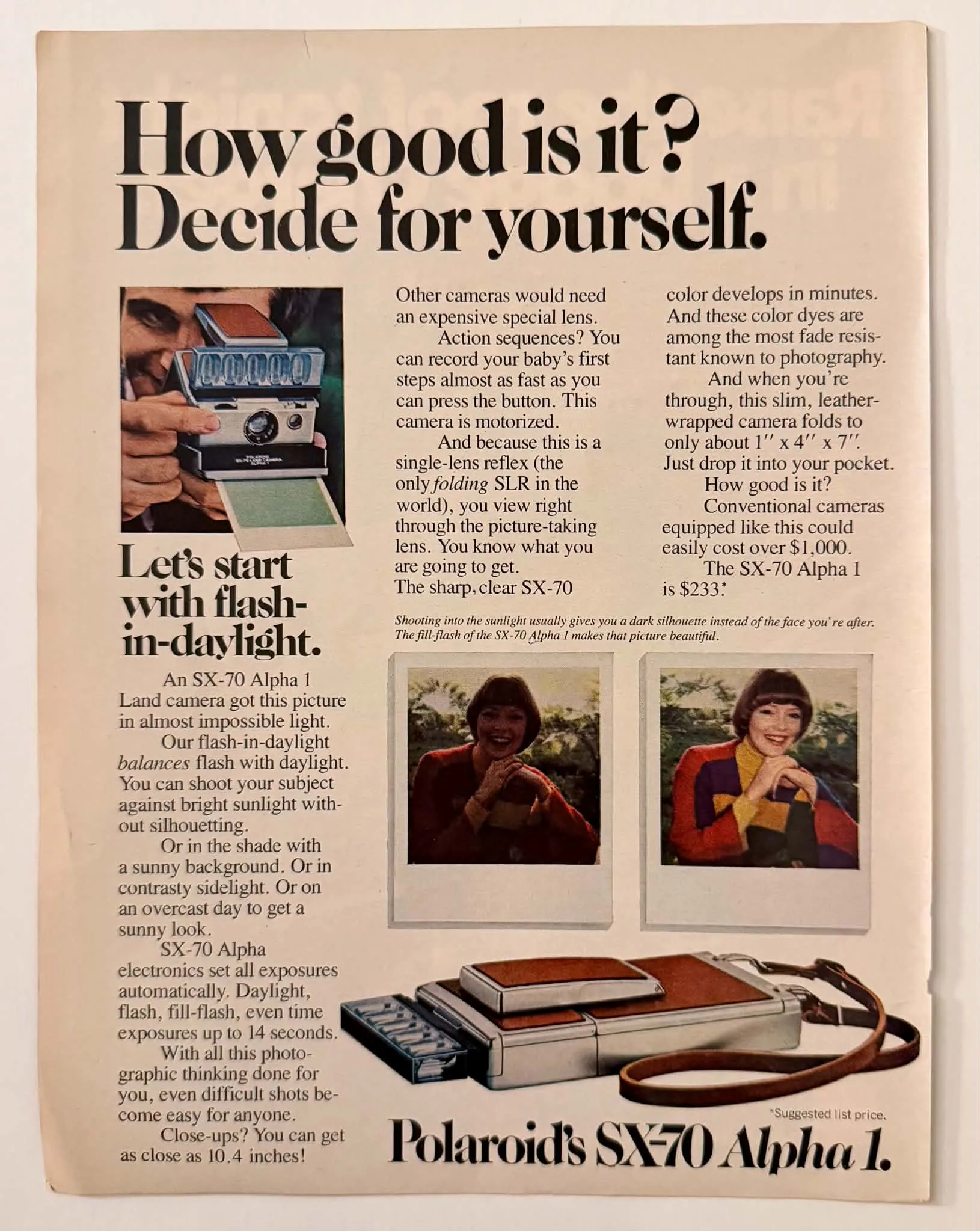
1977 Polaroid SX-70 Alpha 1 Land Camera Vintage Advertisement
During the late 1970s, Polaroid dominated the instant photography market, successfully transitioning consumers from bulky, peel-apart film cameras to sleek, motorized marvels. The SX-70 Alpha 1, an evolution of the groundbreaking original SX-70, represented the zenith of this technological leap. This specific advertisement, headlined "How good is it? Decide for yourself," employs a direct, evidence-based marketing approach. By juxtaposing two instant photos—one marred by dark silhouetting and the other perfectly illuminated—Polaroid effectively demonstrates the practical value of its automatic fill-flash feature. The advertising copy heavily emphasizes the technological superiority and convenience of the Alpha 1. It points out the inherent challenges of shooting into bright sunlight and positions the camera’s automated electronics as the ultimate solution, seamlessly balancing ambient daylight with the flashbulb array. Furthermore, the advertisement reinforces the camera's status as a luxury precision instrument. Mentions of its authentic single-lens reflex viewing, motorized action sequences, and its ability to fold down to a mere 1" x 4" x 7" leather-wrapped rectangle position the SX-70 Alpha 1 not just as a camera, but as a marvel of modern engineering. Priced at $233—a significant investment for a consumer camera in the late 1970s—the Alpha 1 was targeted at discerning users who desired professional-grade features without sacrificing the immediate gratification of instant film. The ad also proudly notes the camera's macro capabilities, allowing focus as close as 10.4 inches, and touts the highly fade-resistant nature of their proprietary color dyes. This document serves as a prime example of late-20th-century consumer electronics marketing, where complex optical physics were distilled into a promise of effortless, beautiful memories.
Category: Cameras & Optics
Year: 1977
Rarity Class: B
Paper & Print Condition
This artifact is a prime example of high-volume commercial offset lithography characteristic of late-1970s premium magazine production. The substrate is a standard lightweight, uncoated stock that has developed a slight, uniform patina of age—a natural yellowing or mild oxidation that enhances its vintage authenticity without compromising structural integrity. The paper's classic matte texture minimizes glare, allowing the high-contrast ink application to stand out. Under macro archival inspection, the distinct CMYK halftone rosette patterns become highly visible, serving as a forensic hallmark of period printing techniques. This dot structure is particularly pronounced in the complex gradients of the model's skin tones, the multicolored geometric pattern of her sweater, and the simulated reproduction of the instant Polaroid photographs. Despite decades of natural aging, the ink saturation remains remarkably robust; the dense, opaque blacks utilized in the bold serif typography provide a striking visual anchor, while the rich, warm brown pigments used for the camera's signature leather paneling retain their original depth and luster. There is minimal evidence of ink transfer or page-bleed from the reverse side, indicating a high-quality initial press run.
Provenance & Rarity
Originally sourced from a high-circulation mainstream lifestyle or photography periodical published circa 1977. During this era, the Polaroid Corporation executed massive, multi-million-dollar print campaigns to solidify their dominance in the instant photography market. Consequently, while these advertisements were originally printed in staggering volumes, the survival rate of museum-grade specimens has dropped precipitously over the intervening decades. The inherent fragility of lightweight, commercial magazine stock means that most copies succumbed to moisture, UV degradation, or were simply discarded. To locate an intact, full-page example from this specific "flash-in-daylight" campaign—one that retains crisp typography, high color fidelity, and minimal page-bleed from the reverse side—is increasingly uncommon. It serves as a vital historical record of consumer electronics marketing, capturing the exact moment when complex optical physics and advanced circuitry were distilled into a mass-market luxury commodity. This scarcity in high-grade condition firmly justifies its classification as a Class B artifact.
Rarity & Condition Summary
Class B artifact in Very Good condition. The structural integrity of the page is well-preserved with only minor edge wear indicative of its age. The color fidelity of the lithograph remains highly legible, successfully communicating the original marketing intent without significant degradation, fading, or moisture damage.