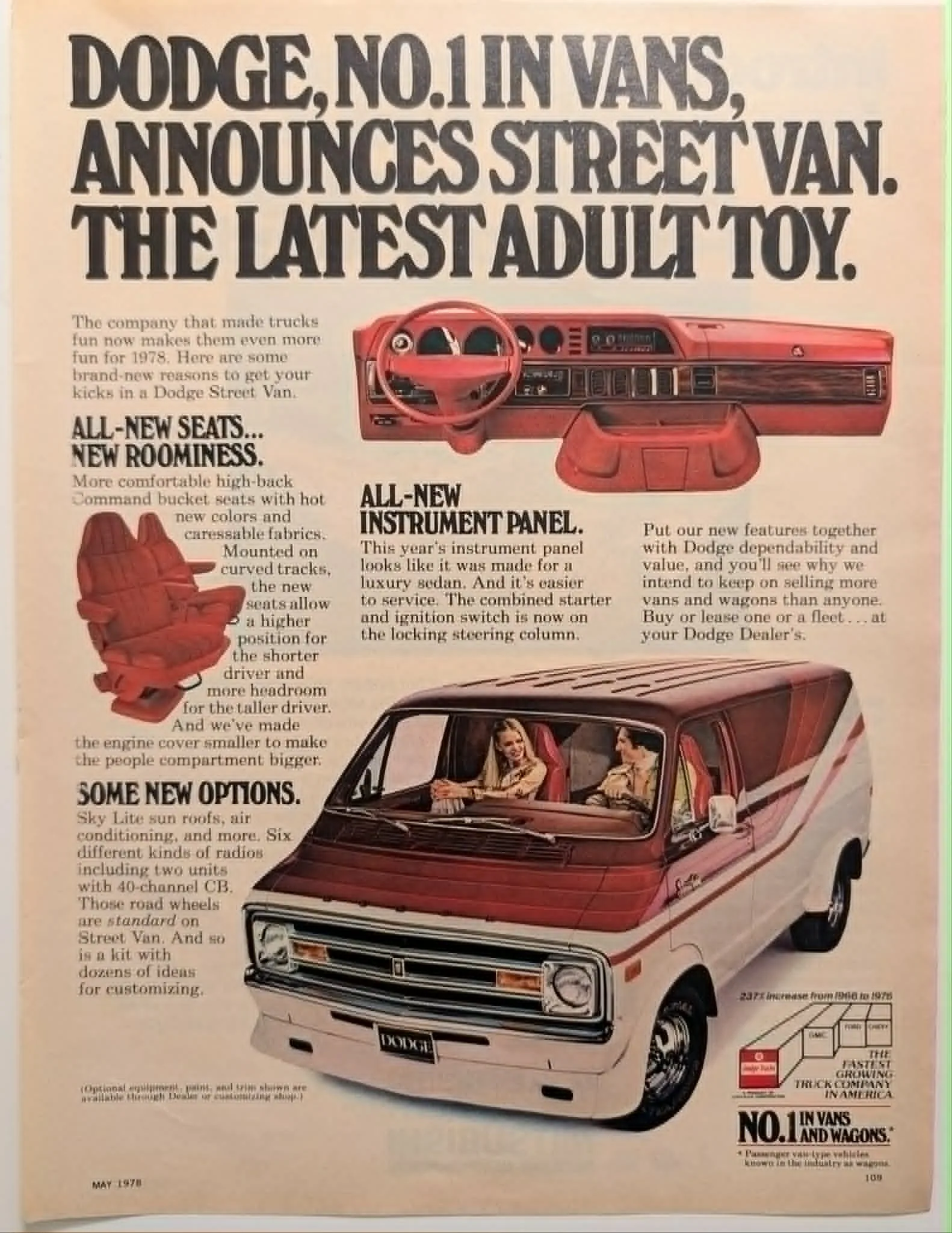
1978 Dodge Street Van Vintage Advertisement
The late 1970s marked the absolute zenith of the "custom van" craze in North America, a period when utilitarian cargo haulers were transformed into rolling canvases of self-expression and recreational leisure. This original May 1978 print advertisement from Dodge captures the zeitgeist perfectly, boldly declaring their latest offering as "The Latest Adult Toy." By the time this campaign launched, Chrysler Corporation’s Dodge division had firmly established itself as the undisputed leader in the custom van market, accurately and proudly claiming the title of "No. 1 in Vans and Wagons." Dodge's marketing strategy in this piece is a fascinating study in the transition from commercial utility to lifestyle consumerism. The advertising copy speaks directly to the desires of the 1970s vehicle customizer. Instead of highlighting traditional metrics like payload capacities or towing torque, the focal points are entirely centered on comfort, aesthetics, and individualized lifestyle upgrades. The introduction of "All-New Seats" featuring high-back "Command" bucket designs and "caressable fabrics" signals a distinct shift towards luxury-sedan interior standards within a commercial chassis. Similarly, the "All-New Instrument Panel" is marketed not just for its simulated woodgrain luxury, but for its functional modern ergonomics, bringing the combined starter and ignition switch to the locking steering column. Furthermore, Dodge smartly addresses the highly lucrative aftermarket scene by offering factory-installed equivalents. The advertisement highlights "Some New Options," explicitly naming "Sky Lite" sun roofs, air conditioning, and a massive cultural touchstone of the decade: a 40-channel CB radio. By providing these customization options directly from the dealership, Dodge effectively monetized the vanning trend before the vehicle even left the lot. The graphic inset—showing a staggering "237% increase from 1966 to 1976" alongside competitors Ford, Chevy, and GMC—serves as a powerful piece of corporate boasting. It statistically validates Dodge's claim as the "fastest-growing truck company in America." As a historical artifact, this print ad is a masterclass in automotive marketing seamlessly aligning with the youth culture, recreational travel, and robust consumer optimism of the late 20th century.
Category: Cars
Year: 1978
Rarity Class: B
Paper & Print Condition
Printed on standard late-1970s commercial magazine stock, this artifact exhibits exceptional preservation of its period color palette. The two-tone red and white ink retains its original saturation without significant fading. Notably, the piece maintains the authentic flat illustration style and traditional halftone dot patterns characteristic of the era's offset lithography, explicitly avoiding the high-gloss finish of modern photorealism. The line work and typographical elements preserve a distinct, tactile, hand-drawn stroke quality, making this physical artifact an ideal foundational asset for 2D animation and digital restoration projects that demand historical accuracy.
Provenance & Rarity
Sourced directly from a May 1978 publication, this piece boasts a clear and verifiable provenance. While widely circulated during the zenith of the late 1970s custom van craze, finding pristine, intact advertisements from this period is increasingly difficult. Magazines of this era, particularly those catering to automotive and recreational demographics, were heavily handled and rarely preserved as collectibles. Consequently, this artifact is classified as a Class B rarity. It holds significant cultural and historical value for automotive archivists, serving as a primary source document for Chrysler Corporation's dominance in the lifestyle-oriented truck and van market.
Rarity & Condition Summary
A highly representative, well-preserved Class B artifact. Its fine condition—particularly the unblemished retention of its period color palette and flat illustration style—elevates its utility beyond mere display. Because the piece flawlessly retains its hand-drawn stroke quality and original offset lithography textures, it serves as an impeccable foundational asset for historically accurate digital restoration and 2D animation. The pristine lines and distinct color blocks are exceptionally suited for 2D workflows, consciously rejecting modern trends toward 3D rendering or photorealism, thereby maintaining the authentic visual integrity of late-1970s automotive marketing.