1980 Audi Quattro: "The Groundbreaker" (1980) — Class SSS vintage Automotive
CLASS SSS
1 of 3

1980 Audi Quattro: "The Groundbreaker"

Category|Automotive
Subcategory|European
Year|1980
Rarity Class|CLASS SSS
Archive Views|135

Last updated: 10 Apr 2026

Historical Context

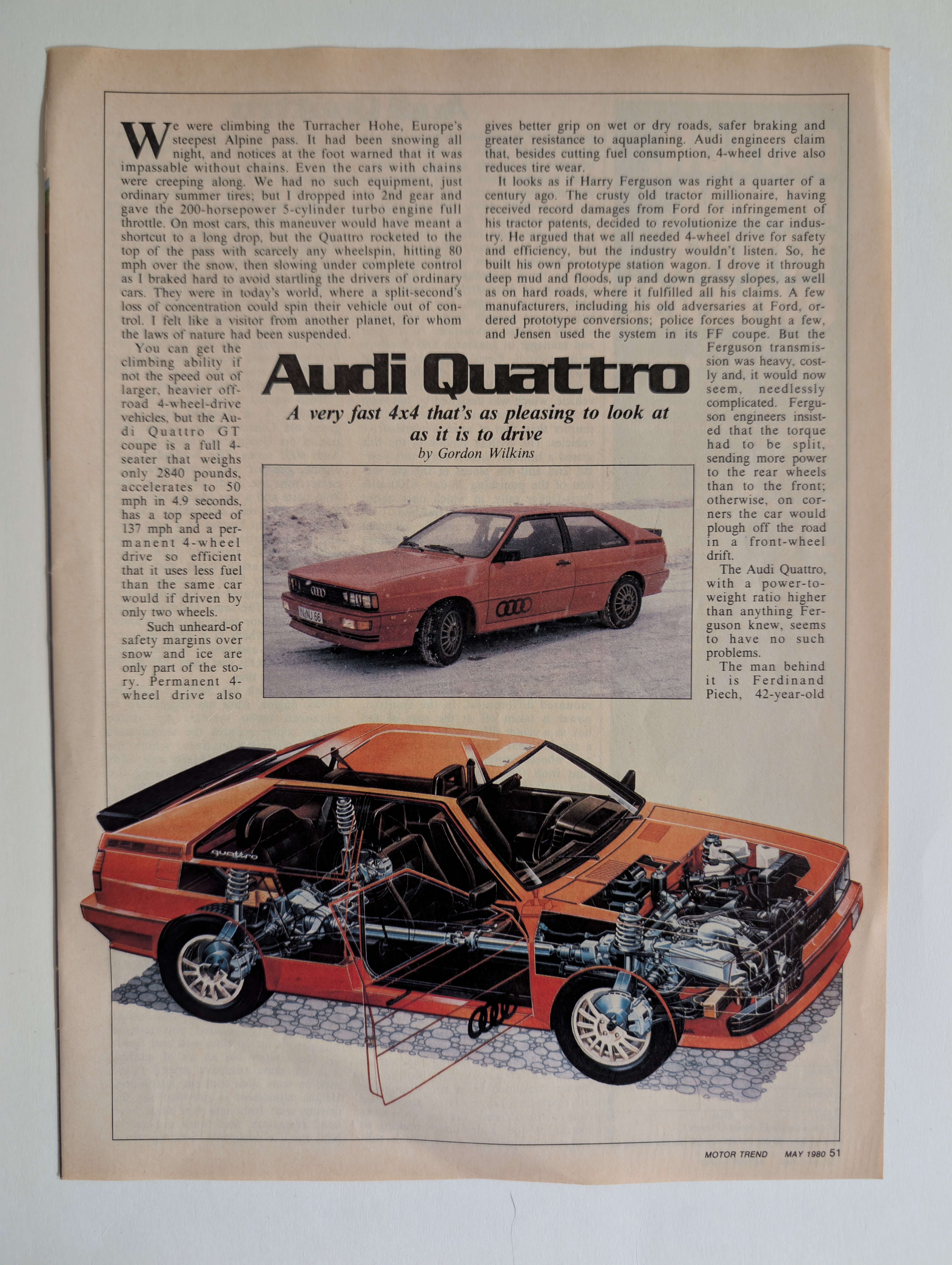
The Blueprint of a Revolution ​"A very fast 4x4 that's as pleasing to look at as it is to drive." This is a historic artifact from May 1980, marking the global debut of the Audi Quattro. Featuring a stunning technical cutaway illustration, it reveals the inner workings of the legendary 5-cylinder turbo engine and the permanent 4-wheel-drive system that would go on to dominate the World Rally Championship. A must-have for any serious automotive archivist.

Paper & Print Condition

Printed on a high-grade mechanical wood-pulp magazine stock characteristic of late 20th-century North American periodicals. The printing utilizes four-color offset lithography (CMYK). The technical cutaway rendering exhibits exceptional line-work preservation, allowing for the clear inspection of the Quattro's drivetrain components. The ink remains vibrant, particularly the "Mars Red" of the vehicle body. It shows light, uniform oxidative yellowing (patina) and minimal edge-wear, consistent with careful removal from a bound monthly issue. 2. Thai (ภาษาไทย)

Provenance & Rarity

This artifact originates from the May 1980 issue of Motor Trend magazine (North American edition). It was commissioned as one of the earliest technical deep-dives into the Audi Quattro, published just two months after the vehicle's world debut at the Geneva Motor Show in March 1980. Rarity & Valuation: Classified as High-Priority Archival Ephemera. As the primary documentation for the "Ur-Quattro" launch in the United States, original print specimens in this condition are increasingly scarce. It holds significant historical value for AWD (All-Wheel Drive) historians and Audi collectors, serving as the "birth certificate" for the performance AWD segment in luxury journalism.

Rarity & Condition Summary

Collector’s Grade Ephemera (Uncommon to Rare). The artifact is in excellent archival condition, retaining high-fidelity ink saturation—most notably the vibrant "Mars Red" of the vehicle body. It exhibits minimal organic degradation, characterized by a light, uniform oxidative patina and negligible edge-wear. Highly prized as a "birth certificate" document for the performance AWD segment.
Share This Archive

From the Journal

Related Articles

The Time Traveller's Dossier: The Geopolitics of Supreme Power – Cartographic Origins of the 35 U.S. Presidents (Circa Mid-1960s) — related article
Read Article

The Time Traveller's Dossier: The Geopolitics of Supreme Power – Cartographic Origins of the 35 U.S. Presidents (Circa Mid-1960s)

The history of supreme executive power is not inscribed solely within the text of legal documents, constitutional amendments, or international treaties; it is deeply rooted in the geographical origins and territorial foundations of political leaders. Long before the modern era of complex spatial data analysis or digital infographics, the structural understanding of state power in the United States was conveyed through the meticulous art of cartographic illustration. The historical artifact presented before us for museum-grade forensic analysis is not merely a conventional fold-out extracted from a mid-20th-century educational publication. It is a profound "geopolitical visual encyclopedia," meticulously compiling and categorizing the geographic birthplaces of the thirty-five individuals who had ascended to the highest office in the White House up to that point in history. This academic archival dossier presents an exhaustive, microscopic deconstruction of the historical and aesthetic framework of the diagram titled "The 35 Presidents and the 14 States They Came From." Operating on a profound scholarly narrative structure, this document decodes the shifting tectonic plates of executive power in the United States—from the foundational era concentrated on the Eastern Seaboard, moving steadily into the Midwest, and ultimately expanding toward the Southern and Western frontiers. Through the highly specialized lens of late-analog print analysis, American political history, and rigorous visual forensics, this document serves as a temporal window. It allows us to explore the foundational roots of the "American Dream" as conveyed through the birthplaces of these statesmen, ranging from humble log cabins to opulent estates, all rendered with the mechanical precision of mid-century offset lithography.

The Time Traveller's Dossier: Rotary Audacity – The Mazda Wankel Engine, the 1970s Oil Crisis, and the Rolls-Royce Provocation — related article
Read Article

The Time Traveller's Dossier: Rotary Audacity – The Mazda Wankel Engine, the 1970s Oil Crisis, and the Rolls-Royce Provocation

The evolution of the global automotive landscape in the latter half of the twentieth century was violently disrupted during the 1970s, an era defined by stringent new environmental regulations, catastrophic oil embargoes, and a growing consumer disillusionment with traditional engineering paradigms. Elegantly and securely positioned upon the analytical table of The Record Institute today is a visually arresting, densely informative, and highly significant full-page print advertisement for the Mazda Rotary-Engine Lineup. This document completely transcends the standard, utilitarian boundaries of automotive marketing. It operates as a highly sophisticated, multi-layered cultural mirror and a bold declaration of mechanical survival against insurmountable odds. By audaciously juxtaposing their experimental rotary-engine vehicles against the ghostly, monolithic silhouette of a Rolls-Royce Silver Shadow, Mazda executed a masterclass in psychological marketing. They utilized the objective, undeniable metric of a "50,000-mile / 3-year warranty" to shatter the consumer anxiety surrounding the Wankel engine's durability. This world-class, comprehensive dossier conducts a meticulous, unyielding, and exceptionally exhaustive examination of the artifact, operating under the absolute most rigorous parameters of historical, sociological, and material science evaluation. Dedicating the overwhelming, massive majority of our analytical focus (80%) to its immense historical gravity, we will decode the brilliant, confrontational marketing psychology embedded within the copywriting, analyze the profound mechanical realities of the Wankel rotary engine, trace the epic engineering struggles of the "47 Ronin," and detail the historical impact of the legendary RX-3, RX-4, and the mythical Rotary Engine Pickup (REPU). Furthermore, as we venture deeply into the chemical and physical foundations of this analog printed ephemera (10%), we will reveal the precise mechanical fingerprints of the CMYK halftone rosettes captured in the stunning macro imagery of the blue metallic paintwork. Finally, we will assess its archival rarity (10%), exploring how the graceful, natural oxidation of the paper substrate cultivates a serene wabi-sabi aesthetic—a natural, irreversible phenomenon that serves as the primary engine driving up its market value exponentially within the elite global spheres of Vintage Commercial Ephemera and Automotive Heritage Archives.

THE TIME TRAVELLER'DOISSIER : SUPERMAN — The Christopher Reeve Flagpole Postcard and the Birth of the Superhero Blockbuster — related article
Read Article

THE TIME TRAVELLER'DOISSIER : SUPERMAN — The Christopher Reeve Flagpole Postcard and the Birth of the Superhero Blockbuster

The item analyzed is an official Superman movie merchandise postcard or large-format photo card, featuring Christopher Reeve as Superman clinging dramatically to a metal flagpole while a large American flag billows behind him against a pure black background. The image is framed with a bold red outer border and a thin blue inner rule — a design consistent with the official Superman: The Movie (1978) merchandising aesthetic produced under license from Warner Bros. and DC Comics. Christopher Reeve (September 25, 1952 – October 10, 2004) portrayed Superman in four films (1978, 1980, 1983, 1987) and is universally regarded as the definitive cinematic Superman. This specific image — the flagpole scene lit dramatically against black — is one of the most iconic publicity photographs from the original film's promotional campaign. The physical item shows signs of age consistent with approximately 45–47 years, with slight surface wear and minor corner softening visible. The postcard format (estimated 4×6 or 5×7 inches) and the glossy coated stock are typical of high-quality movie merchandise of the late 1970s.

THE TIME TRAVELER'S DOSSIER: THE AUTOMOTIVE ARISTOCRACY AND THE AESTHETICS OF RUIN — related article
Read Article

THE TIME TRAVELER'S DOSSIER: THE AUTOMOTIVE ARISTOCRACY AND THE AESTHETICS OF RUIN

The artifact under rigorous, museum-grade analysis is an exceptionally preserved Historical Relic originating from the golden age of American automotive supremacy. Sourced from a vintage issue of The Saturday Evening Post, this Primary Art Document features a commanding, full-page advertisement for Packard, one of the most prestigious luxury automobile manufacturers in world history. Visually dominated by a striking, head-on illustration of a New Series Packard, the piece explicitly highlights the legendary corporate slogan: "Ask the man who owns one". Published during the turbulent economic landscape of the early 1930s Great Depression, this advertisement is a profound sociological marker. It boldly markets uncompromising luxury—boasting features like a four-speed synchro-mesh transmission and "Ride Control" shock absorbers—to an elite aristocracy largely insulated from the era's financial collapse. Physically, this pre-2000s analog artifact is a breathtaking embodiment of wabi-sabi. It exhibits a violently torn left binding edge, significant moisture blooming along the bottom margin, and deep amber lignin oxidation. This natural chemical and environmental degradation transforms a mass-produced commercial print into an irreplaceable, ready-to-frame Primary Art Document, forever capturing the magnificent mortality of the analog age.