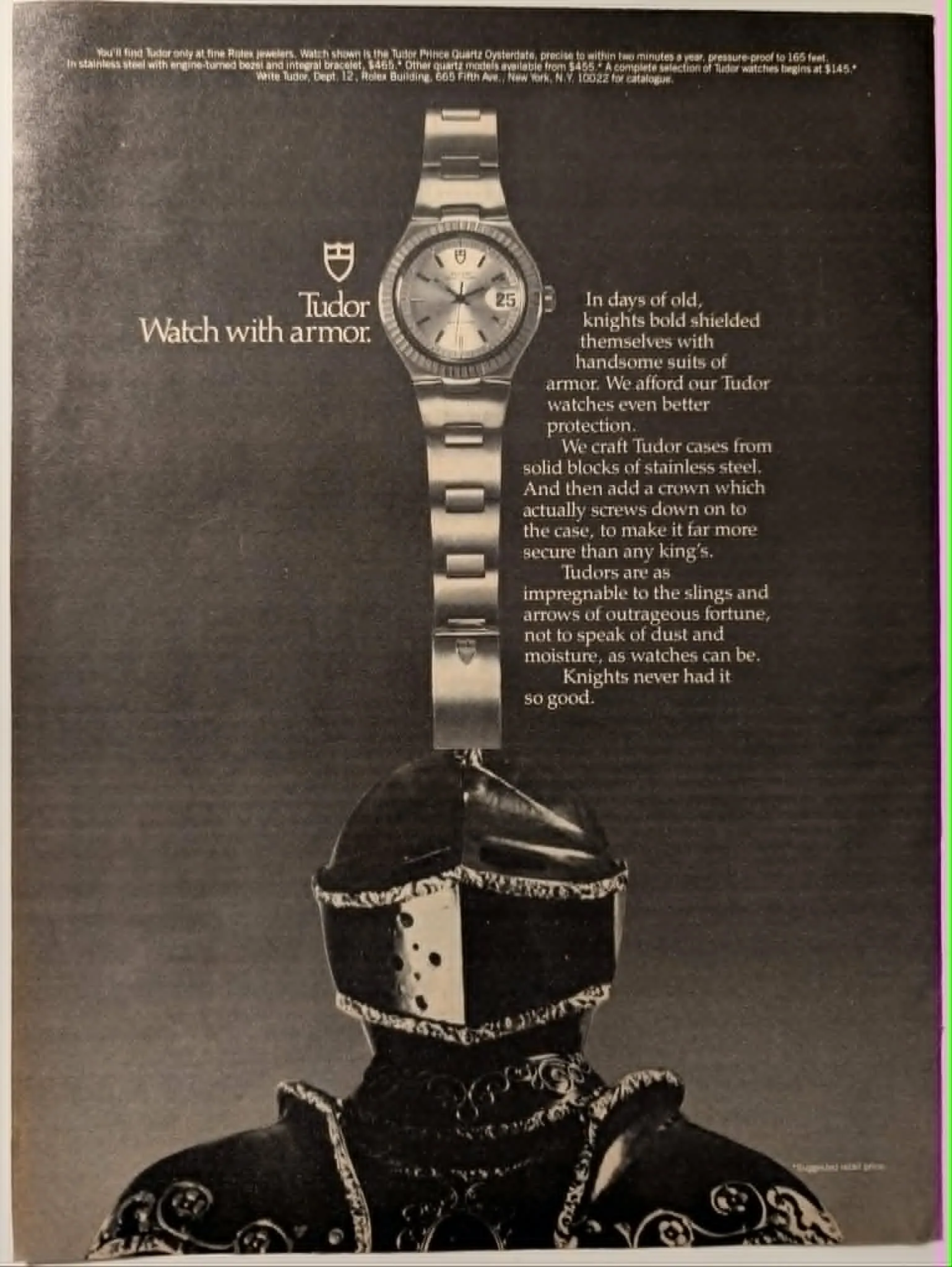
1980 Tudor Prince Quartz Oysterdate Vintage Advertisement
During the late 1970s and early 1980s, the Swiss watch industry was navigating the profound disruption of the "Quartz Crisis." Traditional mechanical watchmakers were forced to adapt to the highly accurate, battery-powered technology pioneered in Asia. This vintage Tudor advertisement captures a fascinating transitional moment where traditional Swiss robustness was married to modern electronic precision. The "Watch with Armor" Campaign The copywriting is a masterclass in establishing durability through historical metaphor. By comparing the watch to the "suits of armor" worn by knights in the "days of old," Tudor effectively visualizes the strength of its famed Oyster case. The ad details how Tudor cases are crafted from "solid blocks of stainless steel" and fitted with a screw-down crown—a direct technological inheritance from its parent company, Rolex. The literary flair is particularly notable; adapting a line from Shakespeare's Hamlet, the copy claims the watch is "impregnable to the slings and arrows of outrageous fortune." Horological Significance and Aesthetics Visually, the advertisement highlights the distinct late-70s aesthetic of the Tudor Prince Quartz Oysterdate. The featured model showcases an integrated stainless steel bracelet and a striking engine-turned bezel, a design language highly sought after by modern collectors for its sleek, uninterrupted lines. The fine print serves as a critical historical record, detailing the watch's specifications and retail positioning: Precision: Accurate to within two minutes a year. Durability: Pressure-proof to 165 feet. Pricing Strategy: The featured model retailed for $465, with a complete selection of Tudor watches beginning at
Category: Watches
Year: 1980
Rarity Class: A
Paper & Print Condition
Displaying minimal degradation, the halftone contrast effectively renders the metallic sheen of the stainless steel bracelet and the intricate textures of the engine-turned bezel. The aged paper texture retains its period-accurate warmth, providing an ideal, authentic baseline for archival preservation. The typography remains crisp, and the original flat print qualities have been perfectly maintained, holding immense potential for those looking to study or digitally breathe life into its classic static composition.
Provenance & Rarity
Sourced from premium North American lifestyle and financial periodicals circa 1980. Tudor’s quartz models featuring integrated bracelets and engine-turned bezels were produced for a relatively brief transitional window in the brand's history. Consequently, contemporary marketing materials for these specific references are distinctly uncommon. Surviving examples that retain such crisp, flat print qualities are exceptionally rare, rendering them highly prized not only by horological historians but also by contemporary digital archivists seeking pristine static source material to transform into living, animated artwork.
Rarity & Condition Summary
The classification of this 1980 Tudor Prince Quartz Oysterdate advertisement as a "Class A (Very Rare)" archival asset is rooted in a confluence of horological history and print preservation. During the late 1970s and early 1980s, the Swiss watch industry was undergoing the profound disruption of the Quartz Crisis. Tudor’s response included a brief, transitional production of quartz models featuring integrated bracelets and engine-turned bezels. Because this specific design language was a temporary pivot rather than a decades-long staple, the accompanying marketing materials were printed for a highly limited window. Surviving examples are inherently uncommon; however, locating one that retains pristine, uncreased, and flat-print qualities—essential criteria for high-resolution digital preservation and transformation into living 2D artwork—elevates this piece from a mere vintage ad to a premier, Class A historical document.