1981 Toyota "The All-New Celica Supra" Magazine Advertisement — "Oh What a Feeling"
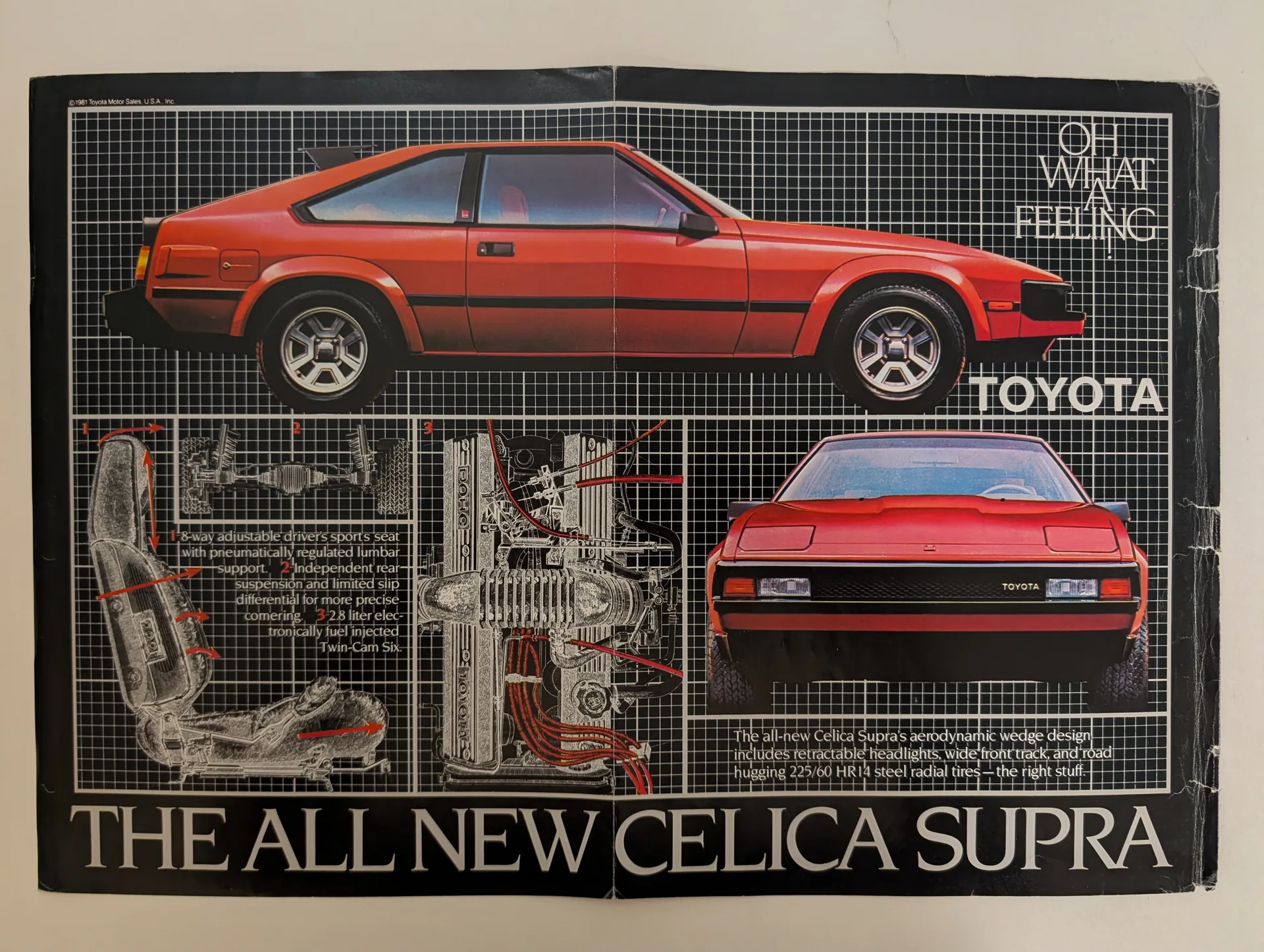
*Paragraph 1 — Visual Description:* The supplied images show a single landscape two-page magazine advertisement, photographed as a loose spread with a visible center fold crease running vertically through the layout. The entire ground is a solid black field overprinted with a fine white engineering-grid, the horizontal and vertical grid rules framing the whole sheet. Dominating the upper half is a red two-door wedge coupe in left-facing side profile, its bodywork rendered in continuous-tone illustrated/photographic color with a black lower trim band and silver-gray multi-spoke wheels; a smaller frontal three-quarter view of the same red car, headlights retracted behind flush lids, occupies the lower right. Across the top right, the slogan "OH / WHAT / A / FEELING!" is set in stacked, tall, narrow white serif capitals with an exclamation mark; the word "TOYOTA" appears in large bold white sans-serif capitals to the right of the front view. A black banner across the full width of the lower edge carries the line "THE ALL NEW CELICA SUPRA" in large white spaced serif capitals. The lower left and center hold three numbered technical diagrams in white line art with red accents: (1) a cross-hatched cutaway illustration of a driver's sports seat annotated with red adjustment arrows; (2) an underbody diagram of the rear axle and suspension, rendered in grayscale line work; (3) an engine illustration with finned valve covers carrying the cast-in words "DOHC" and "TOYOTA" and a fan of red ignition leads. Red callout numerals 1, 2, 3 key the diagrams to a block of white sans-serif caption copy. Beneath the front view, a smaller block of white copy describes the aerodynamic wedge design, retractable headlights, wide front track, and 225/60 HR14 steel radial tires. The upper left carries a small white copyright line. The right edge of the sheet shows scuffing and localized paper loss along the edge, and the surface carries visible sheen under the photography lights. *Paragraph 2 — Printed Text & Marks:* The banner headline reads "THE ALL NEW CELICA SUPRA." The slogan reads "OH WHAT A FEELING!" The side mark reads "TOYOTA." The three diagram captions read, with red numerals: "1—8-way adjustable driver's sports seat with pneumatically regulated lumbar support. 2—Independent rear suspension and limited slip differential for more precise cornering. 3—2.8 liter electronically fuel injected Twin-Cam Six." The lower-right body copy reads: "The all-new Celica Supra's aerodynamic wedge design includes retractable headlights, wide front track, and road hugging 225/60 HR14 steel radial tires—the right stuff." The upper-left copyright line reads: "© 1981 Toyota Motor Sales, U.S.A., Inc." In the seat-diagram detail view, a small control panel on the seat's side carries partially legible text including the word "AIR" and what appears to be a lumbar-adjustment label; the full wording is not resolvable at the supplied resolution. The engine detail shows the cast words "DOHC" on the left valve cover and "TOYOTA" on the right valve cover. No publication masthead, issue date, agency credit, or illustrator signature is resolvable anywhere on the sheet at the supplied resolution; this is a limit of the reproduction, not evidence that none was printed. *Paragraph 3 — Maker Context:* The printed copyright line names "Toyota Motor Sales, U.S.A., Inc." — treated here as the printed copyright holder and, on the artifact's own evidence, the United States sales and marketing arm issuing the advertisement (the company's wider history requires downstream verification). Whether the red car depicted is a photograph, an airbrush illustration, or a retouched photograph cannot be determined from the supplied reproduction. The advertising agency behind the creative, the illustrator or retoucher of the car images and diagrams, and the photographer — if any was involved — are unidentified: the sheet carries no agency, studio, or artist credit at the supplied resolution. The words "DOHC" and "TOYOTA" cast into the depicted engine's valve covers are product details of the illustrated object, not maker credits of the advertisement. *Paragraph 4 — Geographic & Audience Context:* The printed credit places the issuing entity in the "U.S.A.," and the copy is written in American English ("cornering," "fuel injected"), addressing a United States magazine readership. The dating evidence is printed, not inferred: the line "© 1981 Toyota Motor Sales, U.S.A., Inc." dates the advertisement to 1981 on the artifact's own authority. The sheet's headline phrase "The all-new" presents the model as a new offering for that market year (the model's generation history requires downstream verification). The original publication in which this spread ran is not identified on the sheet: it is photographed as a loose spread and carries no masthead, folio, or issue information, so its circulation context — magazine title, date of issue, and placement — is undetermined. *Paragraph 5 — Visual Language Analysis:* The visual language is the engineering-spectacle advertising of the early 1980s: the entire sheet is staged as a blueprint, with the fine white grid and black ground converting the advertisement into a drafting-room presentation in which the car is treated as a machine under inspection. The technical diagrams adopt the vocabulary of exploded engineering illustration — cross-hatching, annotation arrows, keyed numerals — and are given equal compositional weight to the car's glamour views, so that the advertisement reads as both display and documentation. A single red accent ink ties the layout together: the car's body, the adjustment arrows, the callout numerals, the ignition leads, and the diagram numbers share one red, making the technical content feel like extensions of the vehicle itself. The typographic hierarchy is deliberate: a monumental spaced-serif banner for the model name, a tall condensed serif for the emotional slogan ("OH WHAT A FEELING!"), and a neutral sans-serif for the engineering captions — emotion at the top, evidence at the bottom, brand in the middle. The closing phrase "the right stuff" assigns the car a quiet claim to proven equipment without stating a comparison. *Paragraph 6 — Function & Archival Significance:* The sheet functioned as a two-page magazine advertisement introducing the Celica Supra to the American market, selling it through enumerated technical features rather than lifestyle imagery: an adjustable sports seat, an independent rear suspension with limited-slip differential, and a fuel-injected twin-cam six-cylinder engine. What the artifact documents that other sources do not is the precise advertised configuration of the model as Toyota presented it in 1981 — including the "pneumatically regulated lumbar support," the "225/60 HR14 steel radial tires," and the retractable headlights — preserved with its original dating evidence intact. For the archive, the spread is a complete specimen of early-1980s Japanese-brand automotive advertising in the United States: the blueprint-grid staging, the numbered cutaways, and the period slogan survive together in one object. The sheet is photographed as a loose spread; its original assembly, the publication that carried it, and its handling history cannot be inferred from its present state, and the fold crease and edge wear are consistent with handling of several kinds, none of which is asserted here.
Category: Art & Museums
Year: 1981
Rarity Class: B
Paper & Print Condition
The sheet is a landscape two-page spread printed on a coated stock that reads as glossy under the photography lights — visible specular sheen in the detail views supports this (Moderate confidence); physical examination would be required for confirmation. The black ground prints solid and even across the spread, and the fine white grid rules hold continuous with no visible misregistration. The car image and the seat and engine illustrations carry continuous-tone color — the red bodywork, gray underbody line work, and red ignition leads all resolve smoothly — while the fine technical line work and white caption type appear crisp at the supplied resolution. A vertical fold crease runs through the center of the spread, and the right edge shows scuffing with localized paper loss along the outer edge; the top edge shows minor wear. All printed text — headline, slogan, three captions, body copy, and the copyright line — is fully legible. Likely process: offset lithography, consistent with full-color magazine printing of the period (Moderate confidence; the actual separation count, whether the red is spot or process, cannot be determined from photographs). Minimum distinguishable colour separations resolvable in the supplied images: 4 — black ground, white key, red accent (car body, arrows, numerals, leads), and continuous-tone color treatment of the illustrated/photographic car imagery. This is a floor, not a count. No handling or storage history is inferred from the observed fold crease and edge wear.
Provenance & Rarity
Source media observed: a single landscape magazine advertisement spread identified by its printed headline as "THE ALL NEW CELICA SUPRA," photographed as a loose sheet. The original acquisition record, prior ownership, the publication in which the spread originally ran, and the circumstances under which it left its issue are undocumented in the supplied material: [AWAITING CURATORIAL ASSIGNMENT]. No rarity assessment is made here: [AWAITING CURATORIAL ASSIGNMENT — C–OMEGA scale]. No comparative survival claim is advanced for 1980s magazine advertisement spreads without documented holdings data.
Rarity & Condition Summary
The spread presents as an intact two-page advertisement with a vertical fold crease through its center; the right edge carries scuffing with localized paper loss along the outer edge, and the top edge shows minor wear. The printed surface — headline, slogan, three numbered diagram captions, body copy, and the "© 1981 Toyota Motor Sales, U.S.A., Inc." line — is fully legible at the supplied resolution, and the black ground and red accents print solid and even. The rarity half of this summary is [AWAITING CURATORIAL ASSIGNMENT]; nothing in the observed condition is used here to imply scarcity or to grade the object.