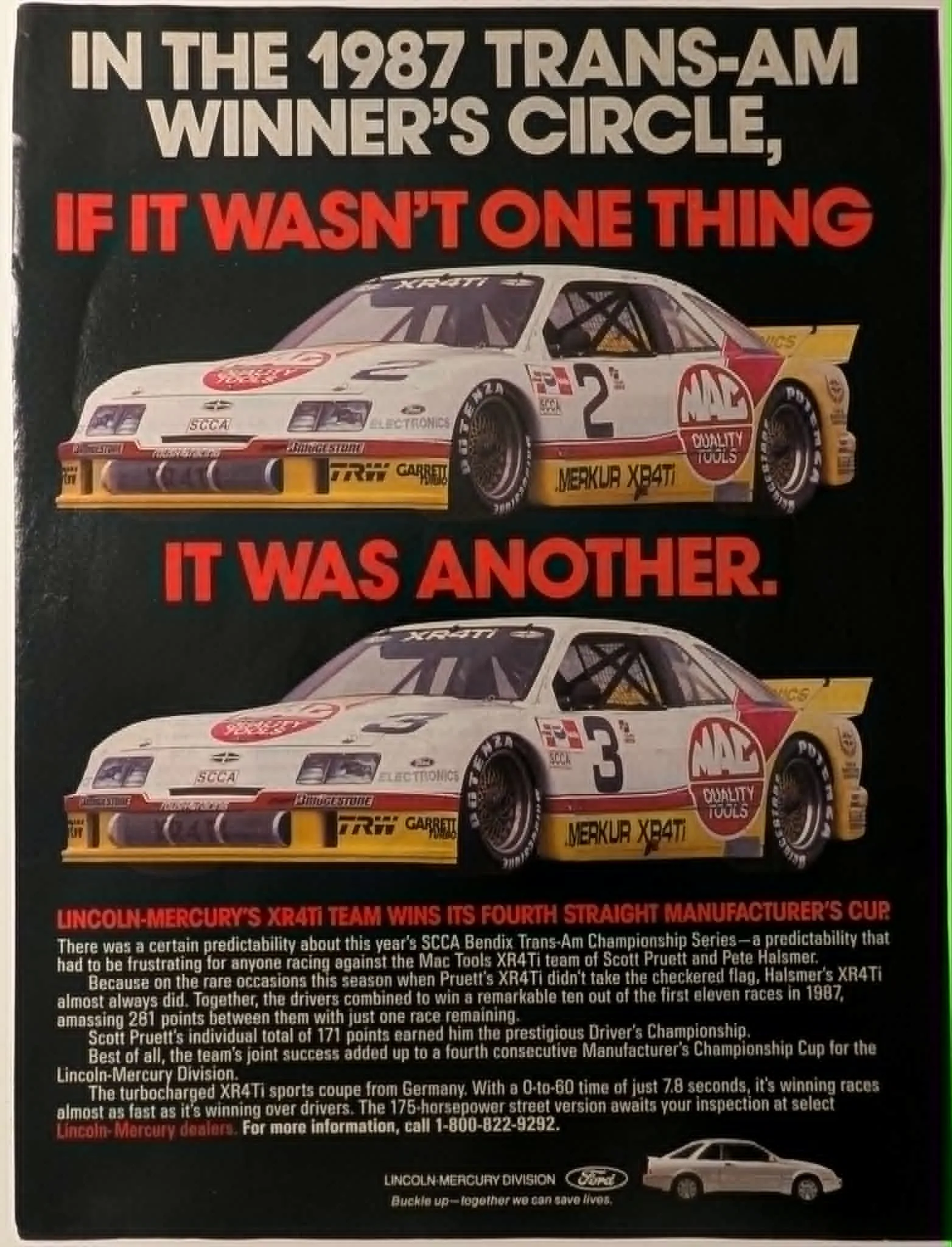
1987 Merkur XR4Ti Trans-Am Championship Vintage Advertisement
The 1987 Trans-Am season was defined by one inescapable truth for competitors: if Scott Pruett didn’t win, Pete Halsmer would. This striking print advertisement from the Lincoln-Mercury division serves as a victory lap for the Merkur XR4Ti, a captive import from Ford of Europe that devastated the Sports Car Club of America (SCCA) Bendix Trans-Am Championship Series. Visually arresting, the advertisement utilizes a dark, atmospheric background to emphasize the bold white, red, and yellow racing liveries of the Mac Tools sponsored XR4Ti cars. The clever, stacked copy—"IF IT WASN'T ONE THING, IT WAS ANOTHER"—perfectly encapsulates the frustration of rival racing teams. It visually reinforces the narrative that these two cars, bearing numbers 2 and 3, were an immovable wall of engineering supremacy on the track. The close-up detailing of the Potenza tires wrapped around intricate racing wheels, alongside prominent sponsor decals like TRW and Garrett Turbo, highlights the high-performance ecosystem required to build a championship-winning machine. Beyond the celebration of motorsport glory, this artifact serves a distinct commercial purpose. The Merkur brand, an ephemeral experiment by Ford to sell European Sierra models to American luxury buyers under the Lincoln-Mercury banner, relied heavily on the classic "win on Sunday, sell on Monday" marketing philosophy. By dedicating the lower quadrant of the advertisement to the 175-horsepower street-legal XR4Ti, the campaign directly translates track dominance into showroom appeal. The copy boasts of a 0-to-60 mph time of 7.8 seconds, attempting to convince the American consumer that the pedigree of a track-devouring champion was available at their local dealership. Ultimately, this advertisement is a fascinating snapshot of late-1980s automotive marketing. It immortalizes the team's staggering ten victories in the first eleven races, Scott Pruett’s Driver's Championship, and Lincoln-Mercury’s fourth consecutive Manufacturer’s Championship. For automotive historians and enthusiasts, it represents the high-water mark of the Merkur project before the brand was quietly discontinued just two years later.
Category: Cars
Year: 1987
Rarity Class: A
Paper & Print Condition
This artifact exhibits exceptional preservation of its original offset lithography. The semi-gloss paper stock retains a distinct, tactile vintage texture without severe degradation or foxing. The print quality boasts high-contrast saturation, particularly in the vibrant yellows and reds of the Mac Tools racing liveries, which stand out sharply against the deep, rich black background. Furthermore, the foundational typography and intricate line work of the vehicles remain crisp, structurally sound, and free from major fading or ink bleed, offering an ideal, flawless canvas for high-resolution archival preservation.
Provenance & Rarity
Originally sourced from high-circulation American automotive and lifestyle periodicals of the late 1980s, this piece was part of a targeted print campaign by the Lincoln-Mercury division to capitalize on immediate motorsport success. While the initial print run was extensive, the survival rate of such ephemeral mass media is exceedingly low. The Merkur brand's brief lifespan, folding shortly after this campaign, drastically elevates the historical significance of its marketing materials. Surviving examples in pristine condition—free from the typical acidic paper degradation and UV fading of the era—are now highly coveted by archivists of SCCA Trans-Am racing, European Ford Sierra enthusiasts, and collectors specializing in the "captive import" era of American automotive history.
Rarity & Condition Summary
This Class A artifact represents a rare convergence of historical motorsport significance and impeccable physical preservation. Because the Merkur brand was so short-lived, enduring promotional materials from this era are inherently scarce. What elevates this specific piece is its immaculate condition; the deep, unblemished black backgrounds and sharp, high-contrast racing liveries are completely free from the fading and acidic paper degradation typical of late-1980s periodicals. This flawless structural integrity not only cements its value as a premier physical collectible but also provides a perfect, high-fidelity foundation for advanced digital archiving, structural scanning, and dynamic visual reinterpretation, ensuring this piece of captive-import history remains vividly alive for future study and modern artistic exploration.