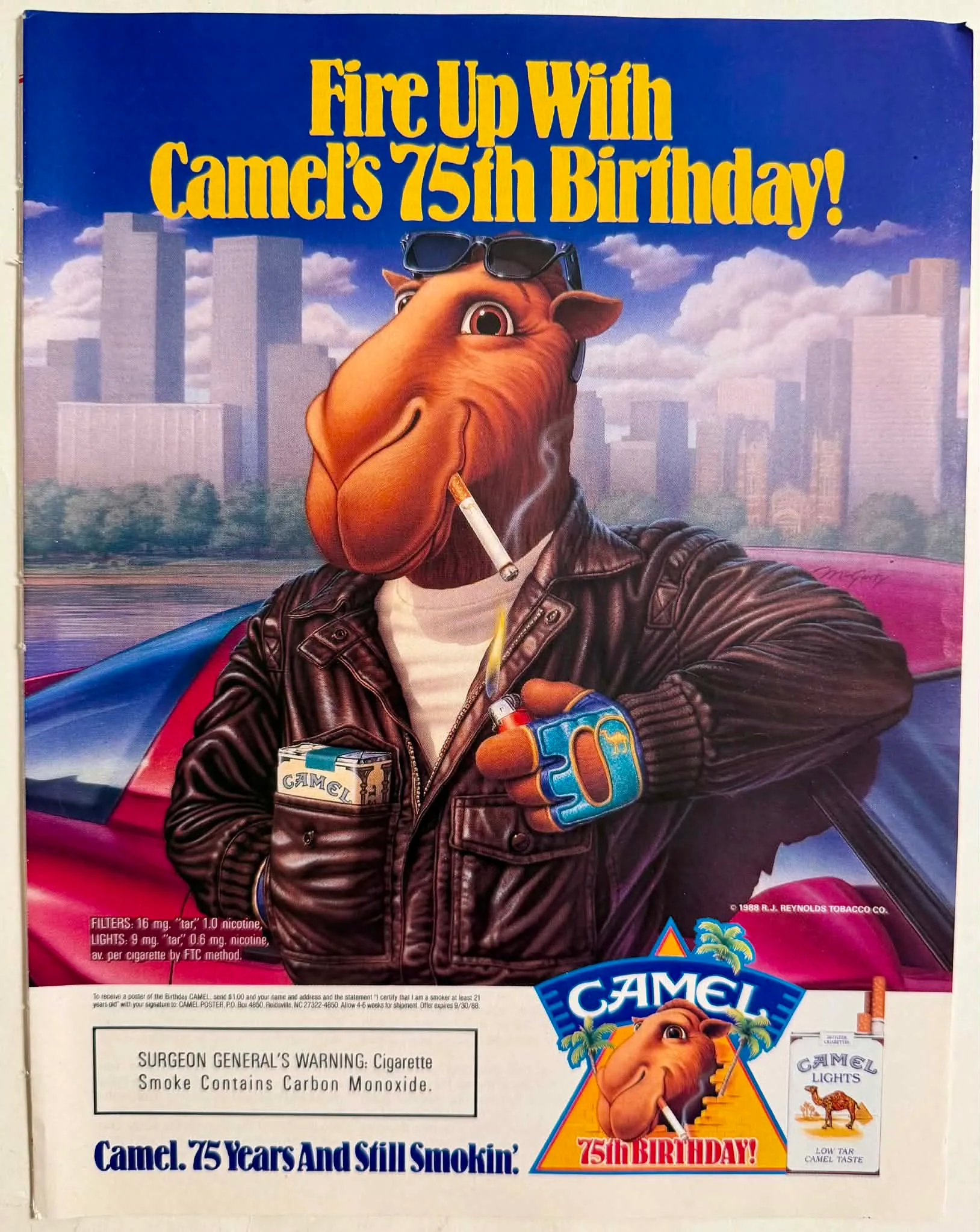
1988 Camel Cigarettes 75th Birthday Vintage Advertisement
The "75 Years And Still Smokin'" campaign marked a pivotal transition for R.J. Reynolds. Seeking to revitalize a legacy brand, the company revamped the traditional Camel mascot to appeal to a contemporary, trend-conscious demographic. This 1988 advertisement presents Joe Camel in a classic "cool guy" archetype, donning a leather jacket and sunglasses, standing confidently in front of a sleek sports car and a metropolitan skyline. From a structural and artistic perspective, the illustration is masterful in its kinetic composition. The artist deliberately separated the visual planes: a highly detailed foreground featuring stylized hands and the product, a midground anchored by the sharp curves of the red vehicle, and a soft, pastel-hued background landscape. This distinct layering creates a
Category: Tobacco
Year: 1988
Rarity Class: B
Paper & Print Condition
Macro-level analysis of the physical artifact reveals standard high-volume offset lithography characteristics, explicitly the visible halftone dot matrix typical of late 1980s magazine inserts and promotional poster distributions. The cyan, magenta, yellow, and black (CMYK) registration remains remarkably tight across the distinct visual planes, preventing color bleed or edge ghosting. Notably, the heavy ink saturation—particularly in the vibrant reds of the foreground elements and the deep blue
Provenance & Rarity
Distributed as part of R.J. Reynolds' nationwide promotional campaign for Camel's 75th anniversary in 1988, these advertisements were mass-produced and heavily circulated in prominent periodicals of the era. However, their physical nature as commercial magazine inserts and promotional tear-outs means survival rates in museum-grade condition are surprisingly low. While the imagery itself is culturally ubiquitous, locating physical specimens completely free from central creasing, severe edge frayi
Rarity & Condition Summary
A structurally sound, well-preserved artifact from a highly contested era of advertising. Its vibrant ink retention and clean visual planes make it a premium reference piece for both commercial history and late-20th-century illustration techniques. Given the high rate of physical attrition and environmental degradation typical for mass-market paper ephemera of this period, securing an unblemished specimen is increasingly uncommon. Therefore, this specific piece is firmly designated as a Rarity C