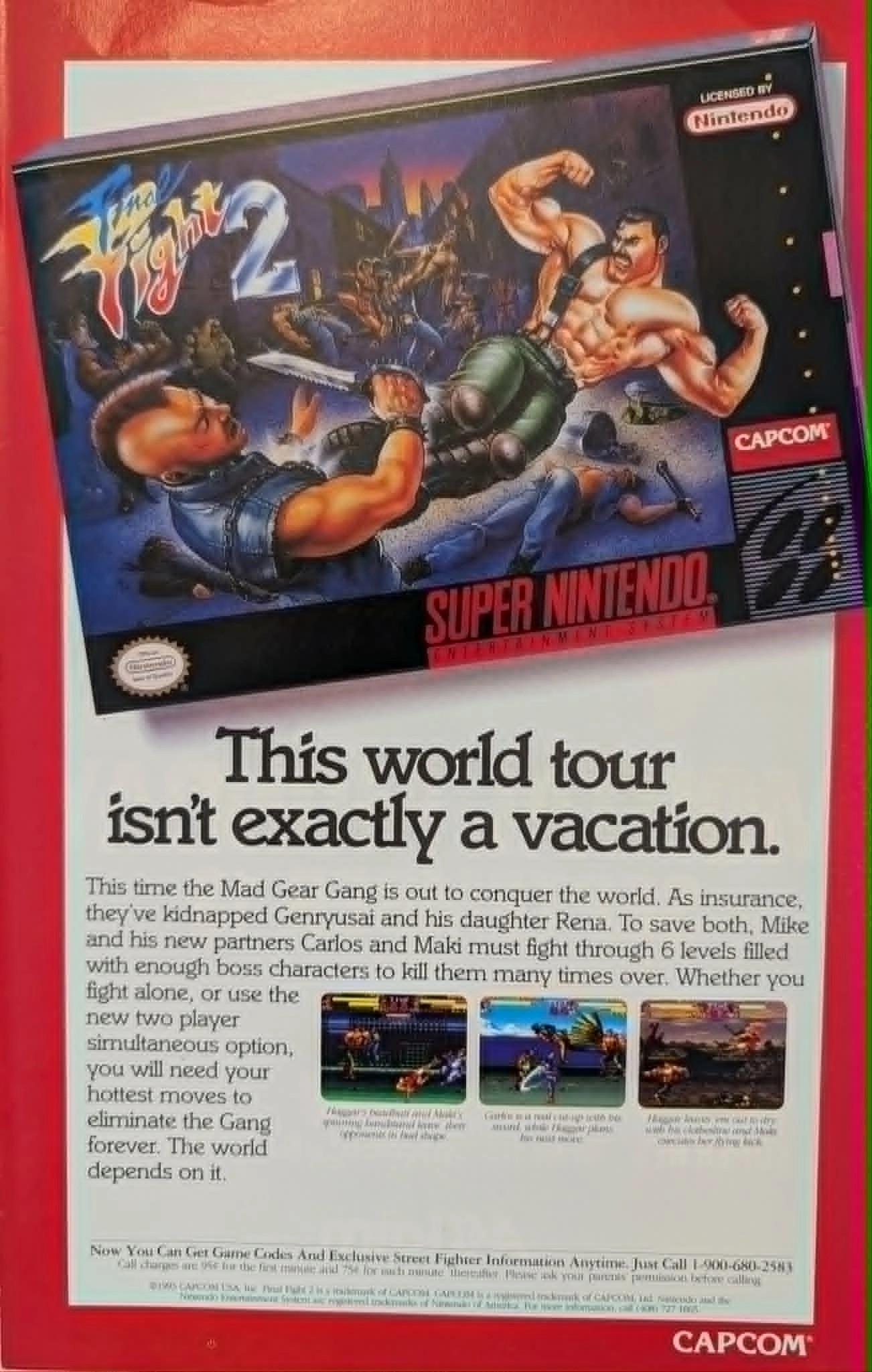
1993 Capcom Final Fight 2 Vintage Advertisement
Released during the golden age of 16-bit console gaming, this 1993 print advertisement for Capcom's Final Fight 2 captures the aggressive, action-packed marketing of the early 90s. Highlighting the game's exclusive release on the Super Nintendo Entertainment System (SNES), the piece features dynamic character art and in-game screenshots to draw in arcade brawler fans. It serves as a classic example of video game magazine advertising from the era, complete with a quintessential 1-900 premium tip line promotion. The early 1990s represented a fierce battleground for 16-bit console supremacy, with Capcom acting as a major third-party pillar for Nintendo's hardware. While the original Final Fight was a massive arcade success, its initial SNES port faced intense criticism from players for lacking a two-player cooperative mode and omitting the popular character, Guy. Final Fight 2 was subsequently developed exclusively for the SNES hardware to directly rectify these shortcomings. This marketing campaign reflects that pivot, prominently emphasizing the "new two player simultaneous option" in the ad copy as a direct response to consumer feedback. Visually, the advertisement leverages detailed, comic-book-style box art illustration—a staple technique in 90s gaming marketing. The central graphic features returning protagonist Mike Haggar alongside new characters Carlos and Maki as they battle members of the resurrected Mad Gear Gang. Below this focal point, four distinct gameplay screenshots are neatly framed, accompanied by italicized captions detailing the specific combat mechanics and signature moves of the characters, ensuring prospective buyers understood the gameplay upgrades. Culturally, the bottom banner holds significant historical value. The inclusion of a premium rate telephone number ("Just Call 1-900-680-2583... Call charges are 95¢ for the first minute...") is a defining hallmark of late 80s and early 90s gaming ephemera. Prior to the widespread adoption of the internet, these tip lines were highly lucrative operations for publishers and served as the primary source for players to access cheats, codes, and "exclusive Street Fighter information." This structural element perfectly encapsulates the media consumption habits and monetization strategies targeting the youth demographic of the era.
Category: Toys & Games
Year: 1993
Rarity Class: C
Paper & Print Condition
The artifact is printed on standard lightweight, high-gloss coated paper stock, characteristic of high-circulation North American consumer periodicals from the early 1990s. Under magnification, the structural integrity of the paper remains remarkably stable. Unlike many surviving examples from this era that suffer from severe oxidation, brittleness, and edge-browning due to high acidic wood pulp content, this specific page exhibits minimal acidic degradation. The ink application utilizes standard four-color (CMYK) offset lithography. A microscopic examination reveals a crisp, well-defined halftone rosette pattern, indicating a moderate to high line screen frequency typical for premium advertisement placements in dominant magazines of the era. Registration of the individual color plates is exceptional, preventing the 'ghosting' or blurred edges often seen in rapid, mass-market rotary printing. The saturation of the vibrant reds, deep blues, and high-contrast yellows remains striking, with absolutely no evidence of UV-induced fading, moisture damage, foxing, or color shifting. The physical edges show only negligible micro-abrasions consistent with very light handling, and the inner margin displays a clean, deliberate separation from the original magazine binding without compromising the live image area or the structural soundness of the page.
Provenance & Rarity
This artifact is sourced directly from a high-circulation North American consumer periodical published in the latter half of 1993, likely one of the dominant video game or comic magazines of the era such as Electronic Gaming Monthly, GamePro, or Nintendo Power. During the zenith of the 16-bit console generation, these publications boasted massive national distribution networks, with monthly print runs regularly exceeding hundreds of thousands, and sometimes millions, of copies to meet the surging youth market demand. Furthermore, unlike retail display posters or point-of-sale ephemera that were heavily handled and systematically discarded by store owners after a brief promotional window, magazine advertisements benefit from a naturally high historical survival rate. Consumers, children, and avid gaming enthusiasts frequently archived entire magazine issues on bookshelves or carefully clipped individual pages to decorate their rooms or keep in personal binders. Consequently, a substantial population of this specific Final Fight 2 advertisement survives intact today. Due to this combination of an exceptionally large original production run and a robust historical preservation rate, the artifact is mathematically abundant in the modern secondary and archival markets. It firmly qualifies for a baseline rarity grade of C (Very Common), as it requires no specialized effort to locate and possesses no unique scarcity modifiers.
Rarity & Condition Summary
Rarity: C (Very Common) — A mass-produced consumer magazine advertisement distributed nationally, possessing a substantial surviving population in intact magazines and clipped pages today. Condition: Excellent — Clean presentation with minimal handling wear, sharp corners, and highly preserved ink fidelity.