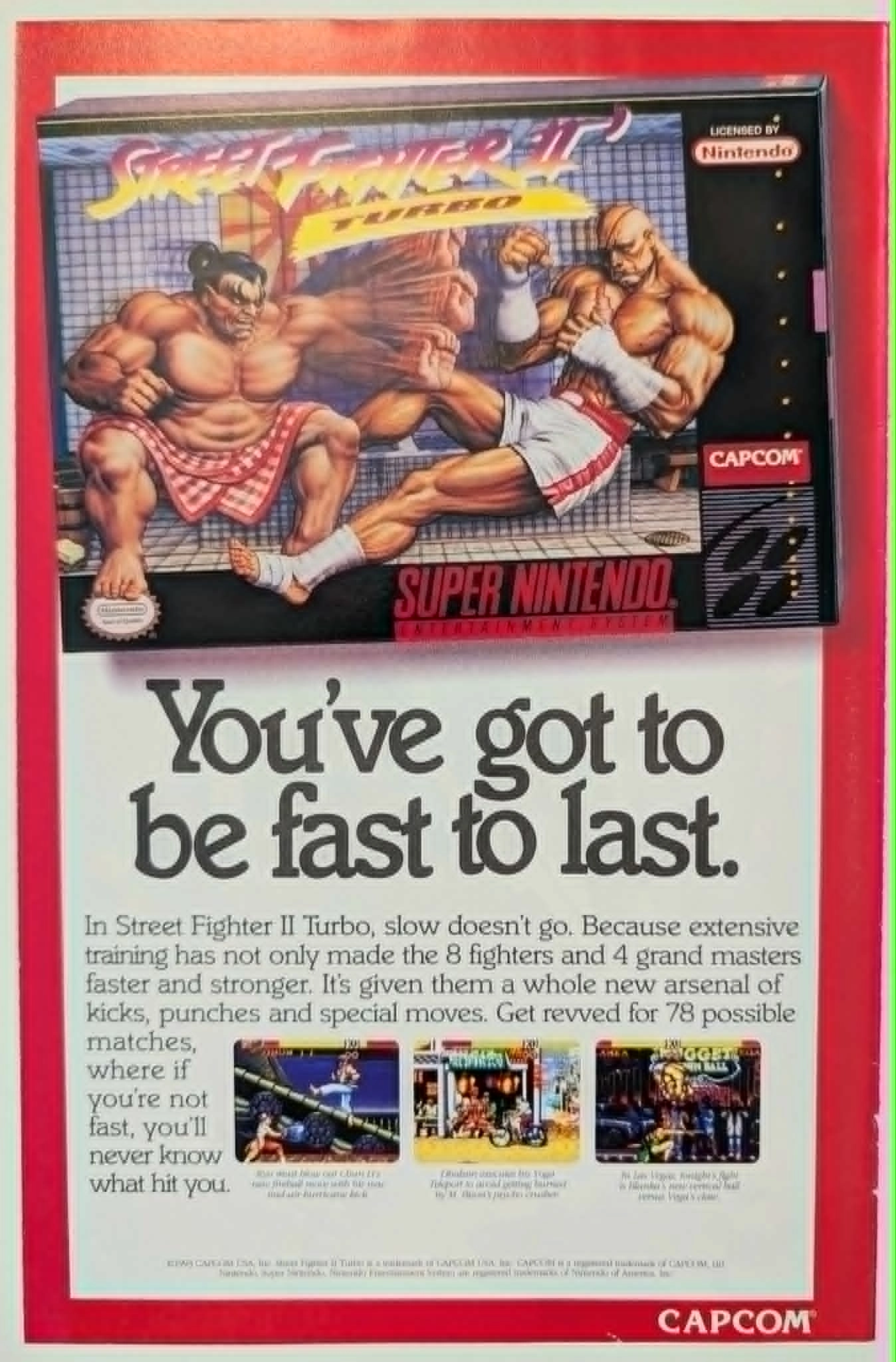
1993 Capcom Street Fighter II Turbo Vintage Advertisement
Released during the absolute peak of the 16-bit console wars, this 1993 print advertisement for Capcom's Street Fighter II Turbo captures the hyper-competitive spirit of early 90s gaming. Highlighting the game's blistering speed and new mechanics exclusively for the Super Nintendo Entertainment System (SNES), the piece features dynamic, stylized character art and strategic in-game screenshots to entice fighting game fans. It stands as a quintessential artifact of mass-market video game advertising from the era. The early 1990s fighting game boom was single-handedly defined by Capcom's Street Fighter II. However, the arcade scene moved rapidly, and players quickly mastered the original game, leading to unauthorized, sped-up, and heavily modified bootleg arcade boards. To reclaim the market and officially provide the frantic pace players desired, Capcom released Street Fighter II' - Hyper Fighting in arcades, which was subsequently ported to the Super Nintendo Entertainment System (SNES) in 1993 as Street Fighter II Turbo. This advertisement perfectly encapsulates this historical pivot. The headline, "You've got to be fast to last," directly addresses the game's defining feature: a significant, adjustable increase in gameplay speed that fundamentally altered competitive strategies and reaction times. Visually, the advertisement utilizes a striking piece of bespoke box art illustration, a common and highly effective marketing technique in the 90s to bridge the graphical gap between arcade cabinets and home consoles. The central image depicts a brutal, dynamic clash between E. Honda and the Muay Thai boss Sagat, set against the iconic backdrop of Honda's bathhouse stage. Below this primary focal point, the ad shifts to practical information, presenting three distinct in-game screenshots. The italicized captions meticulously detail the new gameplay additions that justified the purchase for consumers who already owned the previous version: Chun-Li's new fireball (Kikoken), Dhalsim's Yoga Teleport, and the crucial ability to finally play as the "4 grand masters" (the boss characters: M. Bison, Vega, Sagat, and Balrog). Culturally, this artifact represents the zenith of physical video game print journalism and marketing. In an era devoid of digital trailers or instant online updates, these vivid, full-page magazine spreads were the primary vehicle for generating hype. The meticulous breakdown of "new kicks, punches and special moves" alongside the promise of "78 possible matches" reflects a marketing strategy deeply attuned to the hardcore player base, emphasizing mechanical depth and value. It is a perfect time capsule of 16-bit era aggressive advertising, where speed, character roster size, and exclusive moves were the ultimate selling points in the fierce rivalry between Nintendo and Sega.
Category: Toys & Games
Year: 1993
Rarity Class: C
Paper & Print Condition
The artifact is printed on standard lightweight, high-gloss coated paper stock, characteristic of high-circulation North American consumer periodicals from the early 1990s. Under magnification, the structural integrity of the paper remains remarkably stable, exhibiting minimal acidic degradation despite the era's common use of highly acidic wood pulp. The ink application utilizes standard four-color (CMYK) offset lithography. A microscopic examination reveals a crisp, well-defined halftone rosette pattern, indicating a moderate to high line screen frequency typical for premium advertisement placements. Registration of the individual color plates is exceptional; the deep reds, varied skin tones in the artwork, and high-contrast yellows remain striking, with no evidence of UV-induced fading, moisture damage, or foxing. The physical edges show only negligible micro-abrasions consistent with very light handling.
Provenance & Rarity
This artifact is sourced directly from a high-circulation North American consumer periodical published in 1993, such as Electronic Gaming Monthly or GamePro. During the zenith of the 16-bit console generation, these publications boasted massive national distribution networks, with print runs regularly exceeding hundreds of thousands of copies. Unlike retail display posters, magazine advertisements benefit from a naturally high historical survival rate, as avid gaming enthusiasts frequently archived entire magazine issues or carefully clipped pages. Due to this exceptionally large original production run combined with a robust historical preservation rate, the artifact is mathematically abundant in modern secondary markets, qualifying it firmly for a baseline rarity grade of C (Very Common).
Rarity & Condition Summary
Rarity: C (Very Common) — A mass-produced consumer magazine advertisement distributed nationally, possessing a substantial surviving population in intact magazines and clipped pages today. Condition: Excellent — Clean presentation with minimal handling wear, sharp corners, and highly preserved ink fidelity.