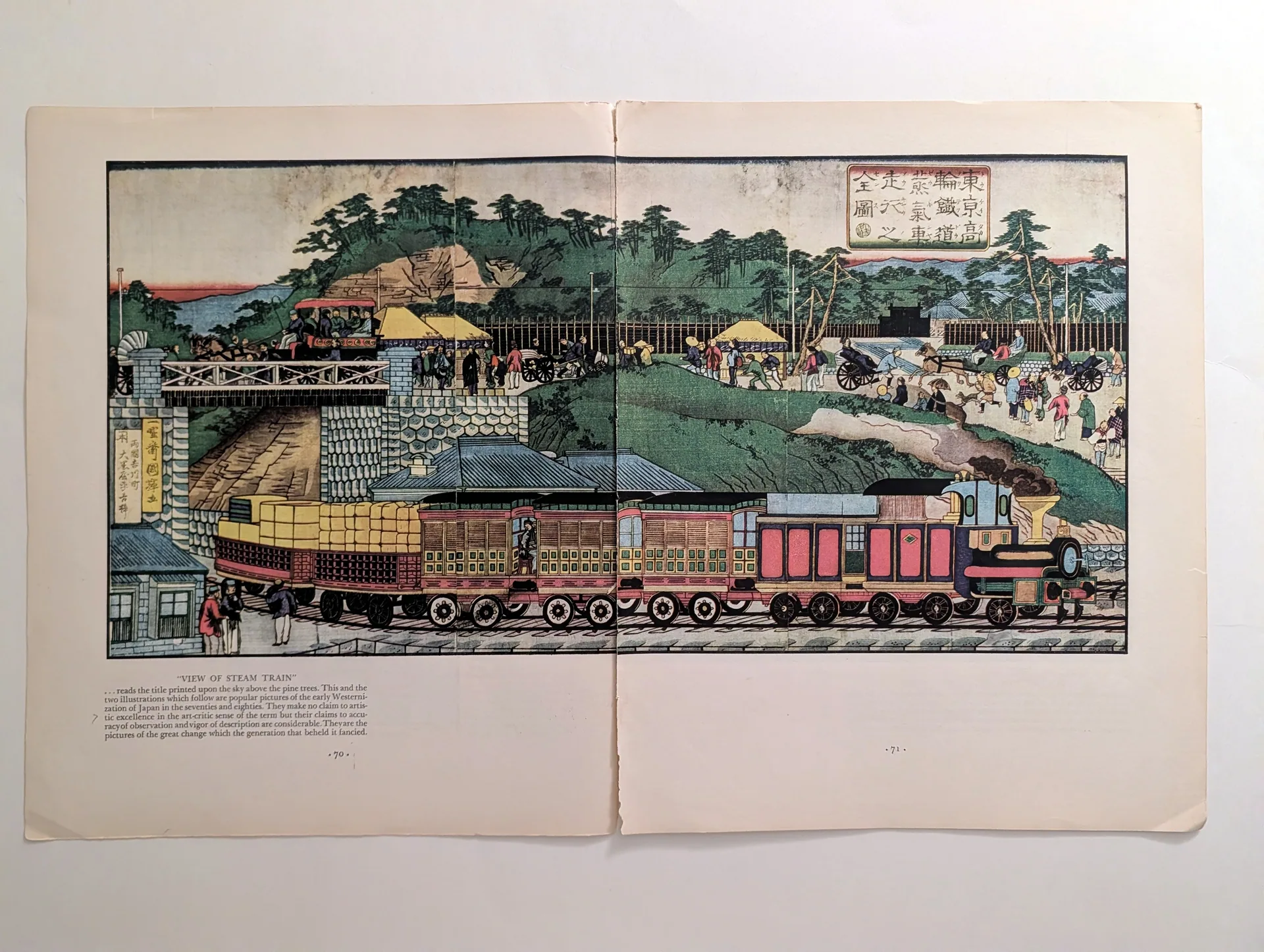
"View of Steam Train" at Tokyo Seaside Station — Book-Spread Color Plate after an 1870s Kaika-e Print (pp.70–71)
*Paragraph 1 — Visual Description:* The supplied images show a two-page book spread (pages 70 and 71), photographed upside down, carrying a full-color reproduction of a Meiji-era Japanese woodblock print in horizontal format. The print depicts a steam locomotive with a tall diamond stack pulling several passenger carriages across a stone-faced railway embankment beside the water; a Western-style station building with a clock or signboard stands at the right, and crowds of onlookers in mixed Japanese and Western dress gather along the platform and the foreshore. Pine trees crown the hillside at the upper left, and the train's dark smoke trails across the sky. The title cartouche is printed in the sky; a smaller title cartouche sits at the lower left of the image; two further inscribed cartouches label the station building. The reproduction is set inside a thin black keyline frame with wide unprinted margins; the page numbers "·70·" and "·71·" are printed in the margins, and a discursive English caption runs above the image on page 70. The paper reads as a cream or off-white coated stock consistent with 20th-century illustrated-book paper. No tears, folds, or foxing are resolvable at the supplied resolution. *Paragraph 2 — Printed Text & Marks:* The English caption is transcribed: "VIEW OF STEAM TRAIN" …reads the title printed upon the sky above the pine trees. This and the two illustrations which follow are popular pictures of the early Westernization of Japan in the seventies and eighties. They make no claim to artistic excellence in the art-critic sense of the term but their claims to accuracy of observation and vigor of description are considerable. They are the pictures of the great change which the generation that beheld it fancied. The Japanese title cartouche in the sky transcribes as 「東京濱海蒸氣車之驛全圖」 — "a complete picture of the seaside steam-train station at Tokyo" (the cataloguer's translation). A small circular seal appears at the foot of the title cartouche; its characters are not resolvable. The station-building cartouches are in running script and are not legibly transcribed at the supplied resolution. No artist signature cartouche is resolvable in the supplied images. No imprint, publisher, or date of the reproducing book appears anywhere in the supplied images. *Paragraph 3 — Maker Context:* The original print's artist is not identified from the supplied images: no artist signature or seal is resolvable, and the exact print has not been matched to a museum holding. The subject, format, title conventions, and katakana-glossed cartouche are consistent with the railway prints of the 1870s — for example, documented railway triptychs by Utagawa Hiroshige III and his contemporaries — but this remains a stylistic comparison, not a verified attribution, and no artist is named for the original in this entry. The reproducing book is unidentified: no title page, colophon, or imprint is visible. The object is therefore catalogued as an anonymous book-spread color reproduction of an 1870s-subject print, not as an original woodblock print. *Paragraph 4 — Geographic & Audience Context:* The print depicts the first Japanese railway, the Shimbashi–Yokohama line, officially opened 14 October 1872; the 53-minute run replaced a journey of some ten hours on foot. The title's "seaside" wording and the coastal embankment setting suggest the Takanawa–Shinagawa section of the line, which ran along Tokyo Bay — an interpretation, as the exact station is not labeled legibly in the supplied images. The reproducing book addresses an English-speaking general audience, framing the print as a "popular picture" of "the early Westernization of Japan in the seventies and eighties" whose value lies in "accuracy of observation" rather than art — terms that now read as condescending. *Paragraph 5 — Visual Language Analysis:* The original print speaks the visual language of kaika-e at its most reportorial: the locomotive is drawn large and frontally as the undisputed protagonist, its wheels, stack, and carriages itemized with an almost diagrammatic care, while the crowd of onlookers — the print's second subject — registers the novelty as a social event. The composition is a hybrid: the elevated, slightly tilted bird's-eye viewpoint and the cartouche-and-seal apparatus are inherited ukiyo-e conventions, while the stone embankment, the Western station building, and the linear perspective of the train itself reach for a European documentary realism. The book caption adds a 20th-century Western editorial layer that treats the image as ethnographic evidence of "the great change" — a framing that says as much about the book's era as about the 1870s. *Paragraph 6 — Function & Archival Significance:* In its original life the print functioned as popular visual journalism, feeding Meiji curiosity about the railway — the era's supreme symbol of civilization and enlightenment. In the reproducing book the image functions as an exhibit in a Western narrative of Japan's modernization, grouped by the caption with "the two illustrations which follow" as Westernization pictures — the Ueno Park (pp.72–73) and Azuma Bridge (pp.74–75) spreads in this same book appear to be those illustrations. What this spread documents that other sources do not is that curatorial grouping itself: an unidentified editor's decision to present kaika-e reproductions as a sequence on the seventies and eighties. The reproduction also preserves, at usable resolution, the print's full Japanese title — a clean transcription reference for the original. The artifact is catalogued strictly as the book spread; no claim is made here about the original woodblock impression's artist, edition, location, or market value.
Category: Art & Museums
Year: 1872
Rarity Class: C
Paper & Print Condition
The color image presents as a reproduction set in a thin black keyline with margins, printed on a cream/off-white coated stock consistent with 20th-century illustrated-book paper; the unprinted margins show no toning resolvable at the supplied resolution. Registration of the color passes appears visually tight, with the black keyline, title cartouches, and page numbers reading crisp. Likely process: offset lithography (physical examination required for confirmation). Confidence: Moderate. No handling or storage history is inferred from the observed state. No tears, creases, or foxing are visible at the supplied resolution.
Provenance & Rarity
Source media observed: a loose two-page book spread identified by its own page numbers as pp.70–71 of an unidentified English-language illustrated book — matching the paper, keyline style, and caption style of the pp.72–73 and pp.74–75 spreads. The original acquisition record, prior ownership, and the circumstances under which this spread left its book are undocumented in the supplied material. Rarity class: C. Justification: a commercially printed color plate from an unidentified book — no scarcity evidence; no artist signature is resolvable on the reproduction and the English caption carries no byline.
Rarity & Condition Summary
The spread presents as an intact two-page plate with legible color and crisp keyline and lettering; the unprinted margins show no visible damage, and the printed English caption and the Japanese title cartouche remain fully legible at the supplied resolution. Rarity: C — a commercial book plate; no scarcity evidence, documentary value only.