Azuma Bridge Woodblock Reproduction — Mid-Century Book Spread, pp. 74–75
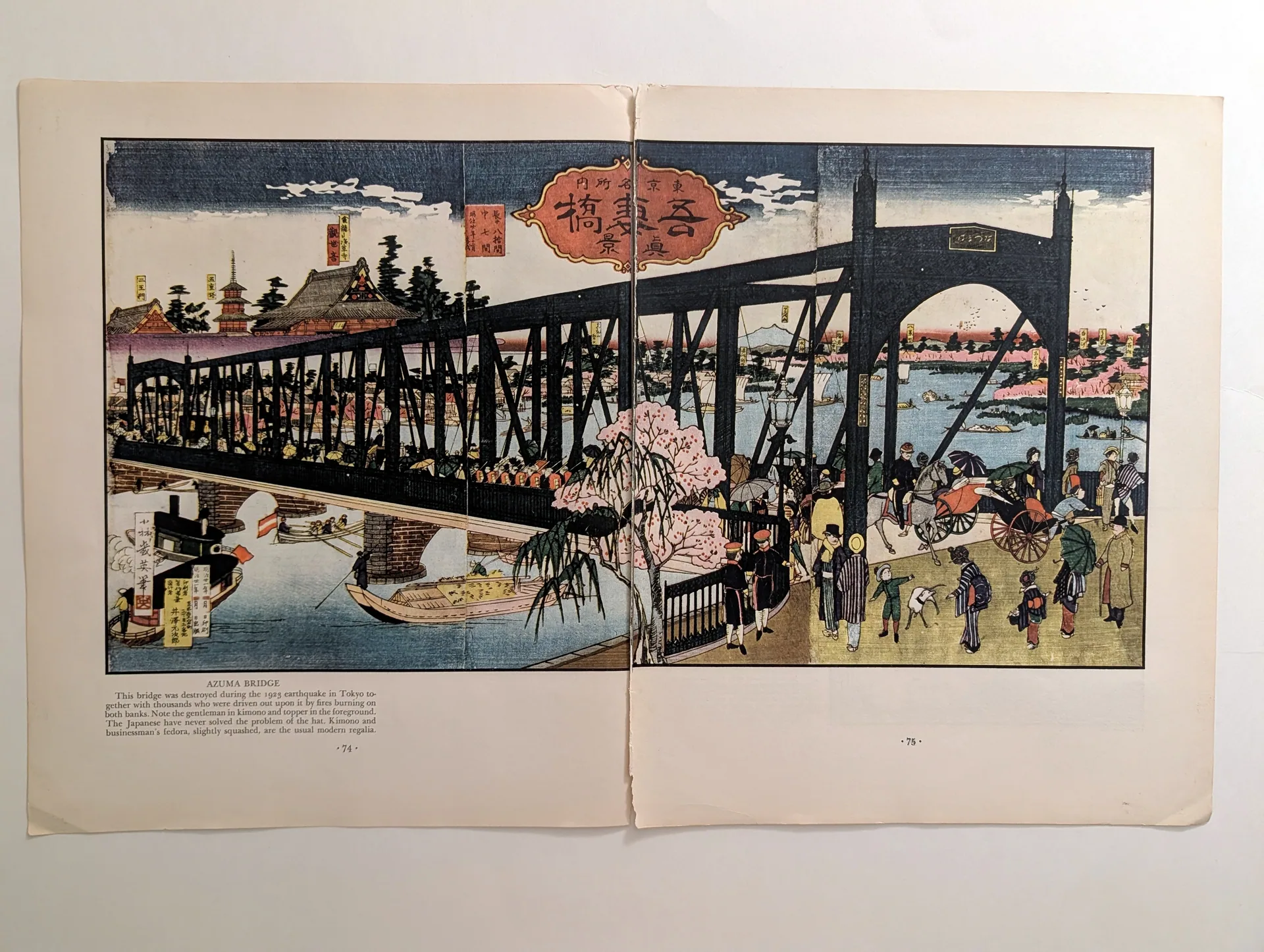
*Paragraph 1 — Visual Description:* The supplied images show a two-page spread (pages 74–75) photographed as a loose bifolium; the spread was photographed rotated 180 degrees and is described here in reading orientation. The spread carries a large color halftone reproduction, spanning the center gutter, of the 1887 Japanese woodblock triptych titled "Tokyo Meisho no Uchi: Azuma-bashi Shinkei" (True View of Azuma Bridge): the black iron truss of Azuma Bridge spanning the Sumida River diagonally across the image, thronged with pedestrians, jinrikisha with pullers, a mounted figure, and a dog; boats on the river below; a cherry-blossom branch and willow at center; temple roofs and a pagoda on the far bank. A red lobed title cartouche sits at the top center of the image; a cluster of smaller cartouches (artist signature, date, publisher) stands at the top left. The reproduction is set with margins on the page; below the image on page 74 runs the English caption headed "AZUMA BRIDGE"; the page numbers "·74·" and "·75·" appear at the foot of each page. The paper reads as a cream book stock with light, even age-toning; the center gutter shows the fold of the binding. *Paragraph 2 — Printed Text & Marks:* The caption on page 74 is transcribed verbatim: "AZUMA BRIDGE. This bridge was destroyed during the 1923 earthquake in Tokyo together with thousands who were driven out upon it by fires burning on both banks. Note the gentleman in kimono and topper in the foreground. The Japanese have never solved the problem of the hat. Kimono and businessman's fedora, slightly squashed, are the usual modern regalia." The red title cartouche reads "東京 名所之内 吾妻橋真景" (Tokyo Meisho no Uchi: Azuma-bashi Shinkei — "From the Famous Places of Tokyo: True View of Azuma Bridge"); transcription confidence is High. The small white date cartouche appears to read "明治廿年○月○日" (Meiji 20, i.e. 1887; month and day illegible at this resolution); confidence Moderate. The white signature cartouche appears to read "三代広重画" (Sandai Hiroshige ga — "drawn by Hiroshige III") beside a small red seal; confidence Moderate, unverified against museum holdings. The yellow cartouche at top left is only partially legible — its right column appears to contain characters reading like a place inscription and the remaining columns cannot be resolved at the supplied resolution; this is a legibility limit, not a finding. Transcription here records what the book printed. *Paragraph 3 — Maker Context:* Two makers must be distinguished: the maker of the reproduced 1887 woodblock print, and the maker of the book that reproduces it. The print's artist is attributed within the image as Utagawa Hiroshige III (1842–1894), who took the master's name after Hiroshige I; the signature-cartouche reading is Moderate confidence and has not been verified against museum holdings. The date cartouche's "明治廿年" (1887) is consistent with the iron bridge's completion that year. The book's author, editor, and publisher are unidentified: no title page was photographed, and caption-phrase searches returned no match, so the book is described honestly as an unidentified English-language book about Japan, likely 20th-century from its printing and paper. The object cataloged here is the book-spread color plate leaf — NOT an original woodblock print. *Paragraph 4 — Geographic & Audience Context:* The print depicts Azuma Bridge over the Sumida River in Tokyo: the iron truss bridge completed in 1887 and lost in the Great Kanto Earthquake of 1 September 1923 (the bridge was rebuilt afterward; contemporary accounts describe it twisted and burned). The original print belongs to the Meiji "kaika-e" (civilization pictures) genre — images celebrating Western-style modernization, here the iron bridge itself, jinrikisha, and figures in mixed Japanese and Western dress (the caption's "gentleman in kimono and topper"). The reproducing book addresses an English-speaking readership interested in Japan. The bridge the print celebrates stood only 36 years, 1887–1923. *Paragraph 5 — Visual Language Analysis:* The reproduced image keeps the triptych's dramatic Meiji composition: a low, close viewpoint from the bridge's flank, the black iron truss drawn as bold engineering geometry against graded sky and water, with the far bank's temples, pagoda, and cherry blossoms rendered in flat decorative color — Western linear perspective fused with ukiyo-e flatness. The crowd is the print's social document: kimono beside Western dress, top hats beside umbrellas, the mixed dress of the modernization decades. The book's presentation is 20th-century color-plate aesthetics: a large halftone spanning the gutter, the wry discursive caption set small beneath, the plate allowed to carry the page. The caption's voice — droll, faintly condescending ("The Japanese have never solved the problem of the hat") — is itself a period artifact of Western writing about Japan. *Paragraph 6 — Function & Archival Significance:* The 1887 print functioned as a meisho-e (famous-place picture): a commercial celebration of the new iron bridge as a symbol of Meiji modernization. The book spread functioned as a color plate in an English-language book on Japan, pairing the image with an anecdotal caption. The leaf's archival significance is double: it preserves, in color, a contemporary image of a structure that no longer exists — the 1887 iron Azuma Bridge, lost in 1923 — and it documents a 20th-century Western framing of Meiji Japan, caption and all. Because the book is unidentified, no claim is made about its edition, print run, or readership.
Category: Art & Museums
Year: 1887
Rarity Class: C
Paper & Print Condition
The image is a large color halftone reproduction spanning the gutter, set with margins on cream book stock; color fields appear even and legible at the supplied resolution, with the black truss lines, blue water, and pink blossom passages all distinguishable. The paper shows a light, even age-toning; the center gutter carries the fold of the binding, and the caption text on page 74 is fully legible. No tears, foxing, or losses are observed in the supplied images. Likely process: offset lithography (physical examination required for confirmation). Confidence: Moderate. No handling or storage history is inferred from the observed toning.
Provenance & Rarity
Source media observed: a loose bifolium, pages 74–75, from an unidentified English-language book about Japan, carrying a large color reproduction of the 1887 woodblock "True View of Azuma Bridge." The original acquisition record, prior ownership, and the book's title and publisher are undocumented in the supplied material. Rarity: C. The object is a commercially printed color-plate book leaf, not an original woodblock. The artist's cartouche visible in the image is the 1887 signature reproduced inside the halftone — it is not the artist's hand on this object. No comparative survival claim is advanced without documented holdings data.
Rarity & Condition Summary
The bifolium presents intact with legible color and text; the gutter fold is present as bound, and the caption and cartouches remain readable at the supplied resolution. Rarity class C: a book-plate leaf reproducing an 1887 woodblock. Nothing in the observed condition is used here to imply scarcity or to grade the object.