1952 "Messages That Made History" No. 8 (signed Eastwood, attribution unverified)
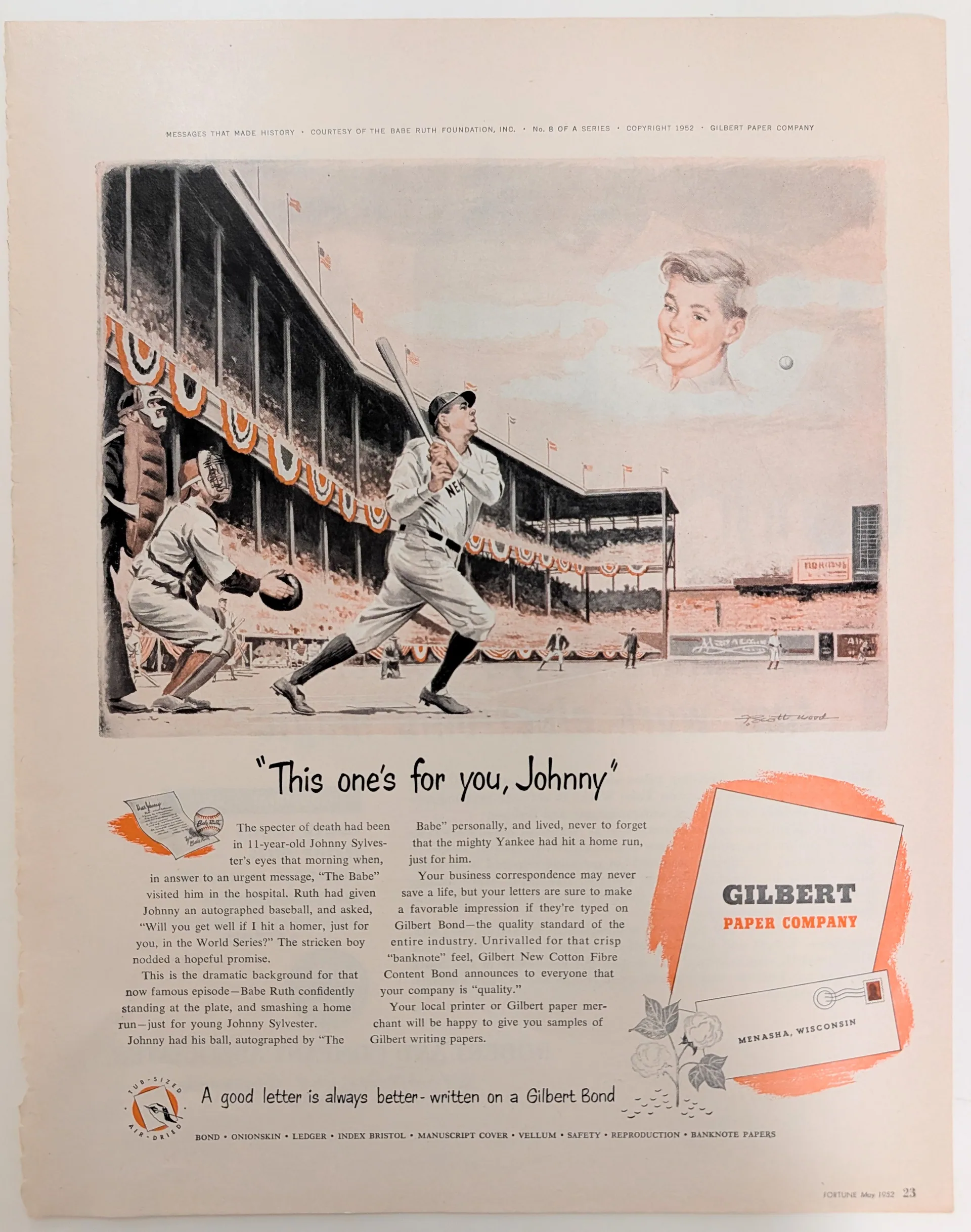
*Paragraph 1 — Visual Description:* The supplied images show a vertical promotional illustration occupying most of a magazine leaf. At left, a baseball player in a light home uniform — the chest lettering reads "NEW," the visible start of the club name — is captured mid-swing, head tilted upward following the ball, bat extended high behind him. Behind him rises a stadium grandstand: a dark roofed upper deck, a packed crowd rendered as dense dark masses, strings of red-and-white bunting along the facade, and small American flags on poles along the roofline. The outfield wall at right carries painted advertising signs, partially legible in the supplied views. Small fielders stand in the middle distance. In the upper right, a large smiling boy's face floats in the sky, painted at a scale far beyond the scene below, gazing down toward the player. At lower right, a facsimile vignette shows a handwritten-style letter headed "Dear Johnny" beside a baseball carrying a script signature reading "Babe Ruth"; beneath the vignette a block of body text begins "in answer to an u—" and is cut off in the supplied views. A script signature in the lower right of the illustration reads "Eastwood." Above the illustration, a single-line masthead band carries the series credits, and a vertical margin notation at the sheet's edge reads "FORTUNE May 1952 23." The palette is warm and muted — peach and cream tones in the sky and faces, rust-orange in the bunting and the vignette's brushstroke ground, olive-grey and black in the grandstand. The sheet appears clean, with minor wear at the edges. *Paragraph 2 — Printed Text & Marks:* The masthead band transcribes in full: "MESSAGES THAT MADE HISTORY · COURTESY OF THE BABE RUTH FOUNDATION, INC. · No. 8 OF A SERIES · COPYRIGHT 1952 · GILBERT PAPER COMPANY." The margin notation reads "FORTUNE May 1952 23." Under the designation-parsing rule these support, literally: the publication name Fortune, an issue date of May 1952, and a page number 23 — and nothing further about sequence, placement, or total series count. The facsimile letter is headed "Dear Johnny"; its body is rendered as simulated handwriting, legible only in fragments at the supplied resolution, and its sign-off is partially obscured by the overlapping baseball. The ball carries the script signature "Babe Ruth." The body text beneath the vignette begins "in answer to an u—" and breaks off at the edge of the supplied view; no continuation is transcribed. The illustration's script signature reads "Eastwood." This is a signature-only observation: it establishes that a signature reading "Eastwood" is present. It does not identify the artist, and no attribution is made from it. *Paragraph 3 — Maker Context:* The artist's status on this record is Signature-only. The script signature reading "Eastwood" is transcribed exactly as observed; per the attribution protocol it is evidence of a signature and nothing more, and it is never used here to identify an artist. The printed credits name three entities, each treated at the minimum the credit supports. "GILBERT PAPER COMPANY" is the printed copyright holder and the series' sponsor — the company behind the advertisement. "THE BABE RUTH FOUNDATION, INC." is credited with courtesy, i.e., as the source of permission for the letter facsimile; no claim is made about the foundation's history or holdings. "FORTUNE" names the magazine in whose May 1952 issue the page appeared, per the margin notation. The designation "No. 8 OF A SERIES" establishes that this page is the eighth in a series; the series' full extent, the other numbers' subjects, and the campaign's run are not printed on the artifact and are not asserted. *Paragraph 4 — Geographic & Audience Context:* The margin notation places the page in the May 1952 issue of Fortune, an American business magazine (the American context is inferred from the printed credits, the English copy, and the baseball subject — interpretive, requiring downstream verification; no country of publication is printed on the artifact). The advertiser is a paper company addressing Fortune's business readership with an institutional message rather than a product offer: the "Messages That Made History" conceit presents paper as the medium on which history is written, with each installment built around a letter from a figure the audience would recognize. The courtesy credit to the Babe Ruth Foundation positions the facsimile "Dear Johnny" letter as a genuine document reproduced with permission — the claim of genuineness is the advertisement's own, transcribed here, not verified by this record. The audience is addressed as business readers presumed to recognize the baseball figure named in the credits and to value the association between the company's paper and historic correspondence. *Paragraph 5 — Visual Language Analysis:* The illustration speaks the visual language of early-1950s American commercial art: soft, naturalistic modeling of the figures, a limited warm palette of peach, rust-orange, olive-grey, and black, and an open layout in which the image floats on generous unprinted margins (possible formal resonance with Mid-Century Modern — see field 19). The composition layers three registers of reality without apology — the stadium scene, the giant boy's face in the sky, and the facsimile letter vignette — a montage logic that lets the advertisement tell a story (the letter), show its hero (the player), and name its recipient (the boy) in a single image. The typography is equally restrained: a single line of widely tracked capitals for the masthead, a small vertical margin notation, and plain serif body text, all held to the edges so the illustration dominates (possible formal resonance with Swiss Style / International Typographic — see field 19). The facsimile devices — the "Dear Johnny" letter, the signed ball — borrow the authority of the document: the advertisement asks to be read as an archive presenting evidence, not as a picture selling paper. *Paragraph 6 — Function & Archival Significance:* The page functioned as institutional advertising: the Gilbert Paper Company used Fortune's pages not to sell a ream of paper but to associate its name with the idea that important messages are written on good paper. The series title states the strategy outright — paper as the substrate of history — and the Babe Ruth letter supplies the proof object, reproduced as a facsimile with a courtesy credit to lend it documentary weight. For the archive, the leaf documents an early-1950s corporate advertising campaign built around celebrity correspondence, preserved with its full credit apparatus: sponsor, series number, copyright year, permission credit, and source-magazine notation all printed on the sheet. The signature-only "Eastwood" illustrates the period's common practice of signing commissioned advertising art without further credit. The facsimile letter's fragmentary legibility in the supplied views limits what can be said about its text; the full transcription of the letter and the identification of its original are tasks for the downstream verifier, not for this record.
Category: Sports & Outdoors
Year: 1952
Rarity Class: A
Paper & Print Condition
The illustration is a screened color reproduction; the supplied close-up views show a resolvable halftone dot screen in the sky, the grandstand, and the vignette — positive evidence of a screened process. The warm palette holds cleanly: peach and cream in the faces and sky, rust-orange in the bunting and the vignette's brushstroke ground, olive-grey and black in the grandstand masses, with soft tonal modeling across the player's uniform. The printed key lines of the masthead, margin notation, and body text appear visually crisp at the supplied resolution. The sheet reads as clean overall, with minor wear visible at the edges in the supplied views; no foxing, staining, or toning breaks the image area at the available resolution. Likely process: probable four-color offset lithography (physical examination required for confirmation). Confidence: Moderate. A plausible alternative is letterpress halftone, ranked less likely because the fine dot structure and smooth tonal modeling are consistent with the offset-lithographic standard for magazine illustration reproduction of the early 1950s; letterpress cannot be excluded from a digital proxy. Minimum distinguishable colour separations resolvable in the supplied image: 4 (process-color behavior in the illustration plus the black text pass). This is a floor, not a count. No storage or handling history is inferred from the observed edge wear.
Provenance & Rarity
Source media observed: a single magazine leaf identified by its margin notation as page 23 of the May 1952 issue of Fortune, carrying the Gilbert Paper Company's "Messages That Made History" No. 8 advertisement, photographed as a loose sheet. The original acquisition record, prior ownership, and the circumstances of the leaf's separation from its issue are undocumented in the supplied material: [AWAITING CURATORIAL ASSIGNMENT]. No rarity assessment is made here: [AWAITING CURATORIAL ASSIGNMENT — C–OMEGA scale]. No comparative survival claim is advanced for early-1950s magazine advertising leaves without documented holdings data.
Rarity & Condition Summary
The leaf presents as a clean single sheet with the illustration, facsimile vignette, masthead band, and margin notation intact and legible. The screened color holds without visible fading at the supplied resolution, the text remains crisp, and only minor edge wear is visible. The "Eastwood" signature is legible in the lower right of the illustration, the "Dear Johnny" letter heading and the "Babe Ruth" ball signature are readable in the supplied detail views, and the vertical "FORTUNE May 1952 23" margin notation is fully legible. The rarity half of this summary is [AWAITING CURATORIAL ASSIGNMENT]; nothing in the observed condition is used here to imply scarcity or to grade the object.