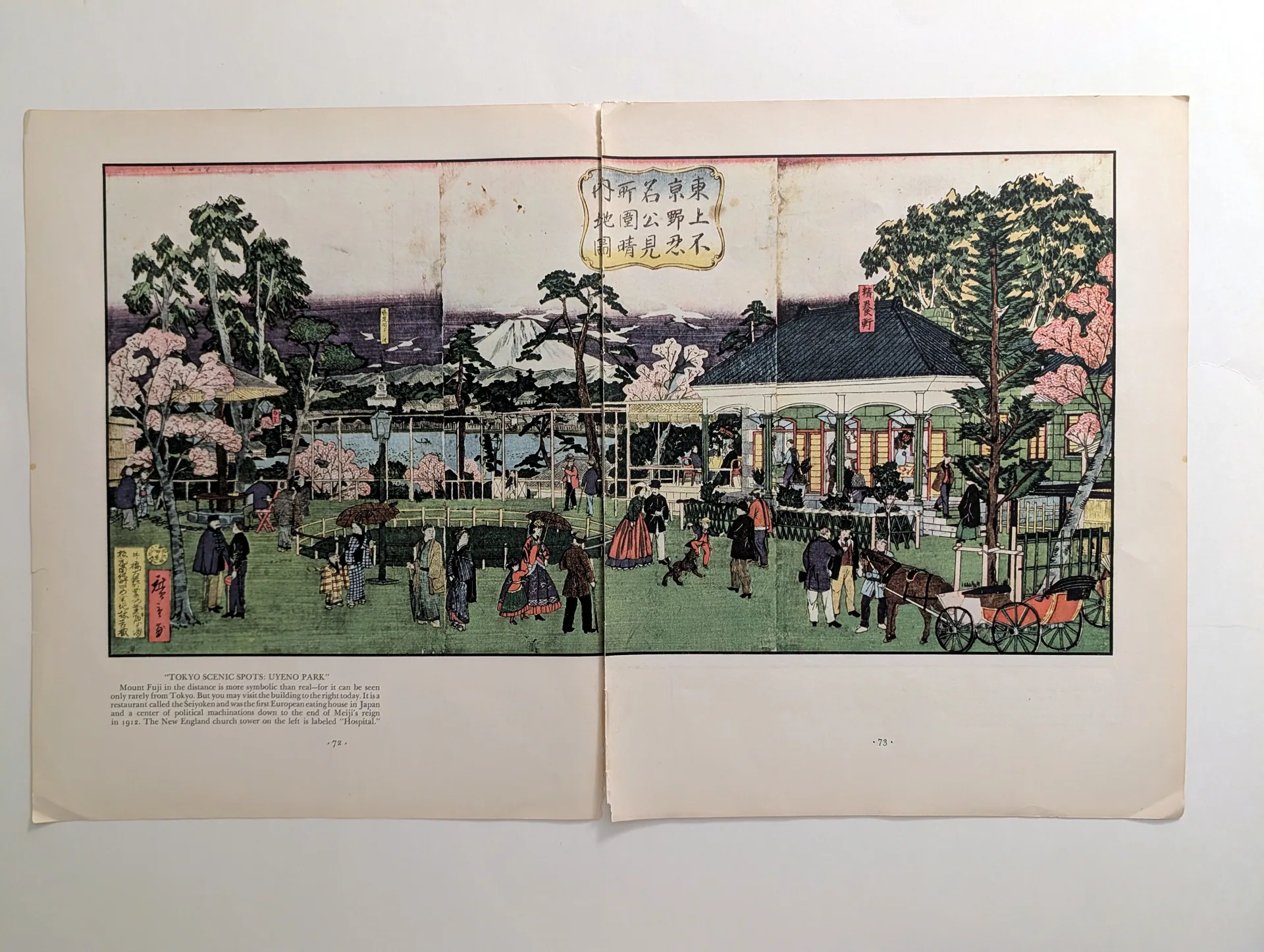
"Tokyo Scenic Spots: Uyeno Park" Book-Spread Color Plate after Hiroshige III's c.1876 Print (pp.72–73)
*Paragraph 1 — Visual Description:* The supplied images show a two-page book spread (pages 72 and 73), photographed rotated 90 degrees, carrying a full-color reproduction of a Meiji-era Japanese woodblock print. The print depicts Ueno Park in cherry-blossom season: strolling figures in a mix of kimono and Western dress, pink cherry trees, dark pines, and a distant Mt. Fuji rendered small on the horizon. At the right of the scene stands a European-style restaurant building with a wide veranda on which small figures sit and stand; at the left rises a church-tower-like building. A horse-drawn carriage and a small dog appear among the foreground figures. The reproduction is set inside a thin black keyline frame with wide unprinted margins; the page numbers "·72·" and "·73·" are printed in the margins, and a discursive English caption runs along the upper margin of page 72. The paper reads as a cream or off-white coated stock typical of mid-20th-century illustrated books. No tears, folds, or foxing are resolvable at the supplied resolution; the gutter between the pages shows a clean bound-spread join. *Paragraph 2 — Printed Text & Marks:* The English caption is transcribed verbatim: "TOKYO SCENIC SPOTS: UYENO PARK" — "Mount Fuji in the distance is more symbolic than real—for it can be seen only rarely from Tokyo. But you may visit the building to the right today. It is a restaurant called the Seiyoken and was the first European eating house in Japan and a center of political machinations down to the end of Meiji's reign in 1912. The New England church tower on the left is labeled 'Hospital.'" Three Japanese cartouches are reproduced inside the print image. (1) A yellow title cartouche reading, right to left: 「東京名所」 (Famous Places of Tokyo) / 「上野公園」 (Ueno Park) / 「不忍見晴之圖」 (a view of Shinobazu) — the final characters of the first two lines are obscured by the page gutter. (2) A red artist cartouche reading 「廣重画」 ("Hiroshige ga" — drawn by Hiroshige). (3) A yellow publisher cartouche in cursive script, partially legible as a Tokyo address, the publisher's name and remaining text not resolvable at the supplied resolution. A small circular seal appears beside the title cartouche; its characters are not resolvable. No imprint, publisher, or date of the reproducing book appears anywhere in the supplied images. *Paragraph 3 — Maker Context:* The original print is attributed to Utagawa Hiroshige III (1842–1894) on two grounds: the reproduced red 「廣重画」 cartouche, and the official history page of the Seiyoken restaurant (seiyoken.co.jp), which uses this exact image labeled "Utagawa Hiroshige (III) 1876". Hiroshige III — born Goto Torakichi, pupil of Hiroshige I, successor to the Hiroshige name — specialized in kaika-e ("enlightenment pictures") documenting the Westernization of Meiji Japan in the 1870s and 1880s. The original publisher's name is not resolved from the cursive cartouche. The reproducing book is unidentified: no title page, colophon, or imprint is visible in the supplied images, and a web search on the caption's distinctive phrasing found no match. The object is therefore catalogued as an anonymous 20th-century book-spread color reproduction, not as an original woodblock print. *Paragraph 4 — Geographic & Audience Context:* The original print's subject is Ueno Park, Tokyo, in the mid-1870s: the park's Ueno branch of the Seiyoken restaurant, which Seiyoken's official history associates with 1876, when Ueno Park was formally opened (the park had been designated among Japan's first public parks in 1873). Seiyoken itself was founded in 1872 in Tokyo as a pioneer of French cuisine in Japan; the book caption's stronger claim — "the first European eating house in Japan" — is presented here as the caption's own editorial claim, not as a verified fact. The Meiji reign ended in 1912 with the emperor's death, matching the caption's "down to the end of Meiji's reign in 1912." The reproducing book addresses an English-speaking general audience: its caption explains the image discursively ("you may visit the building to the right today") and translates the scene's Japanese labels ("the New England church tower on the left is labeled 'Hospital'"). *Paragraph 5 — Visual Language Analysis:* The original print speaks the visual language of kaika-e: a documentary impulse toward new Meiji subjects — Western dress, horse-drawn carriages, European architecture — rendered in the inherited ukiyo-e idiom of flat color fields, strong keyline drawing, and decorative cartouches, with strong reds, purples, and greens consistent with the chemical dyes newly imported in the 1870s. The composition mixes a Western-style deep view (the receding park path, the distant Fuji) with the Japanese convention of the inscribed title cartouche and the artist's red signature seal. The book caption adds a second, 20th-century visual-verbal layer: the wry connoisseur's aside that Fuji is "more symbolic than real" reframes the print for Western readers as period evidence rather than as art, a characteristic move of English-language surveys of Japanese prints. *Paragraph 6 — Function & Archival Significance:* In its original life the print functioned as popular visual journalism, showing Meiji viewers their own modernizing capital. In the reproducing book the image functions differently: as an exhibit in a Western narrative of Japan's Westernization, glossed by an anonymous English caption. What this spread documents that other sources do not is that 20th-century reception itself — the moment when a book editor chose this particular Hiroshige III view, of a restaurant and a park, to stand for the Meiji seventies. The reproduction also preserves, at usable resolution, the print's cartouches and seals, making the spread a working reference for the original's inscription details. The artifact is catalogued strictly as the book spread; no claim is made here about the original woodblock impression's location, edition, or market value.
Category: Art & Museums
Year: 1876
Rarity Class: C
Paper & Print Condition
The color image presents as a reproduction set in a thin black keyline with margins, printed on a cream/off-white coated stock consistent with 20th-century illustrated-book paper; the unprinted margins show no toning resolvable at the supplied resolution. Registration of the color passes appears visually tight, with the black keyline, cartouche lettering, and page numbers reading crisp. Likely process: offset lithography (physical examination required for confirmation). Confidence: Moderate. No handling or storage history is inferred from the observed state. No tears, creases, or foxing are visible at the supplied resolution. Some cartouche characters are obscured by the gutter or not resolvable at this resolution, as noted in the transcription.
Provenance & Rarity
Source media observed: a loose two-page book spread identified by its own page numbers as pp.72–73 of an unidentified English-language illustrated book. The original acquisition record, prior ownership, and the circumstances under which this spread left its book are undocumented in the supplied material. Rarity class: C. Justification: a commercially printed color plate from an unidentified book — no scarcity evidence; its value is documentary, as a record of 20th-century Western commentary on Meiji prints. The artist-signature +1 rule does NOT apply: the red "Hiroshige ga" cartouche is printed ink reproduced inside the plate, not a live artist's signature on this object.
Rarity & Condition Summary
The spread presents as an intact two-page plate with legible color and crisp keyline and lettering; the unprinted margins show no visible damage, and the printed English caption remains fully legible, though some Japanese cartouche characters are obscured or not resolvable at the supplied resolution. Rarity: C — a commercial book plate; no scarcity evidence, documentary value only.