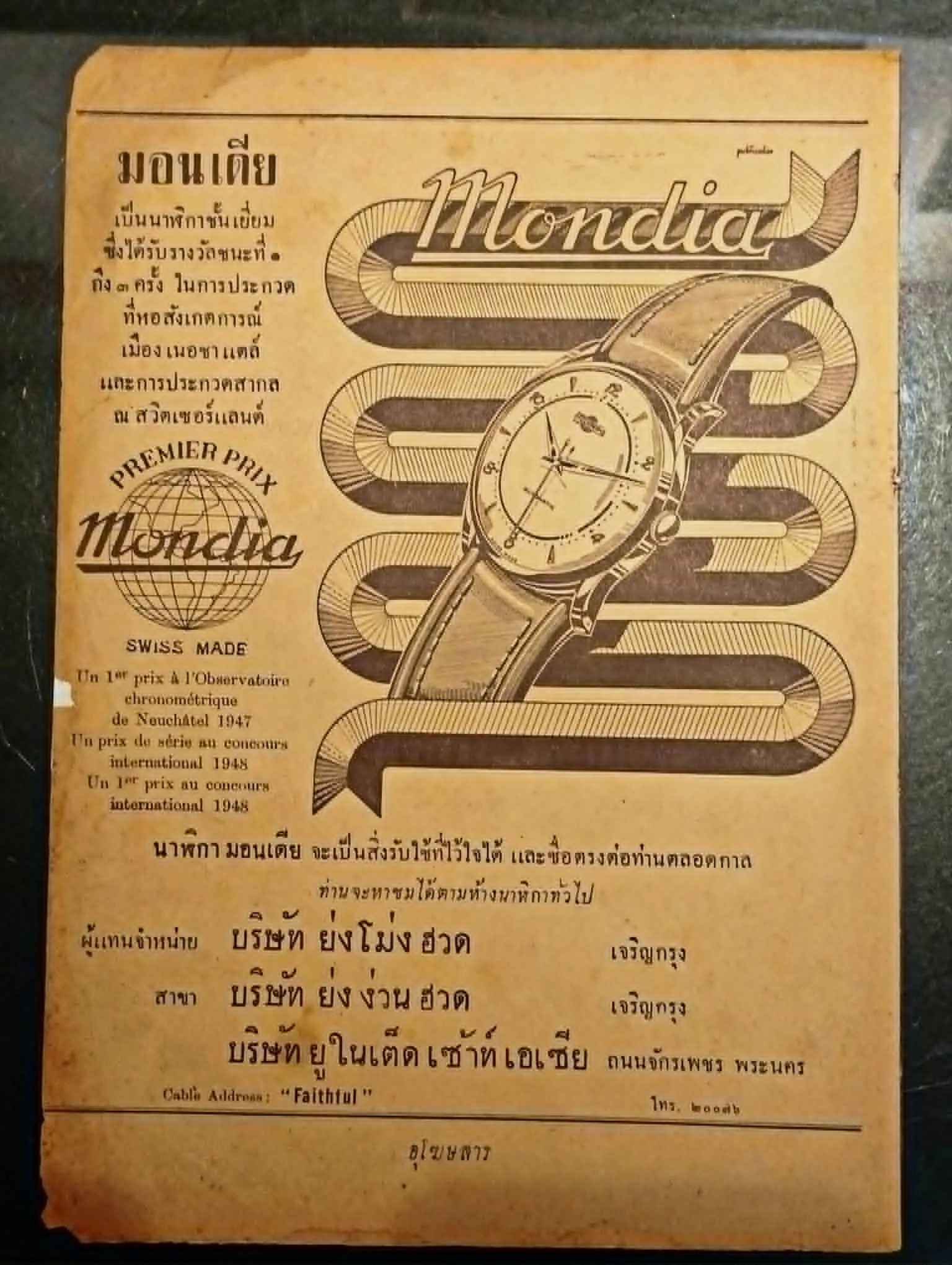
c. 1950 Mondia Automatic Watch Vintage Advertisement (Thai Market)
In the years immediately following the Second World War, the Swiss watchmaking industry experienced a significant global expansion. Brands leveraged their technical achievements in chronometry to establish trust in emerging international markets. This advertisement for Mondia is a prime example of that strategy, explicitly citing its 1er prix à l'Observatoire chronométrique de Neuchâtel 1947 (1st Prize at the Neuchâtel Chronometric Observatory 1947) and subsequent international awards in 1948 to validate its mechanical superiority. Visually, the advertisement utilizes a striking modernist motif. The watch is overlaid onto a continuous, winding ribbon or track, a design choice that evokes both the winding mechanism of an automatic movement and the concept of endless precision. The prominent display of the globe paired with the text "PREMIER PRIX" reinforces the brand's global standing. For the regional historian, the most compelling aspect of this document is its localization. The Thai copy meticulously translates the brand's Swiss pedigree while listing its local authorized distributors: Yong Mong Huat (ย่งโม่ง ฮวด) and its branch Yong Nguan Huat (ย่งง่วน ฮวด) on Charoen Krung Road, alongside United South Asia (บริษัท ยูไนเต็ด เซ้าท์ เอเซีย) on Chakraphet Road. These locations were the beating commercial heart of mid-20th century Bangkok, indicating that Mondia watches were positioned as premium imported goods for the city's affluent merchant class. The inclusion of the English cable address "Faithful" and a five-digit telephone number (20076) further grounds the piece in the logistical realities of mid-century international trade.
Category: Watches
Year: 1950
Rarity Class: A
Paper & Print Condition
This archival piece is printed on highly acidic, uncoated wood-pulp newsprint, a characteristic substrate for mid-century regional ephemera. The paper exhibits moderate uniform oxidation (yellowing) and widespread foxing across the surface, indicative of its age and exposure to tropical humidity. Fraying and micro-tears are present along the raw edges, reflecting its fragile structural state. Nevertheless, the original monotone lithographic application remains remarkably stable; both the intricate line-art illustration of the timepiece and the distinct typography retain sharp contrast and exceptional legibility against the aged background.
Provenance & Rarity
Sourced from mid-20th-century Thai print media, this document is an exceptionally scarce artifact of post-war commerce in Southeast Asia. Advertisements from this specific era, localized for the Thai market and featuring specific Bangkok merchant distributors, are highly uncommon due to the ephemeral nature of the acidic newsprint they were printed on, which was typically discarded immediately after circulation. Its survival provides a rare primary source linking Swiss horological marketing with mid-century Thai merchant networks.
Rarity & Condition Summary
This archival piece represents a highly informative and exceptionally rare example of mid-century regional horological marketing. Classified as Class A rarity due to the exceptionally low survival rate of localized post-war Thai ephemera, the document survives in fair archival condition. While it exhibits the expected material degradation of highly acidic newsprint—including moderate oxidation, structural edge fragility, and widespread foxing—the original monochrome lithography retains striking clarity and historical legibility, making it a vital primary source for Southeast Asian commercial history.