1943 Carnation Evaporated Milk Vintage Advertisement (1940) — Class A vintage Lifestyle & Vice
CLASS A
1 of 7

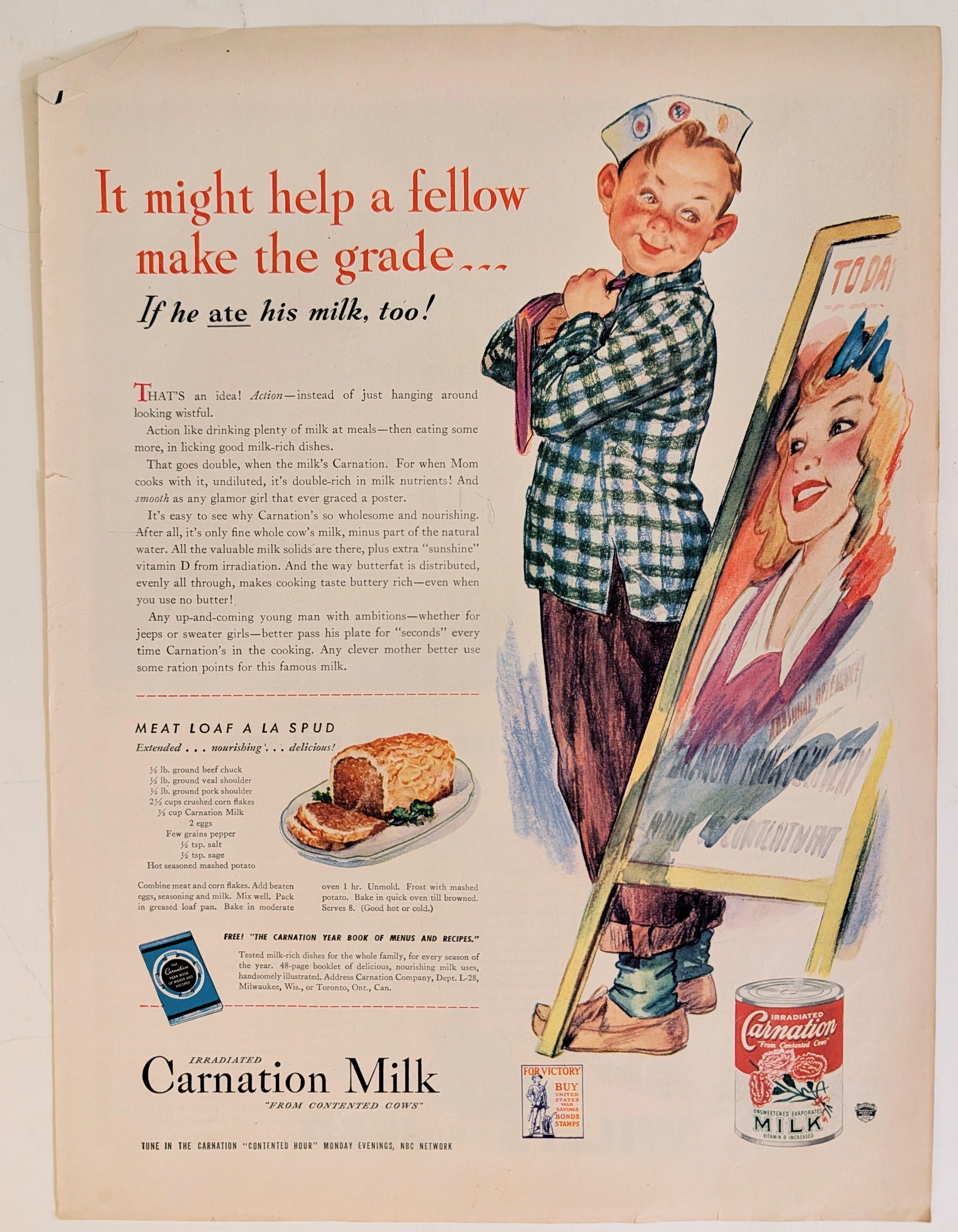
1943 Carnation Evaporated Milk Vintage Advertisement

Category|Lifestyle & Vice
Year|1940
Rarity Class|CLASS A
Archive Views|39
Heritage AdvertisementsFood & Beverage/Canned Goods
Heritage AdvertisementsFood & Beverage/Canned Goods/Carnation
Medium/FormatMagazine Ad
Theme/SubjectFamily/Domestic Life

Last updated: 14 Apr 2026

Historical Context

1943 Carnation Evaporated Milk "Make the Grade" Vintage Advertisement This piece of mid-century advertising offers a fascinating window into the American home front during World War II. The primary messaging of the ad—"It might help a fellow make the grade... If he ate his milk, too!"—is a strategic pivot toward using evaporated milk as an integrated cooking ingredient rather than just a beverage or coffee creamer. The historical context of rationing is explicitly referenced in the copy: "Any clever mother better use some ration points for this famous milk." During the war, canned goods, dairy, and meats were tightly controlled. Carnation positioned its "double-rich" evaporated milk as a vital tool for the economical homemaker. The included recipe for "Meat Loaf a la Spud" perfectly encapsulates wartime culinary strategy. By combining a smaller mix of ground meats (beef, veal, and pork) with crushed corn flakes and evaporated milk, the recipe acts as a "meat extender," yielding a larger meal that "Serves 8" without requiring excessive meat ration stamps. Furthermore, the advertisement serves as a testament to the era's evolving nutritional science. The prominent displays of the "American Medical Association Council on Foods" seal and the recurring mention of "Irradiated" milk highlight the deliberate fortification of the product with Vitamin D—an initiative meant to combat nutritional deficiencies like rickets in children. Culturally, the advertisement is anchored firmly in the 1940s by two distinct markers: the promotion for the NBC Network's "Contented Hour" (a popular musical radio program sponsored by Carnation) and the patriotic "For Victory - Buy United States War Savings Bonds Stamps" Minute Man insignia. These elements transform the advertisement from a simple grocery pitch into a holistic representation of American life, media, and civic duty during the Second World War.

Paper & Print Condition

Printed on standard mid-century periodical stock. The color registration remains impressively vibrant, particularly in the red typography, the "Minuteman" victory stamp, and the iconic Carnation can label. There is mild edge toning typical of the acidic paper utilized during wartime production shortages.

Provenance & Rarity

Sourced from a mainstream American consumer magazine published in the early 1940s. While millions of these magazines were originally circulated, surviving examples with intact, unclipped recipe blocks and minimal fading are increasingly prized by culinary historians and advertising archivists.

Rarity & Condition Summary

An excellent, highly legible preservation of home-front advertising that maintains strong visual fidelity, structural integrity, and deep historical value.
Share This Archive

From the Journal

Related Articles

The Time Traveller's Dossier: How a 1959 Beer Ad Turned Alcohol into 'Health Food' – Barley and Malt Institute Advertisement — related article
Read Article

The Time Traveller's Dossier: How a 1959 Beer Ad Turned Alcohol into 'Health Food' – Barley and Malt Institute Advertisement

History is not written; it is printed. Before digital algorithms dictated human behavior, societal engineering was executed through the calculated geometry of the four-color offset press. The artifact before us is not merely an advertisement; it is a weaponized blueprint of middle-class aspiration. This museum-grade archival dossier presents an academic deconstruction of a 1959 print advertisement commissioned by the Barley and Malt Institute of Chicago. Operating on a profound binary structure, it documents a calculated paradigm shift within the American alcohol industry. It illustrates the precise historical fracture where beer was conceptually transitioned from a stigmatized working-class vice into a health-conscious staple of suburban domesticity. Through the lens of mid-century commercial artistry and precise visual forensics, this document serves as a masterclass in psychological marketing, establishing cultural tropes that unconditionally dominate modern pop culture and contemporary branding

The Time Traveller's Dossier: The Architecture of Slumber – The 1967 Simmons Golden Value — related article
Read Article

The Time Traveller's Dossier: The Architecture of Slumber – The 1967 Simmons Golden Value

The evolution of the American domestic interior during the mid-twentieth century was heavily influenced by the golden age of travel and the rapid expansion of the luxury hospitality industry. The historical artifact elegantly secured upon the analytical table of The Record Institute today is a large-format, two-page centerfold print advertisement for the Simmons Mattress Company, copyrighted in 1967. This document transcends standard consumer goods marketing; it operates as a sophisticated sociological mirror, reflecting a highly specific moment when industrial sleep engineering and the aspirational luxury of the modern hotel were explicitly packaged and sold to the suburban American household. This world-class, comprehensive dossier conducts a meticulous, profound, and historically objective examination of the artifact, operating under the absolute most rigorous parameters of sociological and material science evaluation. We will decode the brilliant marketing psychology embedded within the "First Public Sale" messaging, analyze the iconic "Good Housekeeping" endorsement, and dissect the rich semiotics of the heraldic quilt patterns alongside the modernist architectural illustrations. Furthermore, as we venture deeply into the chemical and physical foundations of this analog printed ephemera, we will reveal the precise mechanical fingerprints of the CMYK halftone rosettes and the graceful, natural oxidation of the paper substrate. This precise intersection of visual nostalgia, mid-century commercial artistry, and the immutable chemistry of time cultivates a serene wabi-sabi aesthetic—a natural, irreversible phenomenon that serves as the primary engine driving up its market value exponentially within the elite global spheres of Vintage Commercial Ephemera and Mid-Century Lifestyle Archives collecting.

The Time Traveller's Dossier: The Sub-Zero Socialite – The Whirlpool Automatic Icemaker Exhibition by Mort Drucker — related article
Read Article

The Time Traveller's Dossier: The Sub-Zero Socialite – The Whirlpool Automatic Icemaker Exhibition by Mort Drucker

The evolution of the domestic appliance from a purely utilitarian instrument of labor into a central pillar of social entertainment and psychological comfort is one of the most fascinating sociological phenomena of mid-twentieth-century America. The historical artifact elegantly and securely positioned upon the analytical table of The Record Institute today is a majestic, large-format, two-page print advertisement for the Whirlpool Refrigerator with an Automatic Icemaker, originating from the cultural zenith of the 1960s. This document completely transcends the traditional boundaries of household goods marketing. It operates as a profound, sophisticated declaration of how technological innovation liberated the American middle class, transforming the private kitchen into a nexus of boundless hospitality, leisure, and social status. This world-class, comprehensive dossier will conduct a meticulous, unyielding, and deep examination of the artifact, operating under the absolute most rigorous parameters of historical, sociological, and material science evaluation. We will decode the brilliant, chaotic, and highly kinetic party scene birthed from the pen of legendary illustrator Mort Drucker, and analyze the dramatic visual juxtaposition of this monochromatic chaos against the highly structured, full-color reality of the Whirlpool refrigerator. Furthermore, as we venture into the chemical and physical foundations of this analog printed ephemera, we will reveal the mechanical fingerprints of the CMYK halftone rosettes and the graceful, natural oxidation of the paper substrate. This precise intersection of visual nostalgia, pop-art mastery, and the chemistry of time cultivates a serene wabi-sabi aesthetic—a natural, irreversible phenomenon that serves as the primary engine driving up its market value exponentially within the elite global spheres of Vintage Appliance Ephemera and Commercial Art collecting.

The Time Traveller's Dossier: The Architecture of Eternity – De Beers "Glory of Bells" Advertisement (Circa early 1940s) — related article
Read Article

The Time Traveller's Dossier: The Architecture of Eternity – De Beers "Glory of Bells" Advertisement (Circa early 1940s)

History is not shaped by chance; it is engineered by those who control the narrative and own the resources. Long before the digital age fragmented human attention, the ultimate manifestations of social engineering and psychological manipulation were executed through the calculated precision of the four-color offset printing press and the masterful strokes of commercial fine art. The historical artifact presented before us is not merely a page from a vintage magazine. It is a perfectly weaponized blueprint of corporate capitalism, a masterpiece of emotional extortion, and a foundational document in the creation of one of the most successful, universally accepted illusions in the history of human commerce: the diamond engagement ring. This museum-grade, academic archival dossier presents an exhaustive, microscopic deconstruction of a World War II-era print advertisement for De Beers Consolidated Mines, Limited, executed by the legendary advertising agency N.W. Ayer & Son. Operating on a profound and ruthless binary structure, this document records a calculated paradigm shift within the global luxury and gemstone industry. It captures the precise historical fracture where a monopolized carbon allotrope was conceptually transmuted from a rare gemstone into an absolute, non-negotiable sacrament of love, faith, and matrimony. Through the highly specialized lens of late-analog commercial artistry and stringent visual forensics, this document serves as a masterclass in psychological marketing. It established the foundational archetype for linking extreme financial expenditure with spiritual and emotional devotion—an archetype that unconditionally dictates the visual and strategic totems of the modern diamond industry today.