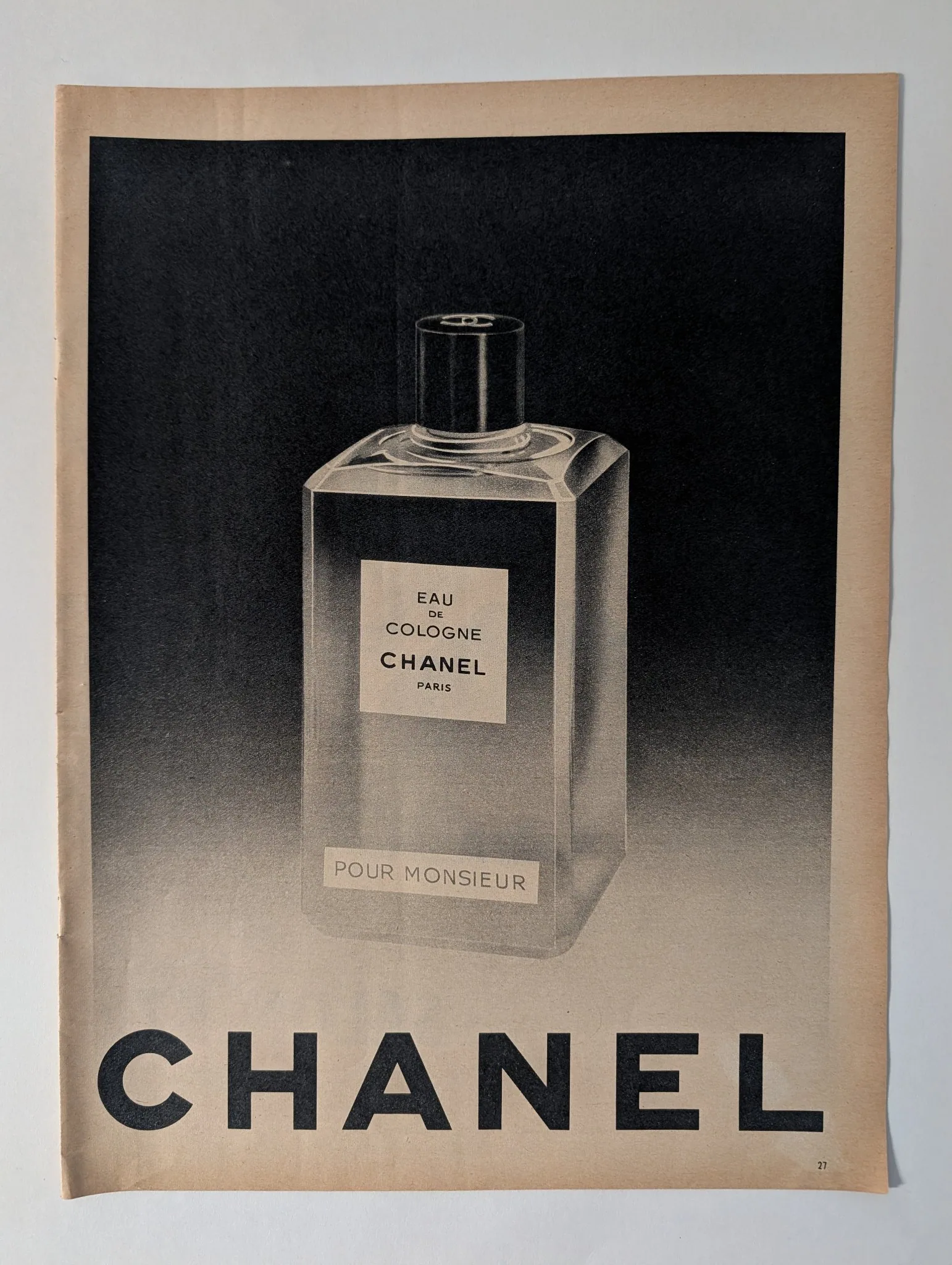
Chanel Pour Monsieur Eau de Cologne Magazine Advertisement
The Record Institute holds the physical page: a single full-page magazine advertisement for Chanel Pour Monsieur Eau de Cologne, printed in black-and-white halftone, from the owner's collection. The page carries no date, no magazine name, no imprint and no credit of any kind; a small folio, "27", at the lower right is its only mark of origin. The Institute catalogues it as a French-market campaign page of the later 1950s: the design is documented in dated copies of 1956 and in sheets spanning 1955 to 1958, but this sheet proves no single year, and the year field is left blank. The image fills the page almost to its edges. Against a field of solid black that softens to grey at the base, a single rectangular bottle stands at monumental scale, its glass built from halftone dots that catch light along the shoulders and fade down the body. The black cap carries the interlocked double-C on its top face. The bottle's plain white label reads "EAU DE COLOGNE", "CHANEL", "PARIS"; a second band low on the glass reads "POUR MONSIEUR". Below the image, the word "CHANEL" is set in bold sans-serif capitals nearly the width of the page. That is all: the page's entire printed text amounts to eight words, plus the folio numeral — no headline, no body copy, no slogan, no price, no claim. Pour Monsieur was launched in 1955, created by Henri Robert, who had succeeded Ernest Beaux as the house perfumer the year before. It was Chanel's first fragrance for men and, as the house still notes, the only men's fragrance created during Gabrielle Chanel's lifetime — a fresh chypre of lemon, spice and woods. The launch belonged to the comeback era: on 5 February 1954, aged seventy-one, Chanel reopened her couture house after fifteen years, coldly received in France but championed by the American press. The revival was financed by Pierre Wertheimer, whose Parfums Chanel — created in 1924 (Wertheimers seventy percent, Théophile Bader twenty, Chanel ten) — was the enterprise's financial engine. The fragrance was not sold under one name: at launch it was "Chanel Pour Monsieur" in France, "Chanel for Men" in the United States and "A Gentleman's Cologne" in Britain; the French name went worldwide only at the 1989 relaunch. This bottle's French lettering therefore places the page in the French-market campaign. Period references list both eau de toilette and eau de cologne versions under 1955, and a collector documents sheets of this exact design — white "eau de cologne" label, "pour monsieur" band low on the bottle — from 1955, 1956, 1957 and 1958. The page's grammar — one product, monumental, alone on an empty field, identified only by its label and an oversized wordmark — continues the graphic language Chanel established for its perfumes in the 1920s. The N°5 label of that era, reading simply "N°5, CHANEL, PARIS" in a plain sans-serif, had been a radical simplification in its day, and Gabrielle Chanel's packaging maxim is recorded as "always remove and never add". The double-C on the cap is the house monogram in its original trademark form, filed in November 1924 and registered in February 1925 for perfume and cosmetic products. Chanel's current description of this presentation — "a bottle swathed in flannel grey: elegant, sober, discreet" — names exactly what the page performs in black and grey. In the curator's reading, the eight-word text is the strategy rather than an economy: the advertisement argues nothing because it presumes a reader who already knows. It offers no notes, no promise, no price — confidence addressed to readers expected to recognise the bottle as readily as the wordmark. Even the printing cooperates: the bottle dissolves into halftone dots at its edges, so the product seems to emerge from the darkness rather than sit in front of it. As evidence, the page works on several levels at once. It is launch-era primary documentation for a landmark product — a house's first men's fragrance, and the only one of its founder's lifetime — printed while the product was new. It records a vanished regime of brand geography: one scent, three names, three markets, decades before a single global name was imposed in 1989. It documents the eau de cologne presentation through which the fragrance was advertised in France in this period. And it is an unusually pure survival of the house's codified visual language: a full-page campaign whose entire copy is the product's own labelling, the restraint itself being the documentable feature. It also testifies to the comeback's economics: perfume, not couture, was the Wertheimer engine that paid for the 1954 revival. What cannot be said matters as much. The exact year of this sheet is unresolved: dated copies of the design belong to 1956 and sheets survive from 1955 to 1958, but nothing printed here chooses among them. The source magazine and issue are unidentified, and the verso has not been examined. No photographer, designer or agency is credited on the page, and none is named in any source consulted; the bottle's designer is likewise undocumented. A published reference crediting the bottle to Jacques Helleu is chronologically impossible — Helleu joined Chanel in 1956 at eighteen and took charge of promotion only in 1965 — and that credit is not repeated here. The class is recorded as B: unsigned, uncredited, mass-campaign work that survives in quantity. What the page lacks in scarcity it returns in clarity — eight words, one bottle, and nothing left to remove. References / Sources S1 — CHANEL, official heritage timeline, 1950s — https://www.chanel.com/my/about-chanel/the-house-of-chanel/1950/ S2 — CHANEL, Pour Monsieur product page — https://www.chanel.com/al/fragrance/p/117460/pour-monsieur-eau-de-toilette-spray/ S3 — Basenotes database statement attributed to Chanel, as quoted on Badger & Blade — https://www.badgerandblade.com/forum/threads/chanel-for-men-what-is-it-now.46571/ ; corroborated by Italian Wikipedia, "Pour Monsieur" — https://it.wikipedia.org/wiki/Pour_Monsieur S4 — Fragrantica.it forum, "Le origini di Chanel Pour Monsieur" (collector testimony) — https://www.fragrantica.it/board/viewtopic.php?pid=41751 S5 — Perfume Intelligence — The Encyclopaedia of Perfume, Chanel house page (EdT/EdC listing only) — http://www.perfumeintelligence.co.uk/library/perfume/2017/17006/houses/Chanel1.htm S6 — PicClick mirrors of eBay France listings (dealer dating of this design to 1956) — https://picclick.fr/Eau-de-Cologne-Chanel-335099130445.html S7 — Wikipedia, "Chanel" (brand), citing USPTO registration records — https://en.wikipedia.org/wiki/Chanel S8 — Wikipedia, "Coco Chanel" — https://en.m.wikipedia.org/wiki/Coco_Chanel ; Wunderlabel, Chanel company history — https://wunderlabel.com/lab/fashion-company-histories/chanel/ S9 — AFP/WWD obituary reporting via The Scented Salamander — http://www.mimifroufrou.com/scentedsalamander/2007/10/jacques_helleu_chanel_artistic.html ; Kinokuniya, Jacques Helleu & Chanel (Abrams, 2006) — https://www.kinokuniya.co.jp/f/dsg-02-9780810943124 S10 — Grafik magazine, "Fifth Element" (Björn Kusoffsky, Stockholm Design Lab) — https://grafik.net/fifth-element/ ; Packly, packaging history of Chanel N°5 — https://www.pack.ly/en/blog/packaging-and-chanel-n5-the-story
Category: Perfume & Cosmetics
Rarity Class: B
Paper & Print Condition
The condition record rests on the owner's photographs of the physical page (photographed 26 October 2026); no separate handling examination has been supplied, and the verso has not been photographed. The object is a single magazine leaf, recto printed in black-and-white halftone. The dot screen is clearly legible in the macro views, building the bottle's glass from a coarse grain that dissolves into the black field at the edges. The sheet shows even age toning across its surface, warmest in the unprinted margins, and a slight waviness along the edges, most visible as a gentle lift at the left margin in the full-page view. The image field itself appears clean: no tears, folds, stains or losses are visible in the photographs. Physical dimensions were not supplied and are not recorded. Assessment is limited to what the photographs show.
Provenance & Rarity
The Institute holds the physical original, a single magazine page from the owner's collection, photographed by the owner; no acquisition documentation was supplied for this record. The page is an original period printing, not a reproduction. Its publication is unidentified: no magazine name, issue or date is printed on the sheet, and the folio "27" at the lower right is the only mark of origin. The design is documented in dated copies of 1956 and in advertisement sheets of 1955 to 1958, and the Institute catalogues the page as a French-market campaign sheet of the later 1950s, with the year field left blank. The rarity class is recorded as B. The page is unsigned and uncredited mass-campaign work produced for wide magazine circulation; copies of this design survive in dealer quantity through the French paper-ad trade, and no survival census exists. Its significance — launch-era evidence for Chanel's first men's fragrance — is documented in the article and is recorded separately from scarcity. No creator is credited on the page, and a published bottle-design credit to Jacques Helleu is chronologically impossible and is not adopted.
Rarity & Condition Summary
Object: Full-page magazine advertisement, French-market campaign; no date printed, catalogued as later 1950s. Condition: Photographed sheet evenly toned with slight edge waviness; image field clean; verso not examined. Rarity: Class B — unsigned mass-campaign page surviving in dealer quantity; documentary significance recorded separately. Uncertainty: Source magazine, issue and exact year of this sheet unidentified.