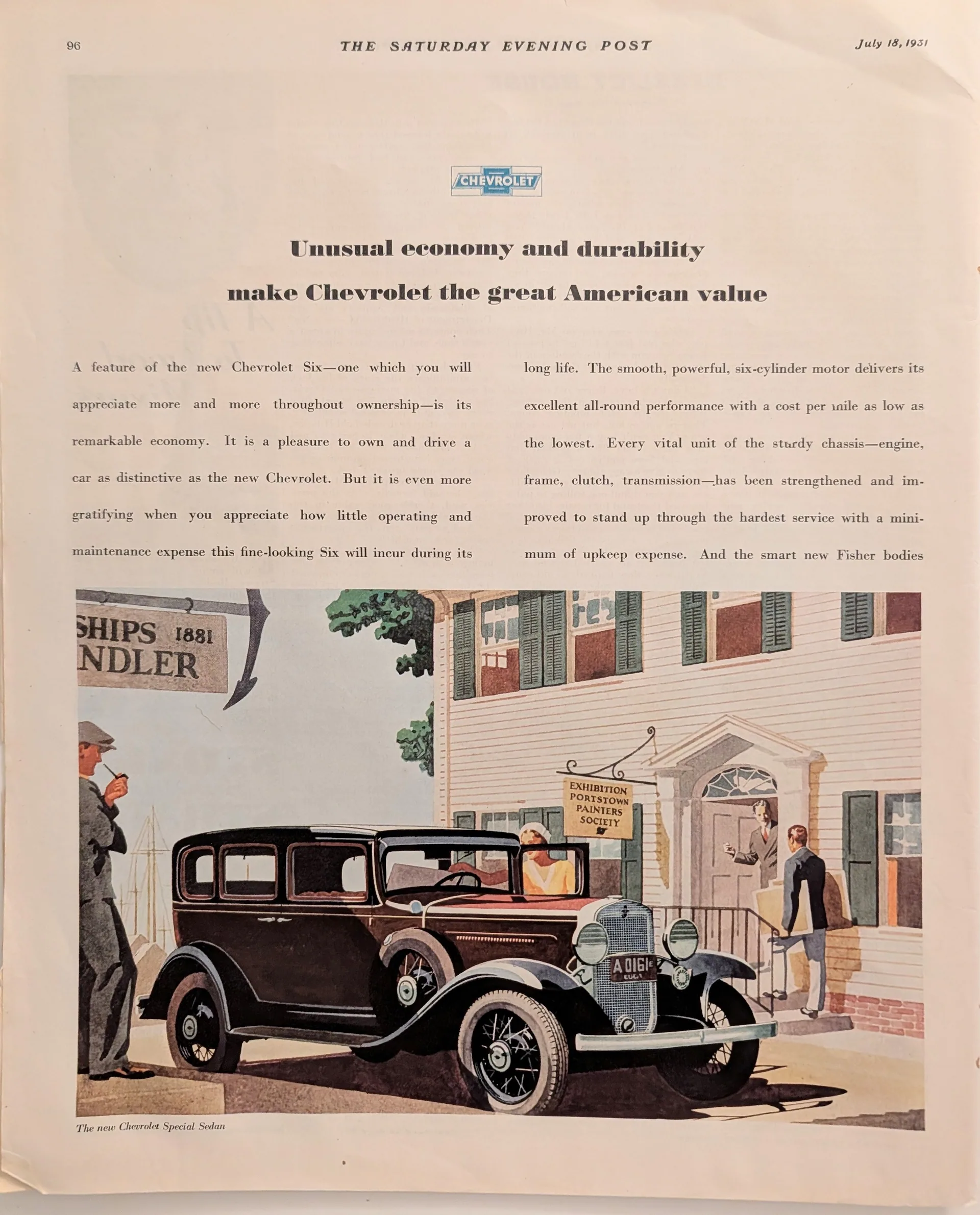
1931 Chevrolet Six Special Sedan — "Unusual Economy and Durability," The Saturday Evening Post, July 18, 1931
This record presents a single original magazine leaf: page 96 of The Saturday Evening Post dated July 18, 1931, carrying a full-page advertisement for the Chevrolet Six [S3]. The leaf is held in The Record Institute's collection and is documented here from the curator's photograph of the physical page. It is an original printed leaf from the 1931 issue, not a reproduction, and its subject is the car the advertisement's own caption names: "The new Chevrolet Special Sedan." The page is built in two registers. Across the top, under the Post's masthead and the printed date, the Chevrolet bowtie sits above a two-line headline: "Unusual economy and durability make Chevrolet the great American value." Below it, two columns of copy argue the case in prose. The text opens on running costs, promising an ownership that grows more satisfying as the owner discovers how little the car costs to run; it credits the six-cylinder engine with performance at "a cost per mile as low as the lowest," states that every vital unit of the chassis — engine, frame, clutch, transmission — has been strengthened, and ends, mid-sentence on this leaf, at the Fisher bodies. The lower half of the page is given to a colour painting. A dark maroon Special Sedan stands before a white clapboard building in a port town: sailboat masts rise behind a pipe-smoking onlooker at the left, beneath a ship chandler's hanging sign dated 1881. The building is hosting an art exhibition — a smaller sign reads "Exhibition, Portstown Painters Society" — and a man is carrying a framed canvas up the steps while the woman at the wheel waits, engine of the scene's quiet errand. No artist's signature or credit appears anywhere on the leaf. The date matters. July 1931 stood deep in the Great Depression, when the American car market had contracted violently and every purchase had to be defended at the kitchen table. Chevrolet's answer was already three years old: in November 1928 it had replaced its four-cylinder car with an overhead-valve six of 194 cubic inches, sold under the banner "a six for the price of a four" [S4][S5]. For 1931 the car became the Series AE Independence, on a wheelbase lengthened to 109 inches, its six rated at 50 horsepower, the closed bodies built by Fisher [S1][S2]. The Special Sedan pictured here stood near the top of the range at 650 USD, and 109,775 were built [S1][S2]. The strategy worked in the only terms 1931 allowed: Chevrolet sold 623,901 cars in the model year and was again the most popular car in America, retaking the lead from Ford; the eight-millionth Chevrolet followed in August [S1][S2][S5]. Read as rhetoric, the page performs a careful double act that the Depression demanded. The painting sells the life the car makes possible — leisure, art, a small harbour town, a woman driving herself to an exhibition — while the copy above it speaks only of thrift, strength and upkeep. Aspiration is pictured; economy is argued. The layout supports the same respectability: a restrained serif headline, generous white space, and the borrowed authority of the Post itself, then America's defining mass-circulation weekly, whose pages had carried automobile advertising since the industry's infancy. Even the setting is chosen with intent. A painters' society exhibition lends the low-priced Chevrolet a cultural polish that its price could not claim on its own, and the ship chandler's sign, dated 1881, anchors the scene in a fifty-year-old continuity of American working life — durability made visible before the headline ever mentions the word. For the archive, the leaf's value is documentary rather than scarce. It preserves, on one page, the exact moment when American car advertising turned from the exuberance of the 1920s to the defensive arithmetic of the Depression, and when a six-cylinder engine at a four-cylinder price became the argument that decided the industry's leadership. It also records the period's commercial art at work anonymously: a fully realised narrative painting, unsigned and uncredited, doing the persuasive heavy lifting for the text above it. Single leaves like this one survive because they were cut from bound volumes and traded as decoration; documented with their issue, page and date intact, they remain primary evidence of how the Depression was sold to, one household at a time. What remains unknown is stated plainly. The painter of the Portstown scene has not been identified, and the leaf offers no credit from which to start. The advertisement's copy ends mid-sentence on this leaf, and any continuation is not held with it. Condition and provenance are recorded in the placard fields from the evidence available: the curator's photograph, and the leaf's place in the collection. Within those limits, the page is complete in itself — masthead, date, argument, painting and caption all present — a small, dated artefact of the year Chevrolet learned to sell economy as a form of pride. References / Sources: S1 — Hemmings, "1931–32 Chevrolets: A Look Back at Iconic American Cars," Hemmings. https://www.hemmings.com/stories/1931-32-chevrolets/ S2 — Hagerty Valuation Tools, "1931 Chevrolet Independence." https://www.hagerty.com/valuation-tools/chevrolet/independence/1931/1931-chevrolet-independence S3 — The Saturday Evening Post, issue archive, July 18, 1931. https://www.saturdayeveningpost.com/issues/1931-07-18/ S4 — Mac's Motor City Garage, "Reinventing the Low-Price Field: The 1929 Chevrolet Six." https://macsmotorcitygarage.com/reinventing-the-low-price-field-the-1929-chevrolet-six/ S5 — HISTORY, "24 Cars That Made America." https://www.history.com/articles/the-cars-that-made-america
Category: Cars
Year: 1931
Rarity Class: B
Paper & Print Condition
This record rests on a single magazine leaf, assessed from the curator's straight-on photograph of the page; no separate in-person examination record accompanies this draft, and the verso is not documented. The leaf shows the even, warm toning expected of a 1931 newsprint-grade magazine page, with strong, unfaded colour in the painted illustration and crisp, legible letterpress text throughout. A crease crosses the top-right corner of the sheet, and there is minor wear at the lower-left edge; no tears, losses or repairs are visible within the photographed area. The painting's printed surface reads as a smooth colour reproduction with no visible halftone disruption at photographic resolution. The assessment is limited to what the photograph shows: paper weight, texture and any verso markings remain unrecorded, and the condition statement should be revised if the leaf is examined directly.
Provenance & Rarity
The leaf is page 96 of The Saturday Evening Post for July 18, 1931, confirmed by the masthead, folio and printed date on the page itself and by the Post's own issue archive [S3]. It is an original leaf from that issue, not a facsimile or later reprint, and it is held in the founder's collection of pre-2000 printed ephemera; the specific acquisition history of this leaf was not supplied for this draft and is recorded as an open item rather than reconstructed. The rarity class assigned is B, as curatorial judgment on the Institute's own scale. The Saturday Evening Post was among the highest-circulation weeklies in America and Chevrolet bought full-page space in it regularly, so the advertisement was printed in very large numbers; but the Institute's method weighs survival and historical context alongside print numbers, and a complete pre-war leaf of 1931 — masthead, folio, date, argument, painting and caption all present — stands at the base grade the archive gives surviving pre-war print. The painting is unsigned and uncredited, so no attribution-based uplift applies, and nothing in the campaign's history supports a higher class. The leaf's particular interest is documentary: a dated, complete example of Depression-era value advertising from Chevrolet's sales-lead year.
Rarity & Condition Summary