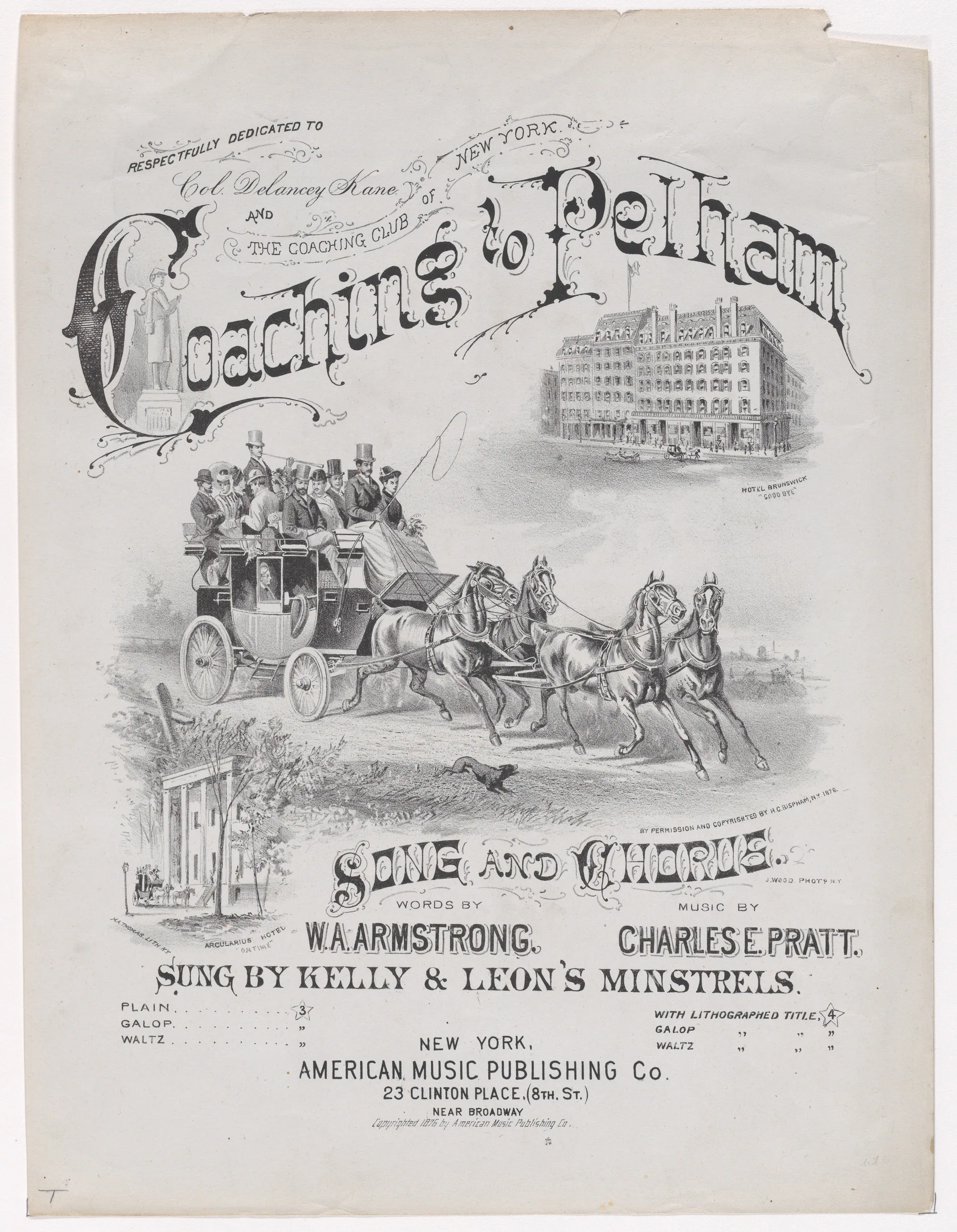
Coaching to Pelham, 1876: The Sheet-Music Cover That Sold a Horse-Drawn Craze
The sheet reproduced here is the cover of Coaching to Pelham, a song and chorus published in New York in 1876 by the American Music Publishing Company and preserved today by the Metropolitan Museum of Art. The Museum catalogues it as a lithograph — a sheet of 14 by 10 9/16 inches — by the New York lithographer Henry A. Thomas, with words by W. A. Armstrong and music by Charles E. Pratt, from the Edward W. C. Arnold Collection of New York prints. Nothing about it was meant to last: it is the wrapper of a topical song, printed to sell in the season of a craze; that it survives whole is the accident on which this entry rests. The cover is a small itinerary disguised as a picture. At the top the title swells across the sheet in enormous ornamented letters, beneath an arched dedication: "Respectfully dedicated to Col. Delancey Kane of New York and the Coaching Club." At the centre, a road coach packed with passengers in top hats and bustles gallops behind four horses; the whip sits up front, reins in one hand, the long whip curling overhead; a bugler rides at the back, and a dog races the wheels. Two vignettes plot the journey's ends. Upper right, a palatial hotel is captioned "Hotel Brunswick — 'Good Bye'"; lower left, a columned hotel, a coach drawing up, is captioned "Arcularius Hotel — 'On Time'". Below the scene the sheet returns to business: Song and Chorus; the credits; "Sung by Kelly & Leon's Minstrels"; the publisher's address at 23 Clinton Place, near Broadway; and a table offering the property plain, and "with lithographed title"; as the song, as a galop, as a waltz. To understand the cover, start with the parlour. In the 1870s the song trade ran on paper: a song was a sheet, sold over a counter and carried home to a piano, and its cover was the publisher's only advertising — displayed in the music-shop window, then kept on display at home while the song lasted. Publishers answered with lithography and topicality — a pictured cover tied to whatever the city was talking about. The same property was hedged three ways — song and chorus for the voice, galop and waltz for the feet — and the cover's own price table asks more for the edition "with lithographed title" than for the plain one. The picture was not decoration on the product: in the shop window it did a poster's work at parlour scale. What New York was talking about in 1876 was coaching. The Coaching Club of New York had been founded the year before, in 1875 — Colonels William Jay and DeLancey Kane its leading spirits — to revive four-in-hand driving as a sport on the English model: not transport but theatre, a scheduled public coach driven by an amateur whip. In the spring of 1876 Kane put his bright yellow road coach, the Tally-ho, on America's first public coaching run, from the Hotel Brunswick on Madison Square to Arcularius' Hotel at Pelham Bridge, some twenty miles run to time; The Sun was previewing the first trips at the end of April 1876. The song arrived in the same season and knows its subject exactly: "Take the coach for Pelham / Hark! the bugler sounds the call." The dedication folds the sport's most famous whip and his club into the sheet as endorsements, the hotel captions turn the timetable into a joke — "Good Bye" at the Brunswick, "On Time" at Pelham — and Kelly & Leon's Minstrels certify the song as stage-tested, completing the circuit from road to theatre to parlour piano. Thomas's lithography — credited in the stone, "H. A. Thomas, Lith., N.Y." — does the selling in a single glance. The coach is drawn at the gallop, hooves stretched and crayon shading streaking past, because the song itself is set at a gallop's tempo; the passengers are not travellers but an audience in evening dress, riding on the roof. The picture's real subject is not the vehicle but the event, and the lettering does the rest: a title large enough to read across a shop, a dedication that borrows the Coaching Club's glamour, and two hotels that turn a twenty-mile pleasure drive into a map. It is an advertisement — for the song, for the run, and for the fashionable world that rode it. The Institute files the record as Class B. This was a commercial lithograph printed for a topical hit, an edition meant to be large and to be used up; complete impressions retaining the dedication, the price table and both hotel vignettes are uncommon survivors of a format that was pasted up, played from and thrown away. It is not Class A: the artist is a credited trade lithographer rather than a name of the affiche era, and the image a fine specimen of its kind rather than a landmark of it. Two limits belong on the record. The plate carries two small credits — "By permission and copyrighted by H. C. Bispham, N.Y. 1876" and "J. Wood, Phot., N.Y." — which suggest the coach scene was drawn after a photograph, but their roles are not established in the sources consulted, and nothing further is asserted about them. And the price table's figures are printed without a currency unit; only the relative prices are stated here. ### References / Sources [S1] The Metropolitan Museum of Art — object 380952, accession 54.90.889: catalogue data, constituents (publisher, lithographer, composer, lyricist), credit line, and Open Access status. [S2] The Frick Pittsburgh — "Coaching Four-in-Hand: Sport Driving for the Gilded Age Gentleman" (2019): Kane's Tally Ho and America's first public coaching run, 1876; the Brunswick-to-Pelham route of about twenty miles. [S3] Historic Pelham (Blake Bell) — research on the Pelham Coach and the Arcularius Hotel at Pelham Bridge, citing The Sun, 30 April 1876, and citing this sheet music among its sources. [S4] Flatiron NoMad Partnership — "The Coaching Club": the club founded 1875 at Madison Square, headquartered at the Brunswick Hotel; Kane's Tally-ho run of 1876; the song "Coaching to Pelham" and its opening lyric. [S5] Coaching Club history (4score.org) — the club's founding in 1875 by nine gentlemen, Jay and Kane the leading spirits; Kane as pioneer of public coaching in America. [S6] The score itself — "Coaching to Pelham", words by W. A. Armstrong, music by Charles E. Pratt, 1876: opening lyric; marked Tempo di Galop.
Category: Music & Entertainment
Year: 1876
Rarity Class: B
Provenance & Rarity
American Music Publishing Company (publisher) · Coaching to Pelham · New York, 1876 — Lithographed sheet-music cover by Henry A. Thomas; words by W. A. Armstrong, music by Charles E. Pratt. Dedicated to Col. Delancey Kane and the Coaching Club, whose yellow Tally-ho made America's first public coaching run that spring — the Brunswick at one end of the picture, Pelham at the other. The Metropolitan Museum of Art, 54.90.889.