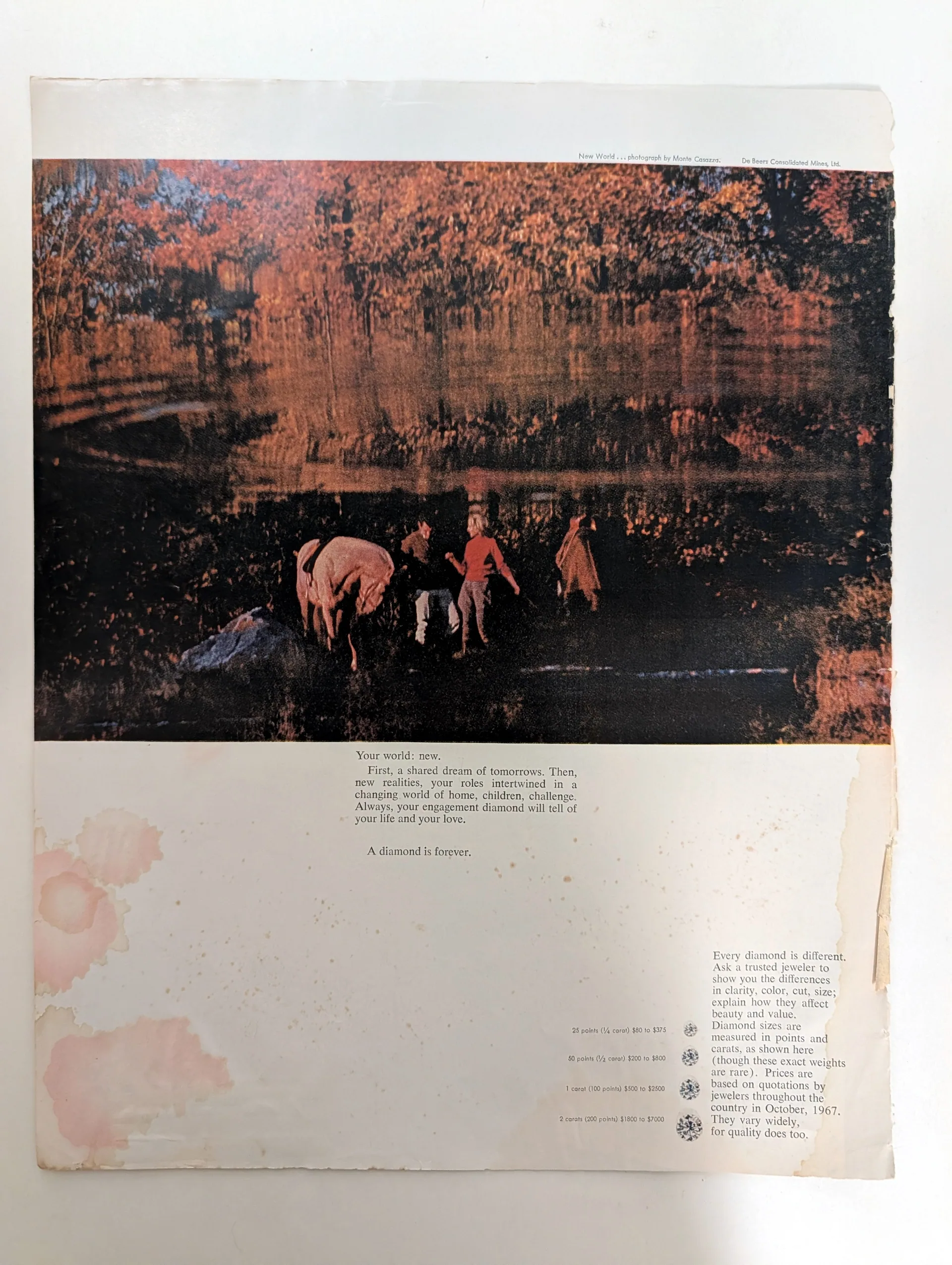
c. 1967–1968 De Beers "A Diamond Is Forever" Magazine Advertisement
*Paragraph 1 — Visual Description:* The supplied images show a full-page vertical color magazine advertisement divided into two horizontal zones. The upper zone, occupying roughly the top three-fifths of the sheet, is a full-bleed night photograph: a young couple stands with two horses at the edge of a dark wood at dusk, trees with red autumn foliage rising behind them against a near-black ground. The figures are small in the frame, the mood set by heavy dark tones, warm reds in the foliage, and low-key contrast. The lower zone is an open field of off-white paper carrying three text blocks. Left of center, set in a plain serif, the headline reads "Your world: new." followed by a short body paragraph and the tagline "A diamond is forever." At lower right, a smaller two-column text panel headed "Every diamond is different" runs beside a vertical column of four round diamond vignettes, each paired with a price line: 25 points (¼ carat) $80 to $375; 50 points (½ carat) $200 to $800; 1 carat (100 points) $500 to $2500; 2 carats (200 points)
800 to $7000. A small vertical credit line runs along the right edge of the photograph area. In the supplied views the sheet shows pinkish water-stain blotches across the lower left, scattered small foxing spots through the text field, edge wear at the top right corner, and general toning of the paper. *Paragraph 2 — Printed Text & Marks:* The headline, body, and tagline transcribe as follows: "Your world: new. / First, a shared dream of tomorrows. Then, new realities, your roles intertwined in a changing world of home, children, challenge. Always, your engagement diamond will tell of your life and your love. / A diamond is forever." The side panel reads in full: "Every diamond is different. Ask a trusted jeweler to show you the differences in clarity, color, cut, size; explain how they affect beauty and value. Diamond sizes are measured in points and carats, as shown here (though these exact weights are rare). Prices are based on quotations by jewelers throughout the country in October, 1967. They vary widely, for quality does too." The four price lines are transcribed in ¶1. The vertical credit at the photograph's edge reads: "New World ... photograph by Monte Casazza. De Beers Consolidated Mines, Ltd." This is an observed printed credit: it records that the advertisement credits the photograph to the name Monte Casazza and names De Beers Consolidated Mines, Ltd. as the advertiser. It is not a verified photographer attribution. The printed "October, 1967" dates the price quotations, not the advertisement's issue — the issue date of the magazine in which this ad ran is not printed on the artifact. *Paragraph 3 — Maker Context:* The advertiser is identified by the printed credit as De Beers Consolidated Mines, Ltd., treated here at the minimum the credit supports: the company named as the advertiser of this page. The photograph is credited in print to the name Monte Casazza; no biographical claim is made about that name, and the credit is transcribed as observed, not verified as an attribution. No advertising agency is named on the artifact. No artist, art director, or copywriter signature appears. The photograph's series title, as printed, is "New World." The status of every maker claim on this record is therefore Unidentified as to the individual maker, with the corporate advertiser named only as a printed credit. *Paragraph 4 — Geographic & Audience Context:* The advertisement's copy is priced in US dollars and refers to "jewelers throughout the country," which probably indicates circulation in the United States — an inference stated here as probable and requiring downstream verification, not as a printed fact. The country of publication is not printed on the artifact. The intended audience, as the copy itself defines it, is couples approaching engagement: the text addresses "your engagement diamond" directly and frames the purchase around "home, children, challenge." The price panel's October 1967 quotations anchor the ad to the late 1960s American bridal market, a period in which the diamond engagement ring was an established consumer expectation (contextual — verify downstream). The magazine in which the advertisement appeared is not identified on the artifact; its title, issue date, and readership are unresolved. *Paragraph 5 — Visual Language Analysis:* The design works by contrast between image and text: a dark, romantic, full-bleed photograph set against a wide field of empty white paper, with the typography kept small, plain, and widely spaced. The photograph does not show a diamond at all — the selling is done by association, the couple with horses standing in for the life the stone is meant to witness. The four small diamond vignettes beside the price table are the only product imagery on the page, and they function as specimens in a consumer-education display rather than as objects of desire. This visual economy — a single dominant photographic image, minimal serif typography, generous white space, and a restrained two-zone layout — shares the visual language of 1960s print advertising's photographic turn (possible formal resonance with Pop Art — see field 19), while the disciplined hierarchy of headline, body, tagline, and small-print price table reflects the era's restrained typographic planning (possible formal resonance with Swiss Style / International Typographic — see field 19). The copy's register is intimate and second-person, a voice addressing the reader's private future rather than describing a product's features. *Paragraph 6 — Function & Archival Significance:* The page functioned as brand advertising for a diamond company that, in this campaign, sold the category of the engagement diamond rather than any specific stone: no retailer is named, no stone is offered for sale, and the reader is directed to "a trusted jeweler." The price panel performs a second function, consumer education presented as transparency — teaching points, carats, and the 1967 quotation ranges while disclaiming that "these exact weights are rare." For the archive, the panel's printed October 1967 quotations are the artifact's documentary core: a dated schedule of quoted retail price ranges for four diamond weights, preserved in the advertiser's own words. The page also documents the long-running "A diamond is forever" campaign's late-1960s register — the tagline is associated with De Beers' campaign of the period (contextual — verify downstream) — and the photographic style of aspirational domesticity through which the industry addressed engaged couples. The loose-leaf state of the photographed sheet reveals nothing about the original magazine's identity or the ad's placement within it.
Category: Jewelry
Year: 1967
Rarity Class: A
Paper & Print Condition
The photograph area shows resolvable halftone dot structure in the supplied detail views — positive evidence of a screened photographic reproduction, with the dot pattern clearly visible in the foliage and dark ground. The image carries the deep blacks, warm reds, and amber highlights of a four-color process reproduction of a color transparency, with tone gradation continuous across the dusk sky and the horses' coats. The text field is printed in a single black pass over off-white paper that shows general toning, pinkish water-stain blotches across the lower left, scattered small brown foxing spots through the white field, and edge wear at the top right corner. The printed key lines of the small text appear visually crisp at the supplied resolution. Likely process: probable four-color offset halftone lithography (physical examination required for confirmation). Confidence: Moderate. A plausible alternative is letterpress halftone, which is ranked less likely because the fine dot structure and smooth tone gradation are consistent with the offset-lithographic standard for color magazine advertising of the late 1960s; letterpress cannot be excluded from a digital proxy. Minimum distinguishable colour separations resolvable in the supplied image: 4 (cyan, magenta, yellow, black process behavior in the photograph, plus the black text pass). This is a floor, not a count. No storage or handling history is inferred from the staining and foxing.
Provenance & Rarity
Source media observed: a single full-page color magazine advertisement leaf for De Beers, photographed as a loose sheet; the magazine of origin is not identified on the artifact. The original acquisition record, prior ownership, and the circumstances of the leaf's separation from its issue are undocumented in the supplied material: [AWAITING CURATORIAL ASSIGNMENT]. No rarity assessment is made here: [AWAITING CURATORIAL ASSIGNMENT — C–OMEGA scale]. No comparative survival claim is advanced for late-1960s magazine advertising leaves without documented holdings data.
Rarity & Condition Summary
The sheet survives as a complete single leaf with the full advertisement — photograph, headline, body copy, tagline, price panel, and photo credit — intact and legible. The paper is toned, with pinkish water-stain blotches across the lower left, scattered foxing spots in the text field, and edge wear at the top right corner; the photographic image itself remains readable with its dark tones and red foliage distinguishable. The four diamond vignettes and their price lines remain individually legible, and the vertical photo credit along the photograph's edge is readable in the supplied detail view. The rarity half of this summary is [AWAITING CURATORIAL ASSIGNMENT]; nothing in the observed condition is used here to imply scarcity or to grade the object.