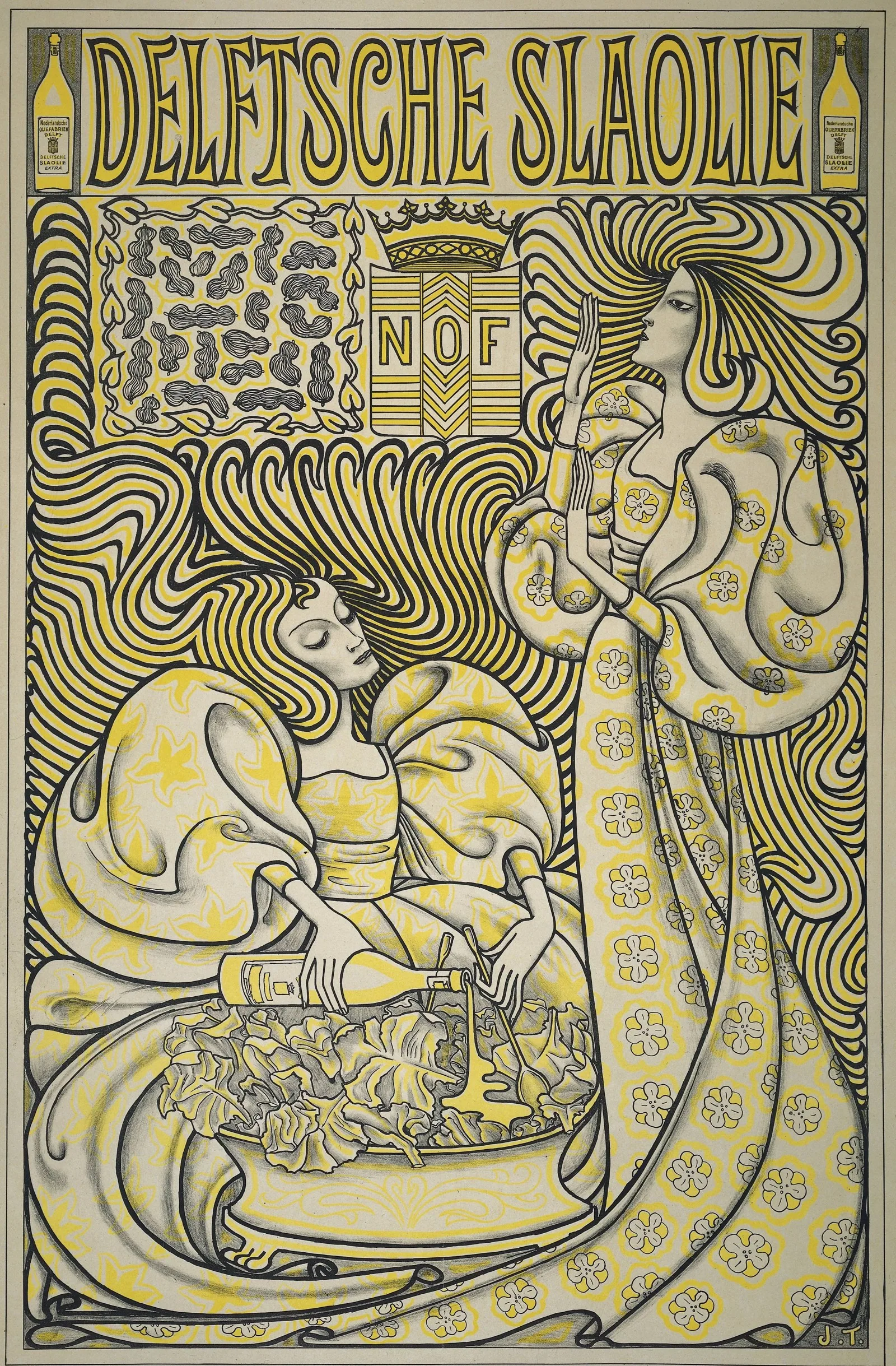
Delftsche Slaolie — Jan Toorop's Salad-Oil Poster, 1894
This record presents the most famous Dutch advertising poster of the nineteenth century: Jan Toorop's poster for Delftsche Slaolie — Delft salad oil — dated 1894 by the Rijksmuseum in Amsterdam, which holds the impression reproduced here (object RP-P-1912-2395) and releases its image as public domain [S1]. It is a colour lithograph on a sheet 950 by 625 millimetres — poster scale, made for walls and hoardings, not for the hand [S1]. The Record Institute presents the Museum's image with credit; the sheet itself is in Amsterdam, purchased by the Rijksmuseum in 1912, while the poster was still within living memory of the streets it decorated [S1]. Read the sheet from the top. DELFTSCHE SLAOLIE runs across the head in heavy lettering, flanked at the corners by drawn bottles of the oil — their labels, legible in the Museum's scan, read "Nederlandsche Oliefabriek Delft / Delftsche Slaolie Extra". Below the headline sits the crowned coat of arms of the Nederlandsche Oliefabriek, the NOF, and at the left a decorative field of peanuts — the raw material of the oil, sourced, as the Museum of Fine Arts, Boston notes, from Indonesia [S1][S3]. Then the poster gives itself over to its two women. They occupy most of the composition: elongated figures with wavy hair and billowing draperies, drawn in emphatic contour. One sits dressing a lettuce salad in a large container; the other raises her gaze and her hands. The Rijksmuseum's own description makes the poster's paradox plain: "The women with their emphatic contours draw attention away from the actual advertisement, namely for the salad oil" [S1]. At the lower right, small in the printing, sits the artist's monogram: "J. T." [S1][S2]. The commission was industrial. The Nederlandsche Oliefabriek, an oil manufacturer in Delft, commissioned the poster, and it was not the company's only approach to artists: the NOF also asked Theo van Hoytema to design advertising material, including the wooden boxes for the salad-oil bottles [S1][S5]. The printing is attributed to S. Lankhout & Co. of The Hague — an attribution the Rijksmuseum record does not itself make, but which the Museum für Kunst und Gewerbe Hamburg and the Minneapolis Institute of Art both record for their impressions [S2][S6]. The poster was issued in three colour combinations; the Rijksmuseum's impression is the yellow-and-black version, the one whose two inks — a acid yellow against deep black — give the sheet its poster-flat power [S4]. Those women carry the artist's own geography. Jan Toorop (1858–1928) was born in Poerworedjo, Java, in the Dutch East Indies, and settled in the Netherlands at the age of eleven; the elongated figures of the Slaolie poster were inspired by Javanese shadow puppets — the wayang — their garments carry yellow batik-inspired designs, and their hands recall Balinese dance [S3][S4]. A Dutch factory selling oil pressed from Indonesian peanuts commissioned, perhaps without knowing it, a poster in which the colony that supplied the raw material also supplied the style. The result outgrew its product entirely. The poster, the Rijksmuseum records, "became an icon and lent Dutch Art Nouveau its nickname, the 'salad oil style'" — slaoliestijl; Sotheby's calls it "the icon of Dutch advertising art" [S1][S4]. Few advertisements in history have named the art movement of a nation. The limits of this record are stated plainly. The date itself is a small lesson in cataloguing: the Rijksmuseum dates its impression 1894 and this record follows the holding institution, but Hamburg and Minneapolis date their copies 1895, and Dutch sources give creation 1893–94 with publication in 1894; no primary document from the NOF or the printer was consulted, and the spread is recorded in the evidence ledger rather than resolved [GAP-03]. The printer attribution rests on the Hamburg and Minneapolis records, not on the Rijksmuseum's own [GAP-02]. No print run, price or distribution figure survives in the sources consulted, and none is claimed [GAP-04]. And no design drawing by Toorop for this poster was found at the Rijksmuseum — the only "design for a Delftsche Slaolie poster" in its collection is a later woodcut by another artist, Reijer Stolk, which this record deliberately does not show, because to illustrate Toorop's process with Stolk's sheet would be a false credit [GAP-01]. What remains is the sheet itself: two women, a bowl of salad, and a bottle of oil promoted, by sheer line, into the emblem of a style. References / Sources [S1] Rijksmuseum, Amsterdam — object record RP-P-1912-2395, "Poster for Delft Salad Oil", Jan Toorop, 1894 — rijksmuseum.nl/en/collection/object/Poster-for-Delft-Salad-Oil--ae832e88fb6f53506d08db16cfd2d6ef [S2] Museum für Kunst und Gewerbe Hamburg — object EP2013.969, "Delftsche Slaolie" — mkg-hamburg.de/en/sammlung/objekt/delftsche-slaolie-nederlandsche-oliefabriek-delft/EP2013.969 [S3] Museum of Fine Arts, Boston — "Salad-Oil Style", Art & Antiques Magazine — artandantiquesmag.com/dutch-graphic-design/ [S4] Sotheby's — Dutch Modernism: The Schiller-David Collection, lot 163 (catalogue note on the Toorop Slaolie poster) — sothebys.com [S5] Museum Prinsenhof Delft — exhibition text, "From Art Nouveau to Modernism" — kunstconsult.com/Blog/From-Art-Nouveau-to-Modernism-The-second-Golden-Age-of-Delft [S6] Minneapolis Institute of Art — object P.98.33.108, "Delft Salad Oil" — collections.artsmia.org/art/67480 Image credit — every image in this record: Jan Toorop (1858–1928), Poster for Delft Salad Oil ("Affiche Delftsche Slaolie"), 1894. Colour lithograph, 950 × 625 mm. Rijksmuseum, Amsterdam (object no. RP-P-1912-2395). Public domain. Detail views are crops of the Rijksmuseum's image of the same impression.
Category: Art & Museums
Year: 1894
Rarity Class: A
Paper & Print Condition
The record is a digital presentation made from the Rijksmuseum's published image of its impression; no physical handling by this Institute is claimed. In that image the sheet presents complete and striking: the yellow ground is flat and even, the black contour drawing is crisp at enlargement, the headline lettering, bottle labels and the crowned NOF crest are all legible, and the artist's printed monogram "J. T." reads at the lower right. The Rijksmuseum catalogues the sheet at 950 × 625 mm, colour lithograph, acquired by purchase in 1912. Condition beyond what the image shows is the holding institution's to state, and is not asserted here.
Provenance & Rarity
The poster was commissioned by the Nederlandsche Oliefabriek of Delft and printed, on the attribution of the Hamburg and Minneapolis records, by S. Lankhout & Co., The Hague. The impression presented here entered the Rijksmuseum by purchase in 1912 (object RP-P-1912-2395) and remains in Amsterdam; other impressions are held by the Museum für Kunst und Gewerbe Hamburg and the Minneapolis Institute of Art. The Record Institute presents the Rijksmuseum's public-domain image for study, with the credit above, and claims no ownership of the object. Rarity is assessed as Class A under the Institute's method: a large-format colour lithograph of 1894, a fragile wall medium with the survival profile of its kind, and the single most consequential poster in Dutch advertising history — the work that named the slaoliestijl. The artist's monogram is part of the printed design; under the Institute's rule a printed signature earns no uplift, and none is applied. No auction prices are cited.
Rarity & Condition Summary