Dinner at Delmonico's — The Chamber of Commerce Banquet Menu, 15 November 1892
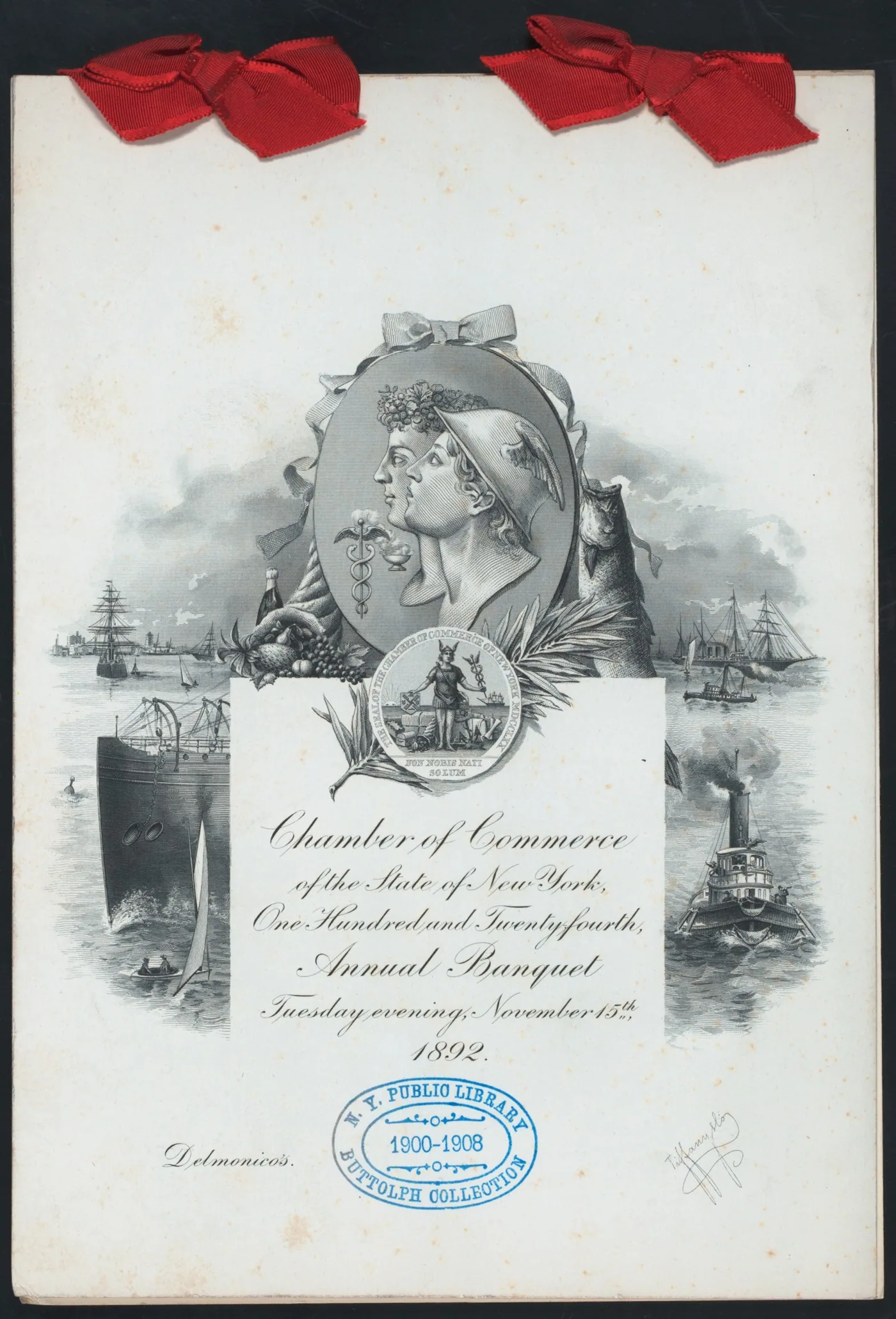
This record presents a dinner. On Tuesday evening, 15 November 1892 — the weekday checks against the calendar, and against the menu's own "Mardi" — the Chamber of Commerce of the State of New York held its one hundred and twenty-fourth annual banquet at Delmonico's, and this folder menu, 9 by 6¼ inches, tied at the top with two red ribbons, is what the diners held [S1]. It survives in the Buttolph Collection of menus at The New York Public Library, which states its belief that the item is in the public domain under the laws of the United States; the Institute presents the Library's images with the credit the Library requests [S1]. The restaurant's street address is not recorded in the item data, and this record does not supply one [GAP-01]. Begin with the cover, because the menu does. It is a steel engraving: a view of New York Harbor taken from the Battery, steamships and sailing vessels and a tug around a great steamship's bow, and at the centre an oval medallion carrying two profile heads — Mercury, god of commerce, and Bacchus, god of feasting — with a caduceus and a bowl beside them, a cornucopia and a codfish at the base, and below, the seal of the Chamber of Commerce, its motto NON NOBIS NATI SOLUM [S1]. At the lower right, in script, an imprint reads "Tiffany & Co." — the only attribution the cover carries; the Library's record names no engraver, and the imprint is reported here as observed, not as a catalogue fact [GAP-02]. Unusually, the menu explains itself: the leaf opposite the cover decodes the whole design in the house's own words, down to the caduceus "with its meaning of prudence and diligence" — printed here in the image set, because an artifact that annotates its own symbolism is doing half the cataloguer's work [S1]. Turn to the dinner. It is printed in blue ink, in French — the period's language of the table — and it is a fixed banquet: no prices appear anywhere on the menu, because nobody at this table was paying by the dish [S1]. Oysters. Consommé Plumercy and clear green turtle soup. Timbales à la duchesse. Aiguillettes of bass, italienne, au gratin; filet of beef Montebello with cauliflower au Parmesan; poularde à la Toulouse; terrapin à la Baltimore. Then, exactly where a modern menu would pause for breath, the evening names its moment: SORBET COLOMBUS — spelled as printed, with one u — served five weeks after New York's Columbian Celebration of October 1892, when the city marked four hundred years since Columbus's landfall and unveiled the Columbus Monument at Columbus Circle on 12 October [S1][S3]. The menu gives the sorbet no explanation; it did not need one. After it: canvas-back duck and partridges, lettuce salad; sweet entremets — Pommes au praslin, spelled as printed, gelée ananas californienne, méringue bavaroise, pièces montées, glaces fantaisies, fruits, petits fours, café; and a wine column that runs Haut Sauternes, Sherry, Pontet Canet, Champagne, Volnay, liqueurs, Apollinaris [S1]. The footer closes the document like a letter: left, "Mardi, le 15 Novembre, 1892." Right: "DELMONICO'S." The house behind the name needs little invention. John and Peter Delmonico, Swiss brothers from Ticino, began in 1827 with a shop at 23 William Street selling cakes, ices and fine wines; in 1837 they opened their restaurant at Beaver, William and South William Streets, among the first in America to let a diner order from a menu at any hour, à la carte — its 1838 menu ran to eleven pages [S2]. Through the Gilded Age Delmonico's was the premier New York room for elite banquets, the house that set the trends the country aspired to — which is why a body like the Chamber of Commerce held its annual dinner there [S2]. The original Delmonico's closed in 1923, under high rents and Prohibition [S2]. And the survival behind the sheet is a woman with a stamp. Frank E. Buttolph began her menu project on 1 January 1900, after a lunch at the Columbia Restaurant; writing to the library that February, she proposed that "it might be interesting to file a bill of fare at the library", and within months 930 menus had passed through her hands [S4]. Over some twenty-three years she gathered about 25,000 menus for the Library, soliciting them by letter and through the trade press, and stamping nearly every one — the blue oval on this menu's cover and back, "N. Y. PUBLIC LIBRARY / 1900-1908 / BUTTOLPH COLLECTION", is her mark; the dates are the stamp's, not the menu's [S4]. The collection has since grown to some 45,000 menus in the Rare Book Division, among the largest in the world, and since 2011 the Library's "What's on the Menu?" project has had volunteers transcribing its dishes [S4][S5]. The folder, the Library notes, holds two identical copies of this menu; the digitised item shows one complete unit — cover, explanation, menu, back — and whether the twin was digitised separately is not shown [GAP-04]. No guest list, speeches or prices survive in the item data, and none are invented here [GAP-05]. What survives is better: the dinner itself, in French, in blue ink, with its sorbet misspelled by history. References / Sources [S1] The New York Public Library, Rare Book Division — Digital Collections item 62abb640-c531-012f-d36b-58d385a7bc34, Buttolph Collection (shelf locator 1892-0132) — digitalcollections.nypl.org/items/62abb640-c531-012f-d36b-58d385a7bc34 [S2] Museum of the City of New York — "A Citadel of Food: Delmonico's" and "The origins of dining out in New York City" — mcny.org; blog.mcny.org/2014/12/10/the-origins-of-dining-out-in-new-york-city/ [S3] Dvořák American Heritage Association — "Dvořák's Arrival" (on New York's Columbian Celebration, October 1892) — dvoraknyc.org/dvoraks-arrival [S4] The New York Public Library — "The Queen B: Miss Buttolph and Her Menus" (Rebecca Federman, 2011) — nypl.org/blog/2011/04/28/queen-b-miss-buttolph-and-her-menus [S5] The New York Public Library — "What's on the Menu?" research support page — nypl.org/research/support/whats-on-the-menu Image credit — every image in this record: From The New York Public Library (Rare Book Division, The Buttolph Collection of menus, shelf locator 1892-0132) — digitalcollections.nypl.org/items/62abb640-c531-012f-d36b-58d385a7bc34. Detail views are crops of the Library's images of the same menu.
Category: Food & Beverage
Year: 1892
Rarity Class: B
Paper & Print Condition
The record is a digital presentation made from The New York Public Library's images of the menu; no physical handling by this Institute is claimed. In those images the folder presents complete: the steel-engraved cover is crisp, its harbour view, medallion and seal all legible, the red ribbons bright at the top, and the script "Tiffany & Co." imprint readable at lower right; the menu page's blue letterpress ink is even and fully legible throughout, course by course; the Library's blue Buttolph Collection stamp appears on the cover and the blank back, with pencil shelf marks. The Library catalogues the object as an illustrated folder, 9 × 6.25 inches, and notes two identical menus in the folder. Condition beyond what the images show is the holding institution's to state, and is not asserted here.
Provenance & Rarity
The menu was produced for the 124th Annual Banquet of the Chamber of Commerce of the State of New York at Delmonico's on 15 November 1892, and survived into the Buttolph Collection of menus assembled by Frank E. Buttolph for The New York Public Library from 1900 onward; her blue accession stamp is on the cover and back, and the menu remains in the Library's Rare Book Division (shelf locator 1892-0132; the folder holds two identical copies). The Record Institute presents the Library's images for study, with the credit above, and claims no ownership of the object. Rarity is assessed as Class B under the Institute's method: single-evening banquet paper is ephemera in its purest state — printed for one dinner, kept by almost nobody — and this sheet's survival is the deliberate act of one collector; set against that, menus as a class are preserved institutionally in very large numbers, and this is a documented, multiply-held example rather than a singular survival. The Tiffany & Co. line on the cover is a printed engraver's imprint; under the Institute's rule a printed signature earns no uplift, and none is applied. No prices are cited, because the menu prints none.
Rarity & Condition Summary