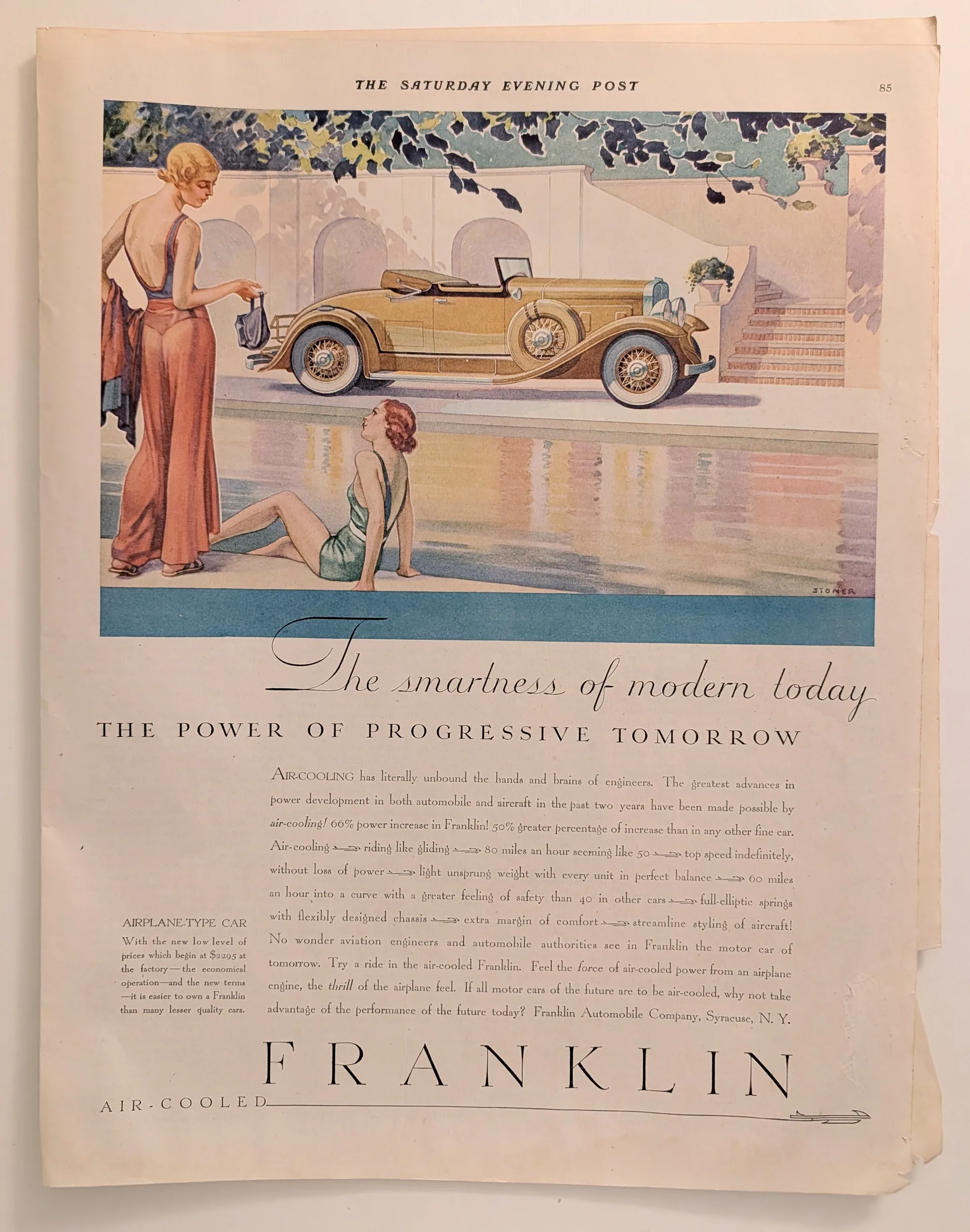
Franklin "Airplane-Type Car" Advertisement with Signed "Stoner" Illustration (The Saturday Evening Post, p. 85)
Page 85 of The Saturday Evening Post carries a full-page color advertisement for the Franklin automobile. The leaf's running header — THE SATURDAY EVENING POST in spaced italic capitals — sits centered at the top of the page, with the page number 85 at the upper right, and the page closes, as it opens, in the language of the brand: a script headline, "The smartness of modern today," answered by a spaced-capital subhead, "THE POWER OF PROGRESSIVE TOMORROW," and the large FRANKLIN wordmark, the word AIR-COOLED set at the left of a horizontal rule that ends at lower right in a small aircraft-like silhouette. The upper half of the page belongs to the color illustration — a gold open roadster parked beside a body of water, two women posed against an arcaded white terrace — and the lower half to the sales argument, set in columns, with a framed side panel headed "AIRPLANE-TYPE CAR" carrying the price pitch. At the foot of the body copy the advertiser names itself in full: "Franklin Automobile Company, Syracuse, N. Y." The illustration's lower-right corner carries a hand-lettered signature in block capitals — STONER — printed within the halftone screen, reproducing the mark as it appeared on the original artwork. What the photographed face does not carry is equally important to record: no date, no volume or issue number, no model year or series name, no telephone number, no horsepower figure, and no credit for advertising agency, copywriter, photographer, engraver, or printer. Every claim this article makes about when the advertisement appeared, and about the hand behind the illustration, must therefore be weighed against what is actually printed — and the page is silent on both. Franklin built its identity on a single engineering conviction: the air-cooled engine. The H. H. Franklin Manufacturing Company of Syracuse, New York, produced air-cooled automobiles from 1902 until 1934, a run of more than three decades in which air-cooling — the absence of the radiator, the water pump, and the plumbing of the conventional water-cooled car — was not a detail of the specification but the whole of the sales story. Air-cooling promised lightness and mechanical simplicity, and Franklin's advertising returned to those promises in every era of the company's life, presenting the air-cooled car as the engineer's answer to problems the rest of the industry solved with water. In 1930 the company introduced a new engine that ultimately produced 100 horsepower, noted for a high power-to-weight ratio for the time — context worth having, though the advertisement itself prints no horsepower figure, names no engine, and carries no model or series designation, so no connection between this page and any specific Franklin engine can be asserted from the sheet alone. Car production ended with the company's bankruptcy in 1934, but the air-cooled engine business did not die with the automobile: Franklin's air-cooled engines continued in aircraft use after the car division closed. That long second life in aviation gives the advertisement's vocabulary its foundation. When this page calls the car an "airplane-type car," invokes "the airplane feel," and summons "aviation engineers" as its expert witnesses, it is speaking the company's own mother tongue — air-cooling was, for Franklin, the bridge between the road and the sky long before this copy was written. The sales argument is worth reading in full, because the advertisement's claims are the artifact's real content — advertiser's statements, to be weighed as such, not verified facts. The framed side panel reads, in full: "AIRPLANE-TYPE CAR With the new low level of prices which begin at 2295 USD at the factory—the economical operation—and the new terms—it is easier to own a Franklin than many lesser quality cars." The main body copy, with its printed decorative arrows joining each benefit to the next, runs: "AIR-COOLING has literally unbound the hands and brains of engineers. The greatest advances in power development in both automobile and aircraft in the past two years have been made possible by air-cooling! 66% power increase in Franklin! 50% greater percentage of increase than in any other fine car. Air-cooling → riding like gliding → 80 miles an hour seeming like 50 → top speed indefinitely, without loss of power → light unsprung weight with every unit in perfect balance → 60 miles an hour into a curve with a greater feeling of safety than 40 in other cars → full-elliptic springs with flexibly designed chassis → extra margin of comfort → streamline styling of aircraft! No wonder aviation engineers and automobile authorities see in Franklin the motor car of tomorrow. Try a ride in the air-cooled Franklin. Feel the force of air-cooled power from an airplane engine, the thrill of the airplane feel. If all motor cars of the future are to be air-cooled, why not take advantage of the performance of the future today? Franklin Automobile Company, Syracuse, N. Y." Every figure in that passage — the 66 percent, the 50 percent, the 80 and 50 miles an hour, the 60 against 40, the 2295 USD starting price — is the advertiser's claim as printed, not an independently verified fact, and the page supplies no baseline, no test method, and no named comparison car against which any of them could be checked. The illustration does the work the copy cannot: it sells the life the car promises. A gold — or pale bronze — two-door open roadster stands at the water's edge with its top folded and its windshield raised, its wire wheels and whitewall tires drawn with the confident shorthand of a commercial artist who knows that gleam sells. One side-mounted spare, held by straps, rides the near side; twin headlamps, a running board, a front bumper, and a rear luggage rack complete the equipment, and no badge, emblem, or series designation is legible anywhere on the bodywork — the car is presented as Franklin in the abstract, not as a named model. Two women occupy the foreground: a standing blonde, seen from behind, in a backless rust-red wide-leg garment, holding a dark bag with a draped wrap over her arm; and a seated red-haired figure in a green backless swimsuit with a white belt. Behind them rise an arcaded white wall, a stair with a planter urn, and an overhanging canopy of foliage, and at their feet a body of water with a hard coping edge reflects the scene — a pool or ornamental basin, which the record should not over-specify as a swimming pool on the evidence of a swimsuit alone. A teal band closes the composition beneath. It is a period vision of leisure in the Art Deco manner: architecture, water, and the machine composed into a single emblem of modernity, with the signature — STONER, in hand-lettered block capitals, set just above the teal band at lower right — printed within the halftone screen itself. As a physical object, the artifact is a full-page magazine leaf printed in color halftone, the running header and page number placing it as page 85 of its issue of The Saturday Evening Post. The paper shows general toning, the even ambering of age, and a tear with paper loss on the right edge at mid-height; small dark specks mark the left margin. A second paper edge is visible beyond the sheet at the top and at the right — another leaf lying beneath or beside it — which means the sheet's binding status has not been established. The reverse of the leaf was not photographed, so the expected facing content — page 86 — remains unseen, and the sheet's dimensions, paper weight, and paper characteristics were not recorded. The toning, the halftone screen, and the edge wear are consistent with an original period magazine leaf, but photographs alone cannot authenticate the sheet. The page is undated, and the issue is not identified. No date, volume, or issue number is printed on the photographed face, and the record must say so plainly: "Undated; issue not identified." The advertisement's own numbers cannot substitute for a date. On rarity, there are no grounds for any scarcity claim: no print-run figure, no census of surviving copies, no institutional holdings search, and no named auction record exist for this advertisement, and The Saturday Evening Post was a mass-circulation magazine. The base rarity class for such a piece is therefore C. The artwork's printed signature, STONER, earns the standing one-class bonus for signed artwork, bringing the class to B, with the caveat that the signature is printed within the halftone, reproducing the original artwork's mark, rather than applied by hand.
Category: Cars
Rarity Class: B
Paper & Print Condition
Full-page color halftone magazine leaf; general toning with even ambering of age; tear with paper loss at right edge mid-height; small dark specks in left margin; second paper edge visible at top and right (binding status unconfirmed); reverse not photographed.
Provenance & Rarity
Undated; issue not identified (no date, volume, or issue number on photographed face). No print-run figure, census of surviving copies, institutional holdings search, or named auction record. The Saturday Evening Post was a mass-circulation magazine. Base rarity C; +1 for the printed "STONER" signature = B.
Rarity & Condition Summary
Rarity class B. Common mass-circulation magazine advertisement format; no scarcity evidence; one-class bonus for the printed "STONER" signature.