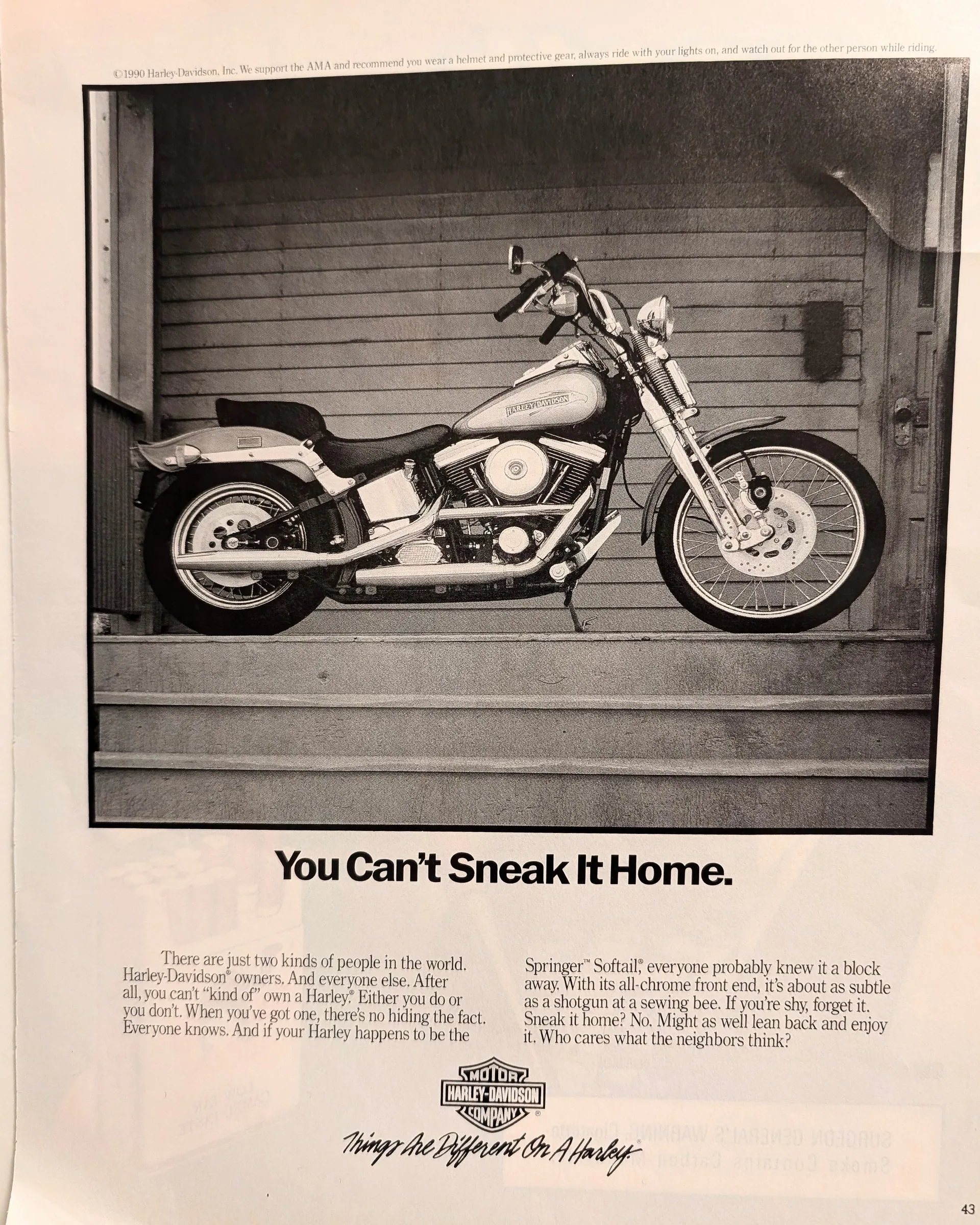
1990 Harley-Davidson Springer Softail — "You Can't Sneak It Home" Magazine Advertisement
This record presents a single magazine leaf: a full-page advertisement for the Harley-Davidson Springer Softail, printed with the line "©1990 Harley-Davidson, Inc." above its photograph and numbered 43 at the foot of the page. The leaf is an original piece of American magazine advertising from 1990. Which magazine it was cut from is not recorded on the page itself, and the host publication remains unidentified [GAP-01]. The Record Institute holds the physical leaf in its collection. The page is built in three bands. The largest is a black-and-white halftone photograph: the motorcycle stands in strict profile on the wooden steps of a clapboard house, its chrome springer front end and drilled front disc catching the light against the dark siding. Above the photograph, in type small enough to miss, runs the copyright line and a safety message: Harley-Davidson supports the AMA and recommends a helmet, protective gear and riding with lights on. Below the photograph comes the argument. The headline reads "You Can't Sneak It Home." Two short columns of copy divide the world in two — "There are just two kinds of people in the world," the owners and everyone else — and concede the joke outright: a Springer Softail, with its all-chrome front end, is "about as subtle as a shotgun at a sewing bee," so the owner might as well enjoy it: "Who cares what the neighbors think?" The page closes with the bar-and-shield badge and the campaign line in script, "Things Are Different On A Harley." The motorcycle in the photograph is the FXSTS Springer Softail. Its defining part is the front end: a leading-link springer fork, exposed springs and all, which Harley-Davidson had last fitted to a production motorcycle in 1949 before reviving it on the 1988 Springer Softail as a near-copy of the earlier unit built from better materials [S1][S2]. Underneath the period costume sat the modern hardware of Harley's recovery: the 1,340 cc Evolution V-twin [S1][S2], belt drive [S5], and the Softail chassis — introduced on the 1984 FXST around engineer Bill Davis's concept [S6] — whose hidden rear shocks preserve the clean line of a rigid frame [S5]. When Cycle World tested the model in February 1989, the test motorcycle was listed at 10,759 US dollars [S1]. The advertisement belongs to Harley-Davidson's comeback decade. The company had been bought back from AMF by its own management in 1981, and the Minneapolis agency Carmichael Lynch, on the account since 1979, rebuilt its voice around the passion of its core riders; by 1984 its advertising was already running the theme that closes this page [S3]. The line was still the company's standing message in 1990, when chief executive Richard Teerlink used it to describe the message Harley sent its market [S4]. This page is that campaign working at full confidence: it does not argue reliability, price or specification at all. It sells visibility — the certainty of being seen, and of being envied by the neighbours the copy pretends to dismiss. As a document, the leaf records the moment heritage became Harley-Davidson's forward strategy: a front fork copied from 1948, an engine and chassis from the 1980s recovery, and copy that treats owning the machine as a public identity rather than a purchase. In the curator's reading, the most honest line on the page is the smallest one — the helmet recommendation printed above a photograph that sells rebellion. The two impulses, corporate responsibility and outlaw image, share the page without resolving, which is precisely what makes it a faithful artefact of the brand in 1990. Two limits frame this record. The photographer is uncredited, and a corner-by-corner inspection of the photograph at full resolution found no signature or credit anywhere on the leaf [GAP-02]. And while the printed copyright line dates the advertisement to 1990, the page carries no model-year marking for the motorcycle itself; its identification as the Springer Softail rests on the advertisement's own copy [GAP-03]. References / Sources [S1] Cycle World, "Harley-Davidson Springer Softail FXSTS," February 1989 — magazine.cycleworld.com. [S2] Motor Cycle News, "Harley-Davidson Springer Softail (1988–2003)," model history and review — motorcyclenews.com. [S3] "Harley-Davidson Motor Company," Encyclopedia.com, company history. [S4] "Harley speeds into the '90s," Milwaukee Journal Sentinel, 1990 — ProQuest record. [S5] "1988 Harley-Davidson FXSTS Softail Springer," HowStuffWorks (Auto). [S6] "The History of Harley-Davidson Softail Motorcycles," Chopper Exchange.
Category: Motorcycles
Year: 1990
Rarity Class: C
Paper & Print Condition
The object is a single magazine leaf bearing a black-and-white halftone photograph over two columns of letterpress-style text. The condition record rests on the curator's photographs of the leaf [OBJ-01]. A horizontal crease crosses the upper part of the photograph, and a second, diagonal crease marks its top-right corner, where the surface catches the light differently. Toning is mild and even; the lower-left corner of the leaf lifts slightly. Show-through from the verso is visible in the lower margin, where reversed text from the page behind can be made out. No text is lost: the imprint line, headline, both copy columns, badge and folio 43 all remain fully legible, and the halftone screen of the photograph is intact throughout.
Provenance & Rarity
The leaf is an original 1990 magazine advertisement, not a reproduction; its printed copyright line names Harley-Davidson, Inc., and its folio reads 43, but the host magazine is not identified on the page and no issue date survives with it [GAP-01]. It is held in the collection of The Record Institute; acquisition documentation supplied with the object is recorded in the provenance ledger, and the photograph is uncredited [GAP-02]. Rarity is assessed at Class C under the Institute's method. This was a mass-circulation campaign page, printed across multiple national magazines in large numbers, and Harley-Davidson advertising of this era was widely kept, so survival is high. The campaign's historical significance is considerable, but under the Institute's method significance is documented in the narrative and does not raise the scarcity class.
Rarity & Condition Summary