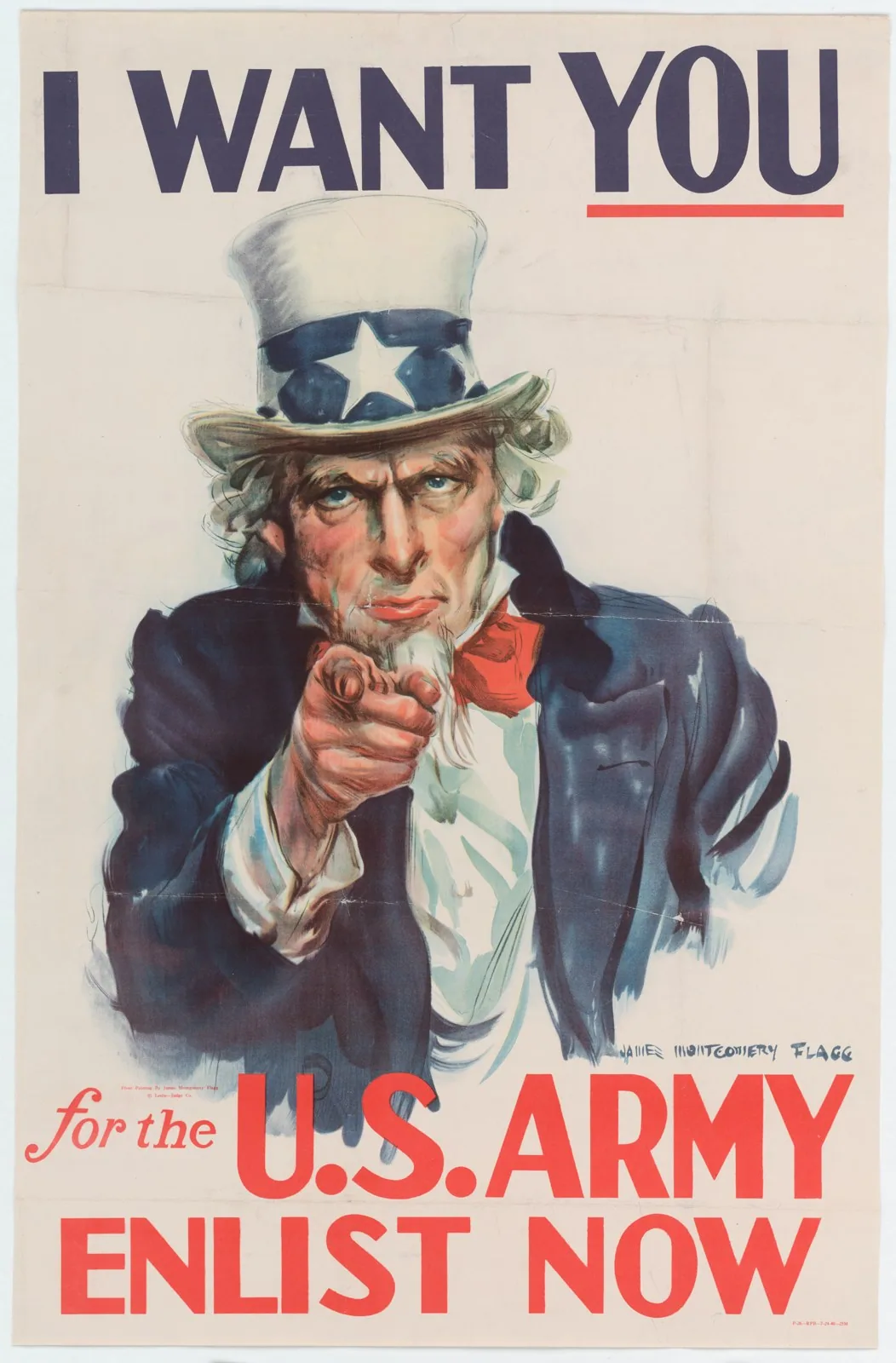
I Want You, Again: Flagg's Uncle Sam Re-enlists, 1941–1945
The sheet reproduced here is the National Archives' file copy of the most famous poster ever printed: James Montgomery Flagg's pointing Uncle Sam, "I Want You for the U.S. Army — Enlist Now". The Archives catalogue the item (NAID 513533, local identifier 44-PA-71) among the Records of the Office of Government Reports, in a series titled World War II Posters, with coverage dates of 1941 to 1945, and record both access and use as unrestricted. That filing is the first fact of this record, and the most instructive: the archive does not file this sheet under 1917, the year of the design's fame, but under the war in which this copy served. It is a First World War image in its second enlistment. What the sheet shows needs little introduction and rewards close reading anyway. Uncle Sam fills the frame at half length — white top hat banded in blue with a single white star, red bow tie, dark coat — and thrusts his right hand out of the picture at the viewer, the forefinger aimed between the viewer's eyes. The typographic frame is a shout in two registers: "I WANT YOU" in dark blue capitals across the top, "YOU" underlined in red, and at the foot, in red, "for the U.S. ARMY — ENLIST NOW". Flagg's signature stands in the image at the right, painted as part of the artwork. At the lower left, small type carries the first publication's credit: "From Painting by James Montgomery Flagg — © Leslie-Judge Co." The Archives' scan also preserves the sheet's working life: horizontal fold creases cross the paper, the marks of a poster that was folded, carried and kept rather than framed. The design's first life began a year before America had a war to recruit for. Flagg — born in Pelham Manor, New York, in 1877, and by 1916 one of America's best-known magazine illustrators — painted the pointing Uncle Sam for the cover of Frank Leslie's Illustrated Newspaper of 6 July 1916, under the question "What Are You Doing for Preparedness?" The gesture itself was borrowed and Flagg never hid it: Alfred Leete's 1914 British image of Lord Kitchener, finger levelled at the viewer, had shown what a pointing statesman could do. When the United States declared war in April 1917, the Army took Flagg's cover, set the immortal line beneath it, and printed — between 1917 and 1918, by the standard accounts — over four million copies. Flagg, who contributed forty-six posters to the war effort, called it the most famous poster in the world. Its face was his own: needing a model in a hurry, he had aged his own features, added the white goatee, and looked in the mirror — afterwards telling President Franklin D. Roosevelt, who praised his resourcefulness, that he had done it to save the model's fee. The shoulders, arm and pointing hand are said to be his neighbour Walter Botts's, posed for the thrust of the gesture — an attribution repeated throughout the Flagg literature and recorded here as such. The second life is this record's subject. When the United States went to war again in 1941, the Army reached for the image a second time. The standard scholarly estimate, Susan E. Meyer's, puts the Second World War printing at about four hundred thousand copies — a tenth of the first run, for an army now recruited in a media age of radio and newsreel, yet still the face the government chose for the recruiting station wall. The Office of Government Reports, whose records hold this copy, was the wartime government's own information clearing-house; that the sheet rests in its poster series, rather than in a 1917 file, is the archive practising its own discipline: a document belongs to the moment of its use. As visual language, remarkably little changed between the two wars, because nothing needed to. The poster is not an argument; it is an interruption. It abolishes the distance between state and citizen by pointing — the one gesture in graphic art that singles out a person in a crowd — and its two lines of type divide the work perfectly: the top line is the accusation, the bottom line the instruction. Flagg's painted handling, all visible brushwork and caricaturist's speed, keeps the figure human where a photograph would be merely official. That the second war's printing retained even the first war's publisher credit line, Leslie-Judge, small at the foot, makes the sheet a small palimpsest of American persuasion: 1916's magazine cover, 1917's recruiting sensation, and 1941's old soldier of a poster, reporting for duty again. The Institute files the record as Class B, and the reasoning is the point. By scarcity this is the least rare object imaginable — millions printed, originals in every major American collection and in countless private hands. Its claim is documentary, and it is total: no other sheet so completely records how the American state learned to speak to its citizens face to face. A curator's limits close the record. The Archives date this copy by its series coverage, 1941–1945; a job imprint at the sheet's lower right is only partly legible in the service scan, and its visible fragments suggest a 1946 printing code — which, if confirmed against the preservation master, would place this copy just after the war it served, among the last of the re-issues. The record states the tension rather than resolving it. Print totals for both wars rest on the secondary literature cited below, not on surviving printer's ledgers, and are given as the estimates they are. References / Sources [S1] National Archives and Records Administration — Catalog record NAID 513533 (44-PA-71): title, series, coverage dates, restriction fields (Unrestricted), digital object. [S2] "James Montgomery Flagg", biographical entry: Leslie's Weekly cover of 6 July 1916; the Leete lineage; four million copies; the artist's own face as the model; Walter Botts; the Roosevelt exchange. [S3] The Doughboy Foundation — "'I Want You': 5 Of America's Best World War I Recruitment Posters": cover publication, Army adaptation, print total, Flagg's forty-six war posters. [S4] Library of Congress — exhibition text on the poster: "the most famous poster in the world" (the artist's own words); more than four million copies printed 1917–1918. [S5] Meyer, S. E., James Montgomery Flagg (Watson-Guptill, 1974), p. 37 — the Second World War print estimate of about 400,000, as cited in the Rockwell Center for American Visual Studies essay "I Want You".
Category: Firearms & Military
Year: 1941
Rarity Class: B
Provenance & Rarity
James Montgomery Flagg (1877–1960) · I Want You for the U.S. Army · design 1916–1917; this printing 1940s — The most famous poster in the world — its creator's words — reporting for a second war. Flagg modelled Uncle Sam on his own face to save the model's fee. National Archives, NAID 513533 (44-PA-71).