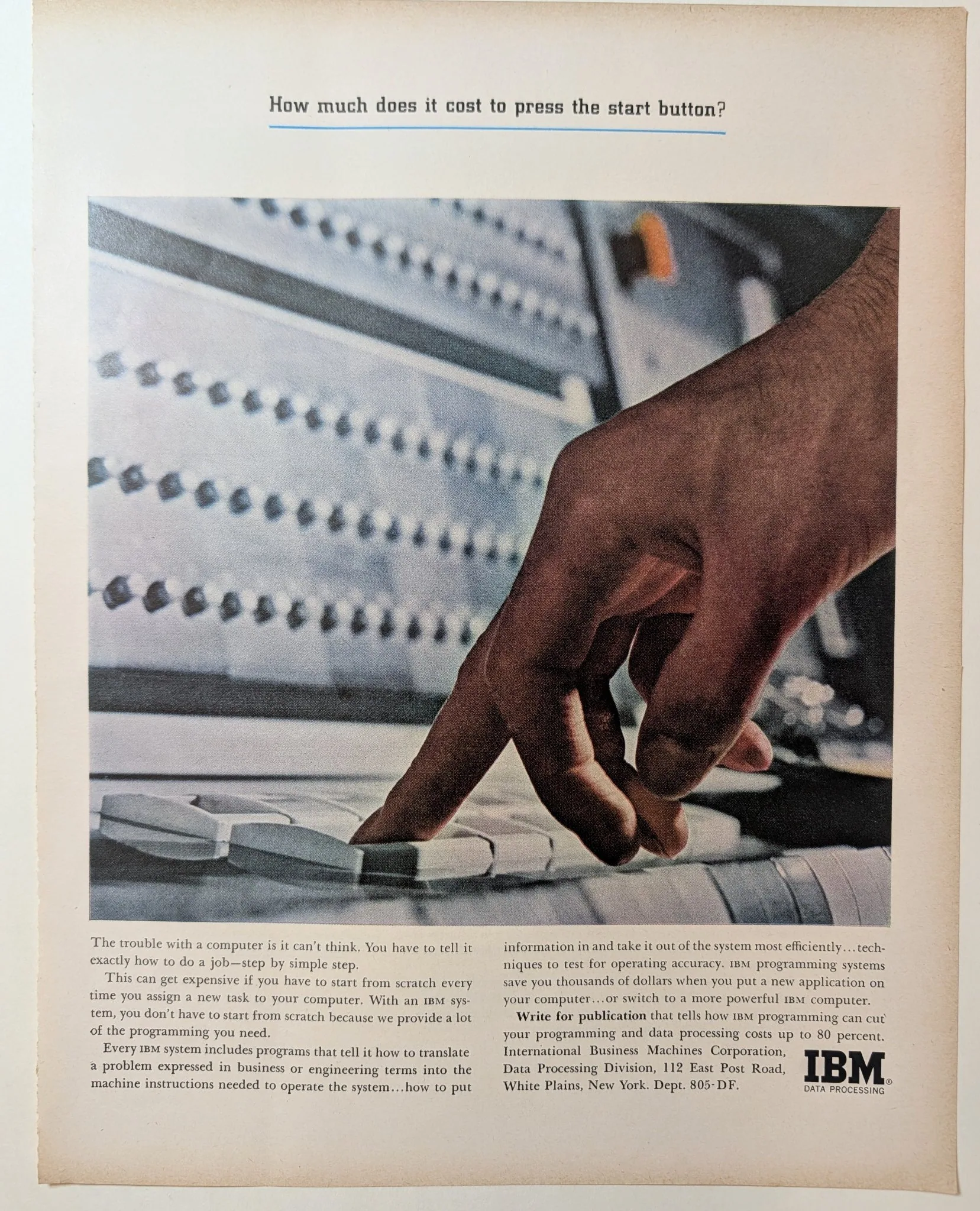
IBM "How Much Does It Cost to Press the Start Button?" Data Processing Magazine Advertisement
Object and source. This is a full-page color magazine advertisement from IBM's Data Processing Division, preserved as a tear sheet from the owner's collection. The page carries no printed date and no magazine name or issue information, so its original publication cannot be identified from the page itself. The sign-off reads "International Business Machines Corporation, Data Processing Division, 112 East Post Road, White Plains, New York. Dept. 805-DF." beneath the solid block-letter IBM logo with "DATA PROCESSING" below it. Only the front of the page was photographed; the reverse was not provided. What the page shows and says. The headline asks "How much does it cost to press the start button?" Above a thin blue rule, the question hangs over a close-up photograph: a hand reaching to press a button on a computer console covered with long rows of small round indicator buttons. The body copy opens with the sentence "The trouble with a computer is it can't think." and argues that a computer must be told exactly how to do a job, step by simple step, which gets expensive when every new task means starting from scratch. IBM's answer is that its systems arrive with much of the programming already provided: programs that translate business or engineering problems into machine instructions, move information in and out of the system efficiently, and test for operating accuracy. The copy closes by offering a publication describing how IBM programming can cut programming and data processing costs by "up to 80 percent" — the advertiser's claim, presented here as a claim, not as a verified result. Historical setting. The advertisement belongs to the era when computer manufacturers supplied programming as part of the machine's value. Before the late 1960s, a computer buyer typically received the manufacturer's programming tools and support as part of the system; the business of selling software separately was still forming. That arrangement changed publicly on June 23, 1969, when IBM announced separate pricing for most systems-engineering activities, future computer programs, and customer-education courses [S2]. The advertisement's message — that IBM-provided programming saves the buyer money when starting a new application or moving to a more powerful IBM computer — is characteristic of the bundled era that preceded that announcement. A second, softer bound comes from the logo itself: the solid block-letter IBM mark shown here predates the striped eight-bar IBM logo introduced in 1972 [S3]. Neither bound dates the page exactly, and no tighter year is asserted here. Visual language and intended audience. The photograph does the persuading. A single human hand against a wall of machine buttons makes the abstract cost of programming concrete: the cheapest gesture in computing — pressing a button — is expensive only because of everything that must happen before it. The color is restrained: the cool gray-blue of the console, the warm skin tones of the hand, and one small orange button in the upper right that draws the eye to the act of pressing. The reader being addressed is the business buyer weighing a computer purchase, who is told that the machine is not the whole purchase — the programming that makes it useful is, and IBM supplies much of it. Documentary significance. Two things make this page worth preserving. First, it captures the manufacturer's side of the programming-cost problem in the years before software became a separately priced industry: the argument that supplied programs, not just hardware, were the reason to buy IBM. Second, it preserves the visual rhetoric of that moment — the console as a wall of buttons, the human hand as the measure of the machine — at a time when computers were still room-sized systems operated by specialists, not personal devices. Curator's conclusion and limits. This page documents IBM's bundled-programming sales argument and the visual language of early business computing. The following remain unidentified and are not asserted anywhere in this record: the year and magazine of publication, the computer model pictured (the console is described only as a computer console; no model is claimed), the advertising agency, the photographer, and the copywriter. The department code "805-DF" is recorded as printed; it is not decoded as a date or issue reference. The "up to 80 percent" savings figure is the advertiser's claim; no supporting study or baseline has been located, and it is not presented as an established result. References / Sources [S1] Page transcription from the owner's photographs (headline, body copy, sign-off, Dept. 805-DF). [S2] IBM Archives, "1969" chronological history — June 23, 1969 announcement of separate pricing for most systems-engineering activities, future computer programs, and customer-education courses. [S3] IBM logo history — striped eight-bar IBM logo introduced 1972 (Paul Rand redesign); the solid block-letter mark in this advertisement predates it. [S4] Martin Campbell-Kelly, From Airline Reservations to Sonic the Hedgehog: A History of the Software Industry, MIT Press, 2003 — manufacturers' programming provision and the pre-unbundling software business. [S5] Peter Naur and Brian Randell, eds., Software Engineering: Report on a Conference Sponsored by the NATO Science Committee, Garmisch, Germany, October 7-11, 1968 — contemporary concern over the cost and reliability of producing software.
Category: Electronics
Rarity Class: B
Paper & Print Condition
Full-page magazine advertisement examined from photographs only; no direct physical inspection was provided. Printed in offset lithography, with the halftone dot structure of the process clearly visible in the close-up photograph of the console. Colors remain strong: the cool gray-blue console, the warm skin tones of the hand, and the small orange button all read cleanly. The paper shows the light, even tonal shift typical of coated magazine stock of this period; no tears, folds, or losses are visible in the images provided. The page edges appear complete with no printed content cut away. The reverse was not photographed and its condition is not recorded.
Provenance & Rarity
Source magazine and issue are unidentified: the owner's copy is a full-page tear sheet without masthead or publication information, provided to TRI as photographs of the front only. It is an original printed advertisement, not a reproduction; its date is not printed on the page and is left blank in this record rather than estimated. No acquisition documentation was provided for this draft, and no ownership history before the current owner is recorded. The advertising agency, photographer, and copywriter are all unidentified; the page carries no signature or agency code. Rarity class B by curatorial assessment: unsigned commercial work from a major manufacturer's magazine campaign, which argues against a higher class, but with documentary value well above average as evidence of the bundled-programming business model before IBM's 1969 unbundling announcement. No census of surviving copies of this insertion exists; the assessment weighs campaign diffusion against documentary distinctiveness, not a counted population.
Rarity & Condition Summary