John Hancock "He Showed Us the Way to the Top" Peary Advertisement
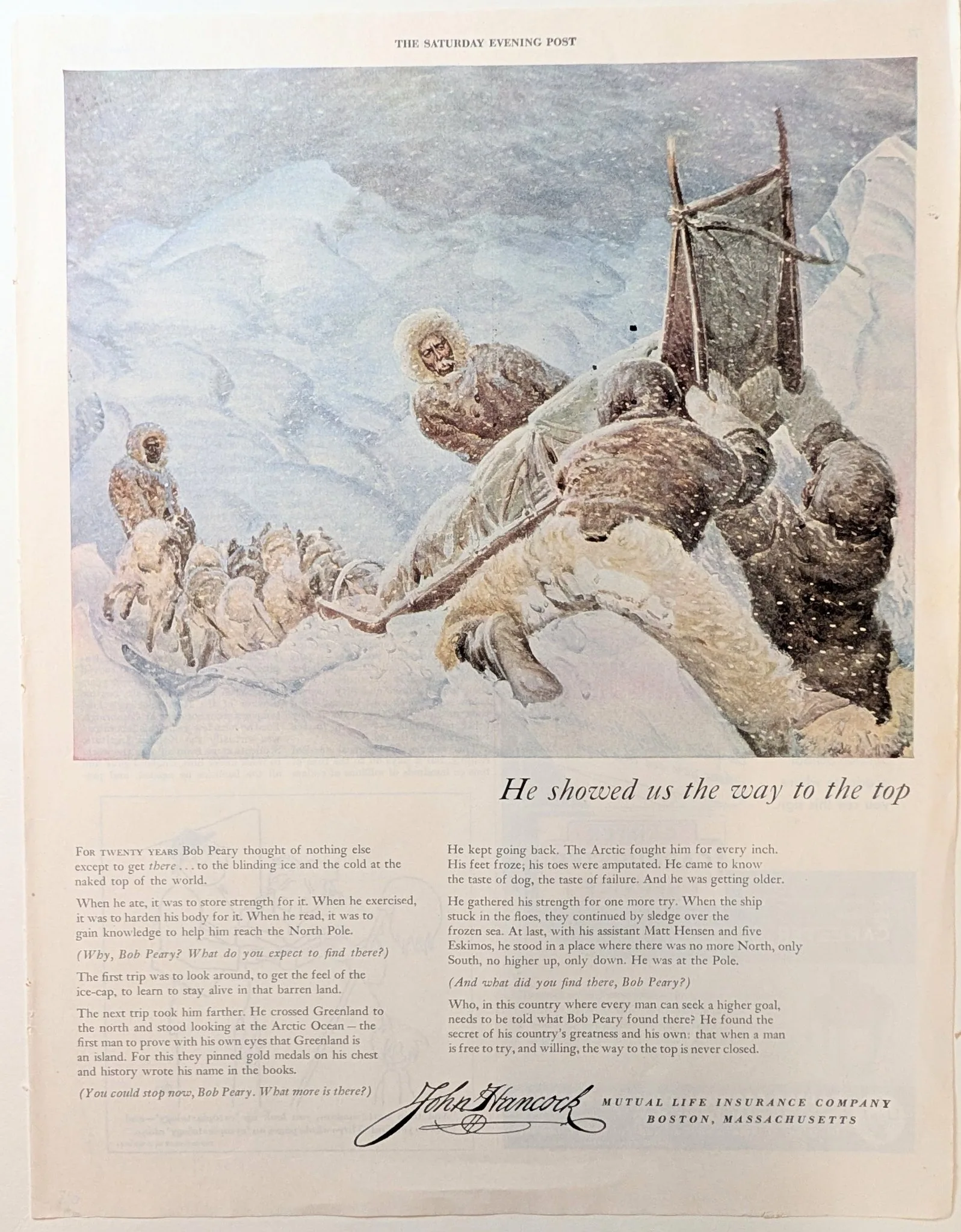
A full-page advertisement for the John Hancock Mutual Life Insurance Company of Boston, Massachusetts, printed in The Saturday Evening Post. The page carries no visible issue date; the advertisement belongs to John Hancock's series of historical-figure advertisements that ran in large-format American magazines through the 1940s and 1950s. The date given here, circa 1950, is a curatorial estimate. The exact issue has not been identified. The advertisement's subject is Robert E. Peary (1856-1920), the American explorer who claimed to have reached the geographic North Pole on April 6, 1909. The illustration, rendered in a painterly style, shows Peary in fur clothing alongside a dog sled team on the Arctic ice, with men hauling a sled up a pressure ridge. The headline reads: "He showed us the way to the top." The copy narrates Peary's decades-long pursuit of the Pole in heroic terms: twenty years of single-minded effort, frostbite that cost him his toes, and a final successful journey. It is worth reading the advertisement's claims against the historical record. Peary did suffer severe frostbite and amputations, though the worst of these injuries dated to an 1898-1899 expedition, roughly a decade before the 1909 attempt the advertisement celebrates. More significantly, Peary's claim to have reached the Pole has been disputed since it was announced. Frederick Cook, a former member of Peary's expeditions, claimed to have reached the Pole a year earlier, in April 1908; Cook's claim is widely rejected. Modern reassessments of Peary's navigational records have split opinion, and the question of whether his party stood at the exact geographic Pole remains open among historians. One passage of the copy requires particular attention. The advertisement states that Peary reached the Pole "with his assistant Matt Henson and five Eskimos." Peary's own published account of the expedition, The North Pole (1910), identifies the final polar party as six men: Peary himself, Matthew Henson, and four Inughuit men — Ootah, Egingwah, Seegloo, and Ooqueah. The advertisement's figure of five is an error, and its terminology reflects the period. This record uses Inuit (specifically Inughuit, the Polar Inuit) except where quoting the advertisement directly. The advertisement's description of Matthew Henson as Peary's "assistant" likewise reflects the period's framing. Henson, an African American explorer who had accompanied Peary on Arctic expeditions since 1891, was essential to the 1909 journey's success. Later recognition included his reinterment at Arlington National Cemetery in 1988. The advertisement's copy, written when such recognition was decades away, reduces his role to a single subordinate clause. The advertisement closes with the John Hancock script signature — the company's long-standing logo — and the full corporate name and Boston address. The signature is a printed corporate mark, not a hand-applied autograph. As an artifact, the page is a document of mid-century American corporate mythmaking: a life insurance company borrowing the authority of exploration history to sell financial security, and in doing so, presenting a simplified and in places inaccurate version of that history. Its value to the archive lies as much in what it gets wrong as in what it depicts.
Category: Financial Services
Year: 1950
Rarity Class: C