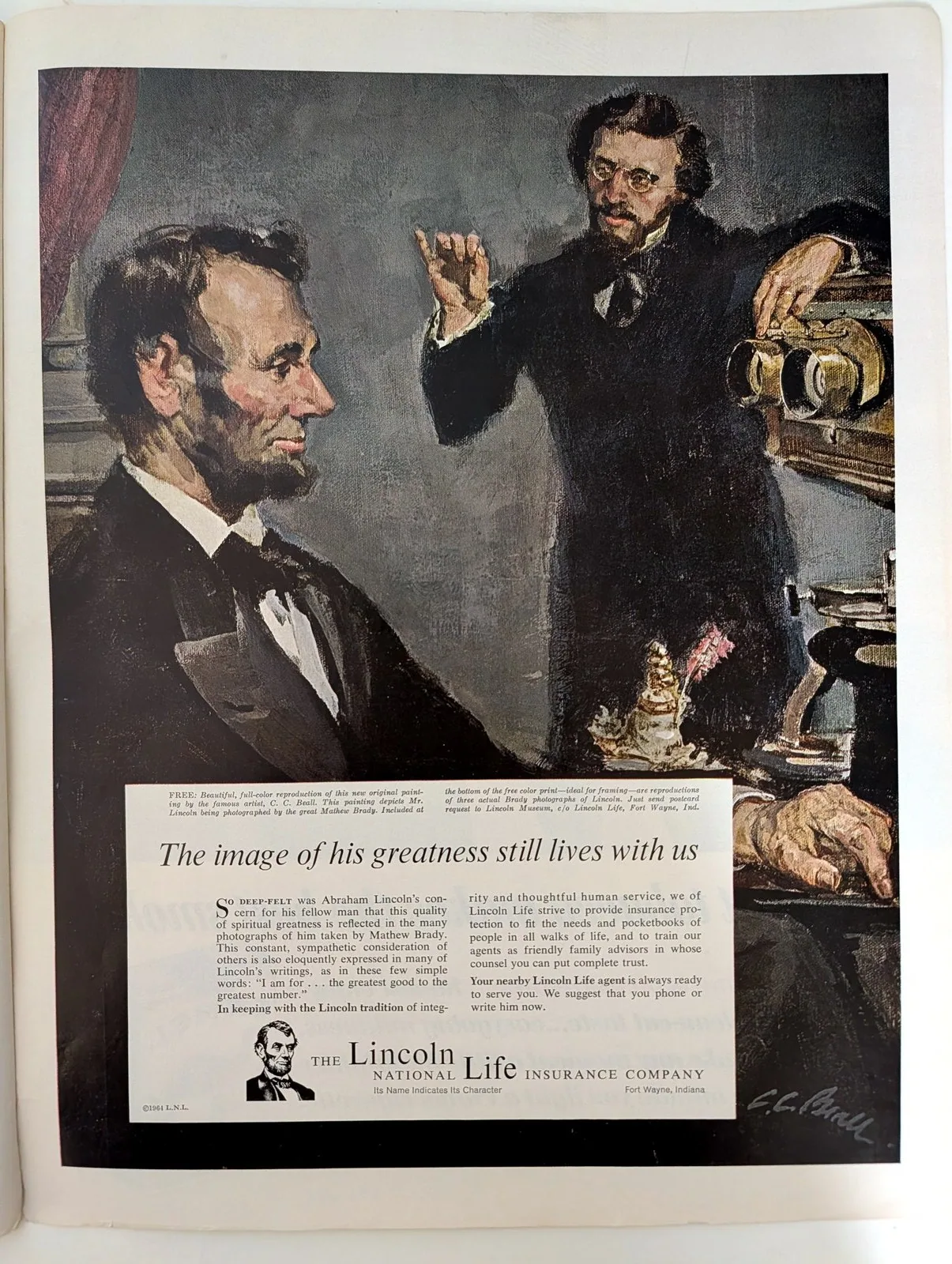
1964 Lincoln National Life Insurance Vintage Advertisement
In the February 8, 1964 issue of The Saturday Evening Post, the Lincoln National Life Insurance Company of Fort Wayne, Indiana, ran a full-page institutional advertisement built around a single painting: Abraham Lincoln sitting for the photographer Mathew Brady. The headline reads, “The image of his greatness still lives with us.” The painting is signed C. C. Beall, and the advertisement presents him in its copy as “the famous artist, C. C. Beall.” The painting has a documented title and a documented commission. In Lincoln Lore, the bulletin of the Lincoln National Life Foundation, the work is recorded as “Lincoln in Brady’s Studio” by C. C. Beall. The Foundation notes the company’s long-standing practice of commissioning prominent commercial artists to paint Lincoln nearly every year, and records that Beall received the commission in late 1963 to create the Brady-studio image for the institutional advertisement scheduled in The Saturday Evening Post for February 8, 1964. Beall did not copy a photograph. According to the Foundation’s account, he conducted detailed historical research for the painting — reconstructing the studio backdrop, the camera, the table, the hat, and the inkwell — and, most significantly, he did not derive Lincoln’s likeness from any single Brady photograph. The Lincoln in the painting is a deliberate composite drawn from several different Brady poses: a historically researched reconstruction of a photographic sitting, not a reproduction of one. This matters because it changes what the object is. The advertisement is not merely a handsome Lincoln picture deployed for insurance sales; it is a work of commercial art grounded in photographic-source synthesis and period reconstruction, commissioned within a corporate program that treated Lincoln imagery as a sustained institutional practice rather than a one-off borrowing. That program, in turn, reaches back to the company’s founding. Lincoln Financial’s own corporate history records that when Arthur Hall founded the company in Fort Wayne in 1905, he chose the name “Lincoln” to associate the firm with integrity and strength — and that Hall wrote to Robert Todd Lincoln to request permission to use his father’s name and image. Robert Todd Lincoln granted the request and sent a photograph of Abraham Lincoln for the company’s use. Abraham Lincoln was therefore embedded in the company’s visual identity from its first year. The 1964 advertisement is not a casual appropriation of a famous historical figure; it is a mid-century expression of a corporate identity continuous since 1905, executed through the company’s annual commissioned-art practice. The artist’s standing supports the advertisement’s own claim. Cecil Calvert Beall (1892–1967) was a portrait artist and commercial illustrator whose work appeared in The Saturday Evening Post, Vanity Fair, Cosmopolitan, and Collier’s. The Franklin D. Roosevelt Presidential Library records that his 1936 Collier’s cover portrait of Franklin D. Roosevelt led to his appointment as art director of the Democratic National Committee. The Delaware Art Museum records his training at the Pratt Institute and the Art Students League, his reputation in watercolor illustration, and his membership in the Society of Illustrators. The advertisement’s “famous artist” is not puffery alone; it is a status with institutional documentation behind it. The proposition of the advertisement itself remains what it was: it sells trust rather than a product. No policy terms appear. No premiums are quoted. But the trust being sold can now be stated as an evidenced argument rather than an interpretation — a company trading on a name it has carried since 1905, through an image commissioned from a nationally recognized illustrator, reconstructed from the photographic record of the president himself.
Category: Financial Services
Year: 1964
Rarity Class: B
Paper & Print Condition
Full-page magazine advertisement — a color halftone reproduction on coated periodical stock. Under magnification, the printing screen resolves Beall’s brushwork into a halftone rosette, yet the direction and loading of the original strokes remain legible — quick, thick passages in Lincoln’s face and Brady’s coat survive the translation from painting to print. That survival is precisely what this archive exists to preserve: the hand of the painter inside the machinery of mass reproduction. The sheet is intact and retained in its original magazine issue, with the facing editorial page present — the placement (p. 3 of cover) and the issue context (February 8, 1964) are therefore physically verifiable, not inferred. Ink saturation remains strong after six decades; no tears, losses, or detachments are observed. Age-toning consistent with bound-issue storage is the expected baseline for this stock and period. Condition methodology note (TRI 1–10 periodical scale): 10 = as-printed; 9 = negligible handling wear; 8 = complete and flat, minor age-toning and edge wear consistent with bound-issue storage, no defects; 7 and below = visible defects (tears, clipping, staining, detached leaves, significant fading). This specimen rates 8/10: complete, flat, colors legible, issue context intact.
Provenance & Rarity
Publication provenance (bibliographic, confirmed): The Saturday Evening Post, February 8, 1964, p. 3 of cover. U.S. copyright registration KK178578, applicant Maxon, Inc., registered 8 February 1964 (Catalog of Copyright Entries). The earlier TRI formulation — “identified via the facing editorial, exact issue date unconfirmed” — is superseded. Chain of custody: From the collection of Ronin Naodhinsuk; photographed by the author for The Record Institute archive. Documented in its original magazine issue. Rarity — Class B (methodology note): Class B here reflects survival rarity, not distribution rarity, and the distinction is material. This advertisement was printed in a national-circulation weekly; original distribution was mass, and no scarcity is claimed at the point of publication. TRI rarity classifications describe observed survival and research availability rather than original print quantity. Class B is assigned provisionally from TRI collection observations and documented searches of institutional and secondary-market records. It should not be interpreted as a statistical estimate of surviving copies. The advertisement’s own premium program — a free full-color reproduction “ideal for framing” — further complicates survival analysis, since framed examples encountered today may be the reprint rather than the magazine page. Rights note: U.S. copyright registration KK178578 records Lincoln National Life Insurance Co. for this advertisement, with Maxon, Inc. identified as applicant author. Current rights status has not been independently determined. Reproduced by The Record Institute for documentation, research, and scholarly reference.
Rarity & Condition Summary
Class B artifact in Good condition (8/10 on the TRI periodical scale): complete and flat, retained in its original February 8, 1964 issue with placement verifiable at p. 3 of cover. Its research significance exceeds its market scarcity — a copyright-registered, foundation-documented instance of mid-century corporate commissioned art, reconstructing photographic history through painted synthesis. REFERENCES / SOURCES Primary / contemporary sources: U.S. Copyright Office, Catalog of Copyright Entries — Lincoln National Life Insurance Co., “The image of his greatness still lives with us,” illus. signed C. C. Beall; The Saturday Evening Post, Feb. 8, 1964, p. 3 of cover; applicant Maxon, Inc.; reg. KK178578 (8 Feb 1964). Lincoln National Life Foundation, Lincoln Lore — “Lincoln in Brady’s Studio by C. C. Beall”: commission (late 1963), the company’s annual Lincoln-art commissioning practice, Beall’s historical research (backdrop, camera, table, hat, inkwell), composite construction from several Brady poses. The artifact itself: The Saturday Evening Post, Feb. 8, 1964, p. 3 of cover (physical inspection — placement, inscriptions “©1964 L.N.L.”, Beall signature). Modern reference sources: Franklin D. Roosevelt Presidential Library — Cecil Calvert Beall (1892–1967): portrait artist and commercial illustrator; Saturday Evening Post, Vanity Fair, Cosmopolitan, Collier’s; 1936 Collier’s FDR cover; art director, Democratic National Committee. Delaware Art Museum — Beall: Pratt Institute, Art Students League; watercolor illustration; Society of Illustrators. Lincoln Financial (corporate history) — founding, Fort Wayne, 1905; “Lincoln” name for integrity and strength; Arthur Hall’s letter to Robert Todd Lincoln; permission granted with photograph.