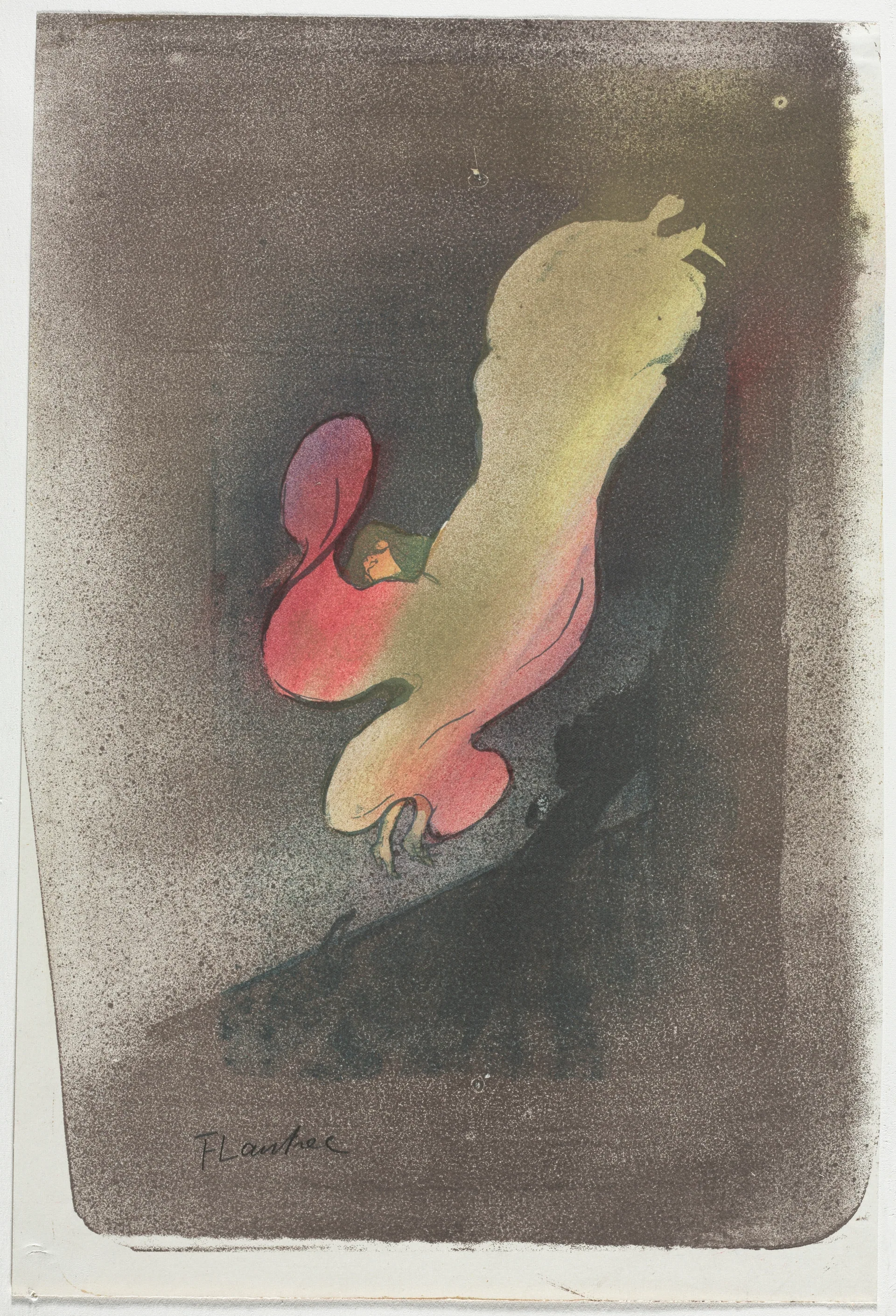
Miss Loïe Fuller, 1893: The Lithograph That Tried to Print Stage-Light
The print reproduced here is the Cleveland Museum of Art's impression of Miss Loïe Fuller, a colour lithograph by Henri de Toulouse-Lautrec, made in Paris in 1893 and published by André Marty. The Museum catalogues the image at 37.9 by 25.7 centimetres and releases its file under CC0; the print is number 39 in Loys Delteil's catalogue of Lautrec's printed work and number 17 in Wolfgang Wittrock's. One candour belongs at the head of the record: although the sheet is habitually called a poster, the holding museums catalogue it as a print. It carries no lettering, no theatre name, no dates — nothing to paste on a wall to sell a ticket. It is the opposite of an advertisement: a small, costly image made for collectors, of the most evanescent act in Paris. What the sheet shows is a flame. Against a ground of near-black, dense with spattered speckle that catches the light like dust in a beam, a single column of silk rises and billows — pale yellow above, breaking into magenta and rose at the left, a wash of green where the fabric turns. Only at the centre does the dancer declare herself: a small face, eyes lowered, green hair, peering from the folds, with a hand and the tips of two wands showing at the hem of the drapery. Everything else is cloth in motion. The Cleveland Museum calls the print the most abstract of Lautrec's lithographs, and the description is exact — the body has been all but abolished, and what remains is the effect the body produced: coloured light moving in the dark. The performer was Loïe Fuller (1862–1928), born Mary Louise Fuller in Fullersburg, Illinois, who had built her Serpentine Dance in American vaudeville in 1891 and carried it to Paris the following year. After an imitator had to be cleared from the stage, she premiered under her own name at the Folies Bergère on 5 November 1892, and became the sensation of the season. The dance itself was a technology as much as a choreography. Fuller stood nearly still inside hundreds of yards of translucent silk, extending her arms with concealed wands of bamboo or aluminium so the fabric became wings, veils, flames; she danced on a glass floor lit from below, ringed by mirrors, while electric lights of her own devising washed the silk in changing colour. She patented the costume. Paris — its poets, its painters, its men of science — saw not a skirt dance but a new art of light, and Lautrec, nightly at the Folies, saw it too. His problem was that the act existed only as light in motion, and his medium was ink standing still. His solution was to make the printing itself unstable. The lithograph is drawn in brush and spatter on five stones, and, in the Cleveland Museum's own account, he experimented with every impression: the edition of about sixty was inked in constantly changing combinations of colour, and some impressions were then dusted by hand with gold or silver powder, so that no two sheets are alike. The National Gallery of Art describes its impression as finished with hand-applied powdered metal leaf; the Clark Art Institute's sheet is printed in blue-grey, brown-aubergine and yellow, Cleveland's in yellow, rose and green. The Cleveland impression even keeps its registration pinholes, the small mechanical witnesses of the stones being aligned. Where Fuller's stage machinery made light repeatable every night, Lautrec made a print that could never be repeated at all. The Institute files the record as Class A. The edition was about sixty impressions — a fraction of a poster run — and because each was inked differently and finished by hand, every survivor is a unique variant rather than a copy; the image is the canonical printed portrait of Fuller and one of the defining sheets of Lautrec's lithographic art. It is not rarer, because survival has been kind: impressions rest today in Cleveland, at the Metropolitan Museum and the Museum of Modern Art in New York, at the National Gallery of Art in Washington and elsewhere, and the image is reproduced everywhere. The signature at the lower left is written in the stone and printed with the design; no hand-signature is claimed for this sheet. A closing symmetry is on the Museum's own record: Fuller, who had been turned into light and paper in 1893, later donated a group of sculptures to the Cleveland Museum after it opened in 1916 — the dancer became, in the end, one of its benefactors, and its print room holds her still dancing. Two limits belong on the record. Descriptions of colour in this entry describe the Cleveland impression; other impressions of the same stones wear entirely different colours, by design. And the edition figure of about sixty, consistent across the Cleveland Museum, the Museum of Modern Art and the sale catalogues, has not been verified against a printer's ledger; it is presented as catalogued. ### References / Sources [S1] The Cleveland Museum of Art — Open Access record 1925.1202: catalogue data, catalogue raisonné numbers, description of Fuller's stagecraft, CC0 status, and the Museum's note of Fuller's later gift of sculptures. [S2] The Cleveland Museum of Art — object text via AMICA Library: the edition of about sixty impressions, each printed differently; five stones inked in assorted colours; gold or silver powder dusting. [S3] The Museum of Modern Art — "Miss Loïe Fuller", 513.2006: publisher André Marty; printer Edward Ancourt; edition approx. 60, each unique. [S4] The Metropolitan Museum of Art — "Miss Loïe Fuller", 1970.534: brush and spatter lithograph in five colours; only state. [S5] National Gallery of Art, Washington — "Miss Loïe Fuller", 1952.8.338: medium including hand-applied powdered metal leaf. [S6] Fuller biography: Encyclopedia of World Biography, "Fuller, Loïe (1862–1928)"; Garelin (Princeton University Press) on the Folies Bergère premiere of 5 November 1892; Frieze, "Serpentine Dancer", on the wands and the 1894 costume patent.
Category: Art & Museums
Year: 1893
Rarity Class: A
Paper & Print Condition
Colour lithograph in five colours (brush and spatter), hand-dusted with gold and silver powder; image 37.9 × 25.7 cm (Cleveland impression); registration pinholes retained.
Provenance & Rarity
Henri de Toulouse-Lautrec (1864–1901) · Miss Loïe Fuller · Paris, 1893 — Colour lithograph in five colours, published by André Marty. Loïe Fuller danced inside a column of electrified silk at the Folies Bergère; Lautrec answered with some sixty impressions, each inked differently and dusted with gold — a print that tries to hold stage-light still. The Cleveland Museum of Art, 1925.1202.
Rarity & Condition Summary
Class A — edition of about sixty impressions, each uniquely inked and hand-finished; broad museum survival.