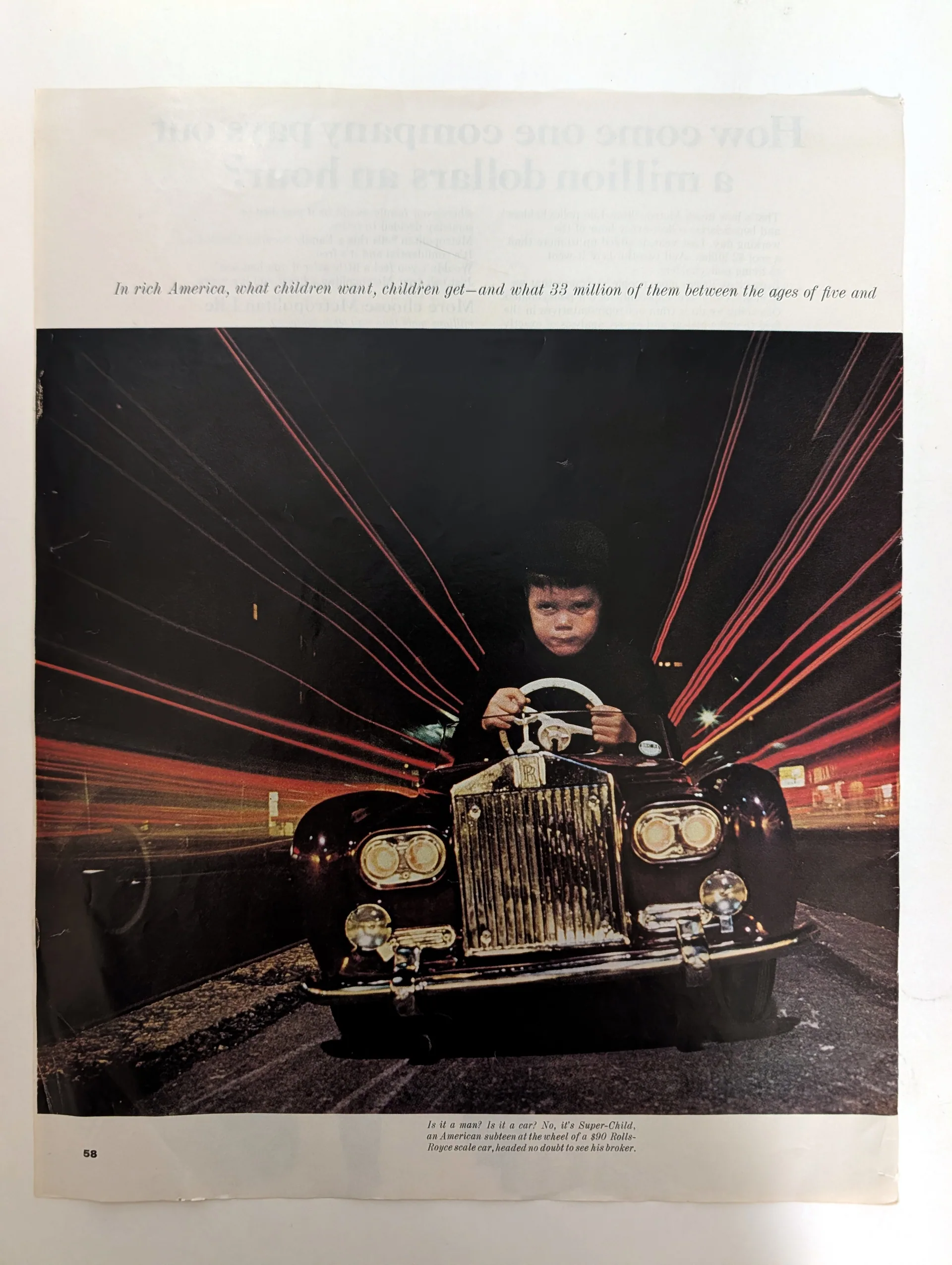
c. 1960s Super-Child Rolls-Royce Scale Car Magazine Photo Page
*Paragraph 1 — Visual Description:* The supplied images show a single magazine leaf dominated by a full-bleed color night photograph. A young child is seen head-on, gripping a white steering wheel with both hands, seated in a scale-model car photographed frontally at close range. The model carries the visual markers of a Rolls-Royce: a tall vertical-slat grille with a small rectangular badge at its crest, paired round headlamps, auxiliary lamps set low on either side, and a polished bumper running across the front. The background is black, crossed by long diagonal streaks of red and amber light that read as traffic trails in a long exposure. Above the photograph, a line of italic editorial text is cut off mid-sentence at the sheet's top edge: "In rich America, what children want, children get—and what 33 million of them between the ages of five and". Below the photograph, a three-line italic caption reads in full: "Is it a man? Is it a car? No, it's Super-Child, an American subteen at the wheel of a $90 Rolls-Royce scale car, headed no doubt to see his broker." The numeral "58" stands at the lower left. Across the upper portion of the sheet, reversed show-through from the other side is legible in places: the headline "How come one company pays out a million dollars an hour?" and the line "More choose Metropolitan Life" identify the reverse content as a Metropolitan Life insurance advertisement. The paper is toned, with light wear at the edges; the photographic colors — red, amber, and black — remain dense and readable. *Paragraph 2 — Printed Text & Marks:* The visible recto text transcribes as: (above, italic, truncated) "In rich America, what children want, children get—and what 33 million of them between the ages of five and"; (below, italic) "Is it a man? Is it a car? No, it's Super-Child, an American subteen at the wheel of a $90 Rolls-Royce scale car, headed no doubt to see his broker."; (lower left) "58". Under the designation-parsing rule, the printed "58" supports page number 58 and nothing further. The reversed text visible through the sheet transcribes as: "How come one company pays out a million dollars an hour?" and "More choose Metropolitan Life" — observed as show-through from the reverse side, which carries a Metropolitan Life insurance advertisement. No publication title, issue date, photographer credit, or artist signature is printed on the visible side. The words "Super-Child," "subteen," "Rolls-Royce," and "$90" are the caption's own wording and are transcribed here, not endorsed as factual claims about the car. *Paragraph 3 — Maker Context:* The photograph is unsigned and its maker is unidentified; no photographer, agency, or art-director credit appears on the visible side. The publication of origin is unidentified — no masthead, folio line, or issue mark is printed on this face of the leaf. The name "Metropolitan Life" appears only as reversed show-through from the reverse side and belongs to that side's advertisement; it is not a maker of this photo page and is not treated as one. The marque "Rolls-Royce" appears solely inside the caption's sentence; it is the caption's designation of the scale car's model, not an endorsement or a manufacturer credit. Every maker claim on this record is therefore Unidentified, and the publication awaits curatorial assignment. *Paragraph 4 — Geographic & Audience Context:* The caption's diction — "rich America," "American subteen," the dollar price, the broker joke — probably places the piece in an American magazine addressing a general readership with satirical commentary on affluence; this is an interpretive reading of the printed words, requiring downstream verification, not a documented fact about the publication. The country of publication is not printed on the artifact. The "33 million of them between the ages of five and" fragment suggests the truncated line above the photograph opened a demographic observation about American children, positioning the photograph as the punchline of an editorial point about what wealthy children are given. The audience is addressed as knowing observers of that affluence rather than as buyers: the page sells no product and names no retailer. The Metropolitan Life advertisement on the reverse indicates the leaf comes from a magazine carrying national insurance advertising, which is consistent with a general-interest weekly or monthly — consistent with, not probative of, a specific title. *Paragraph 5 — Visual Language Analysis:* The page works as a deadpan visual joke. The photograph is staged for maximum incongruity: a small child shot head-on at the wheel, the scale car framed to fill the width of the page so that its toy status is only betrayed by the driver's size, the night setting and streaming light trails lending a miniature vehicle the visual drama of a speeding car. The caption then supplies the irony in three beats — "Is it a man? Is it a car? No, it's Super-Child" — undercutting the image's drama with the information that the driver is a child and the car costs $90. This deadpan elevation of a mass-market object to full-page treatment shares the visual language of 1960s pop imagery's engagement with consumer goods (possible formal resonance with Pop Art — see field 19), while the radiating red and amber light trails, the night-speed idiom, and the "Super-Child" label belong to the decade's visual vocabulary of velocity and technological optimism (possible contextual resonance with Space Age / Futurist revival — see field 19). The typography stays quiet — a single italic voice above and below the image, a bare page numeral — so that the photograph and the caption's irony carry the page alone. *Paragraph 6 — Function & Archival Significance:* The page functioned as magazine editorial entertainment: a photo feature with a comic caption, the kind of single-page visual interlude that general-interest magazines used to vary the rhythm of an issue. Its humor depends on a shared premise with the reader — that a child with a $90 toy car and a broker is funny because the adult world of money has been shrunk to a child's scale. For the archive, the leaf documents two things at once. It preserves a mid-1960s editorial voice — the coined "subteen," the "Super-Child" label, the broker punchline — that treated childhood affluence as a subject for satire. And its reverse side, legible through the sheet, preserves the fact of the leaf's original two-sided magazine context: a Metropolitan Life insurance advertisement backed this page. That show-through is observed evidence of the reverse content; it does not establish the leaf's original binding, issue, or distribution, which require verification. The publication's identity remains the record's principal open question.
Category: Cars
Year: 1965
Rarity Class: B
Paper & Print Condition
The photograph is a screened color reproduction with continuous tone gradation across the black ground and the red and amber light trails; the supplied detail views show the fine dot structure of a halftone screen in the dark areas — positive evidence of a screened photographic process. The red and amber streaks hold dense, saturated color, and the child's face and the white steering wheel resolve clearly against the black background. Reversed text from the opposite side shows through across the upper sheet — the Metropolitan Life headline and tagline legible in mirror image — indicating thin stock with heavy reverse ink coverage. The paper is toned overall with light edge wear; the caption and page numeral appear visually crisp at the supplied resolution. Likely process: probable four-color offset halftone lithography (physical examination required for confirmation). Confidence: Moderate. A plausible alternative is rotogravure, the process standard for high-quality magazine photo pages of the period, which cannot be excluded from a digital proxy and is ranked as a genuine second possibility rather than a lesser one. Minimum distinguishable colour separations resolvable in the supplied image: 4 (process-color behavior in the photograph plus the black text pass). This is a floor, not a count. No storage or handling history is inferred from the toning or the show-through.
Provenance & Rarity
Source media observed: a single magazine leaf carrying an editorial photograph and caption, numbered page 58, photographed as a loose sheet; the publication of origin is not identified on the artifact: [AWAITING CURATORIAL ASSIGNMENT]. The original acquisition record, prior ownership, and the circumstances of the leaf's separation from its issue are undocumented in the supplied material: [AWAITING CURATORIAL ASSIGNMENT]. No rarity assessment is made here: [AWAITING CURATORIAL ASSIGNMENT — C–OMEGA scale]. No comparative survival claim is advanced for 1960s magazine editorial leaves without documented holdings data.
Rarity & Condition Summary
The leaf presents as a complete single sheet with the photograph, truncated editorial line, caption, and page numeral intact and legible. The photographic colors remain dense and readable; the paper is toned, with light wear at the edges, and reversed show-through from the Metropolitan Life advertisement on the reverse is visible across the upper portion. The truncated editorial line above the photograph is preserved only as far as the sheet's top edge allows; the missing continuation reflects the photographed leaf's cropping, not a defect of the original page. The caption's three lines and the page numeral "58" are fully legible. The rarity half of this summary is [AWAITING CURATORIAL ASSIGNMENT]; nothing in the observed condition is used here to imply scarcity or to grade the object.