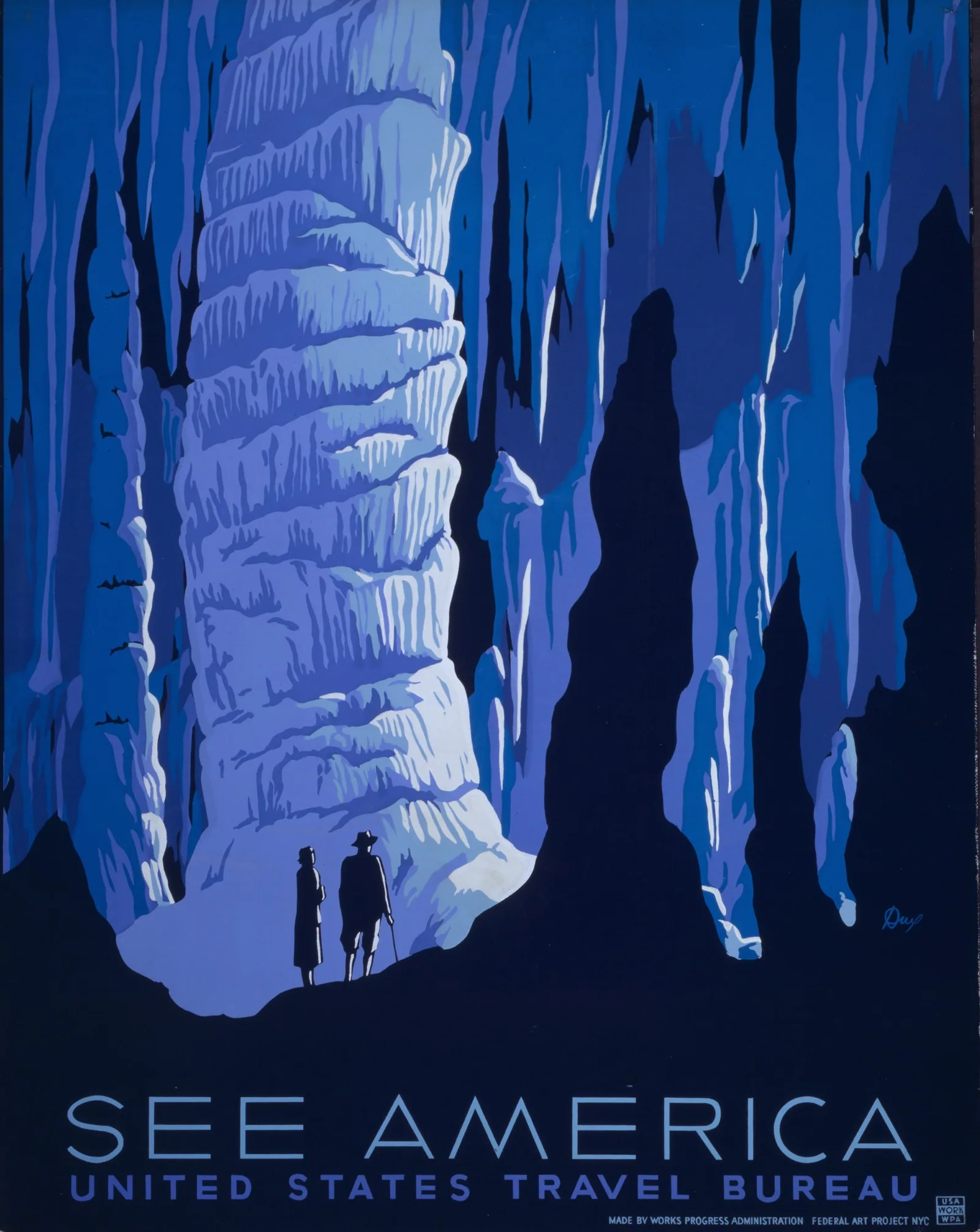
See America — Alexander Dux's Carlsbad Caverns Poster for the WPA, 1936–1939
This record presents the bluest poster of the American Depression: a silkscreen in midnight and ice, made by a government art programme to persuade Americans to holiday in a cave. "See America" was designed by Alexander Dux for the United States Travel Bureau and produced by the Works Progress Administration's Federal Art Project in New York City between 1936 and 1939; the copy reproduced here is held by the Library of Congress (reproduction number LC-USZC4-4243), whose rights advisory reads "No known restrictions on publication" [S1]. The Library catalogues it plainly — "Poster for the United States Travel Bureau promoting tourism, showing two people in Carlsbad Caverns, New Mexico" — and the Institute presents the Library's image with credit; the sheet itself is in Washington [S1]. The design is a lesson in scale. A cavern fills the sheet in layered blues: at centre-left a vast pale column rises tier on tier, its ledges drawn like frozen drapery; stalactites hang in dark silhouette at the right; and at the column's base, on a ledge, stand two visitors — a woman in a long coat, a man in a hat with a cane — tiny black figures against the stone. They are the measuring instrument of the picture: everything the traveller needs to know about Carlsbad Caverns — its depth, its darkness, its inhuman size — is told by how small the people are. At the foot, in letterspaced capitals, SEE AMERICA; beneath it, UNITED STATES TRAVEL BUREAU; and at the lower right the sheet signs its makers twice: the artist's script signature, "Dux", and the printed imprint — "MADE BY WORKS PROGRESS ADMINISTRATION FEDERAL ART PROJECT NYC" — beside the USA WORK WPA shield [S1]. The imprint is the history. In 1935 President Franklin D. Roosevelt established the Works Progress Administration under the New Deal, and within it Federal Project Number One funded the Federal Art Project — relief work for artists, which at its height employed more than five thousand of them [S2]. Poster divisions multiplied across the country — at least eighteen states by 1938 — with New York's the largest, descended from the Mayor's Poster Project of 1934 and led by Richard Floethe [S2]. The posters were first painted and lettered by hand, one by one; in 1936 the project artist Anthony Velonis adapted the silkscreen process to mass production, and a division could thereafter print as many as six hundred posters a day — artists designed and chose colours, technical staff screened the sheets, and Velonis with the curator Carl Zigrosser coined the word "serigraph" for the art of it [S2]. This poster is a colour silkscreen on board, and its flat, unmodulated blues are exactly what that process does best [S1]. Its customer was a campaign. The United States Travel Bureau was established in 1937, managed by the National Park Service, to promote travel inside the United States — to persuade a Depression public that the wonders were at home [S3][S4]. "See America" was its catchphrase, carried on posters for the national parks and monuments produced mostly by the WPA between 1936 and 1943 [S3]. The place in this one is named by the Library's own summary: Carlsbad Caverns, New Mexico — proclaimed a national monument in 1923 and made a national park by Congress in 1930, famous for its 8.2-acre Big Room [S1][S5]. Whether the great column in Dux's design depicts a specific named formation is stated by no source consulted, and this record does not guess one [GAP]. Of all the campaign's images, this is the one the Library of Congress itself chose, eighty years on, for the cover of its magazine's feature on the travel posters [S3]. The record's limits are the usual ones for relief-work paper, and they are kept visible. The Library dates the poster only to the range 1936–1939; the firmest single date attached to it is stamped on the back of the Library's copy — June 28, 1939 — which is why this record's year follows the stamp, with the range stated here [S1]. The Library's record gives no dimensions for this item; a secondary source captions it 28 by 22 inches, and that figure is recorded as an attribution in the evidence ledger, not as the Library's data [S1]. No print run for this design was found, and no count of surviving impressions of it; what is known is the fate of the class — of more than two million WPA posters printed, only about two thousand are known to exist, and the Library's 907, gathered in the 1940s, are the largest surviving group [S2][S6]. The poster was made to be pasted up, read at a distance, and thrown away. That this one can still be read at all is the accident the archive exists to catch. References / Sources [S1] Library of Congress, Prints & Photographs Division — item 96503125, "See America" (LC-USZC4-4243; DeNoon no. 136) — loc.gov/pictures/item/96503125/ [S2] Library of Congress — "Posters of the WPA" collection background — loc.gov/pictures/static/data/wpapos/resources/background.html [S3] Library of Congress Magazine, July/August 2021 — travel posters feature (cover: this poster) — loc.gov/lcm/pdf/LCM_2021_0708.pdf [S4] AIGA Eye on Design — "Celebrate 100 Years of the National Park Service…" — eyeondesign.aiga.org [S5] National Park Service — Carlsbad Caverns National Park brochure — home.nps.gov/cave/learn/upload/CAVE-Unigrid-Large-Print_Small-File.pdf [S6] Library of Congress — Work Projects Administration Poster Collection page — loc.gov/pictures/collection/wpapos/ Image credit — every image in this record: Library of Congress, Prints & Photographs Division, LC-USZC4-4243. Detail views are crops of the Library's copy transparency of the same poster, which has been cropped to the poster sheet for presentation.
Category: Travel & Hotels
Year: 1939
Rarity Class: A
Paper & Print Condition
The record is a digital presentation made from the Library of Congress's colour film copy transparency (LC-USZC4-4243) of its poster; no physical handling by this Institute is claimed, and the transparency's photographic targets and mounting frame have been cropped away so that only the poster sheet is presented. Within the sheet: the blues are deep and even, the pale column's tiered drawing is crisp, the lettering at the foot and the Federal Art Project imprint are fully legible, and the artist's script signature reads at lower right. The Library catalogues the object as a colour silkscreen print on board. Condition beyond what the transparency shows is the holding institution's to state, and is not asserted here.
Provenance & Rarity
The poster was designed by Alexander Dux and produced by the New York City poster division of the WPA Federal Art Project for the United States Travel Bureau, catalogued as DeNoon no. 136 in Posters of the WPA (1987). The copy presented here — its verso date-stamped June 28, 1939 — passed with the WPA poster holdings into the Library of Congress in the 1940s and remains in the Prints & Photographs Division (call number POS - WPA - NY .D88, no. 1). The Record Institute presents the Library's image for study, with the credit above, and claims no ownership of the object. Rarity is assessed as Class A under the Institute's method: the class survival is catastrophic — more than two million WPA posters printed from some 35,000 designs, about two thousand known to survive in total [S2][S6] — and this design stands at the head of its campaign, chosen by the Library of Congress as the cover image of its own magazine feature. No print run or per-design survival count exists in the sources, and none is claimed. The artist's signature is part of the printed design; under the Institute's rule a printed signature earns no uplift, and none is applied. No auction prices are cited.
Rarity & Condition Summary