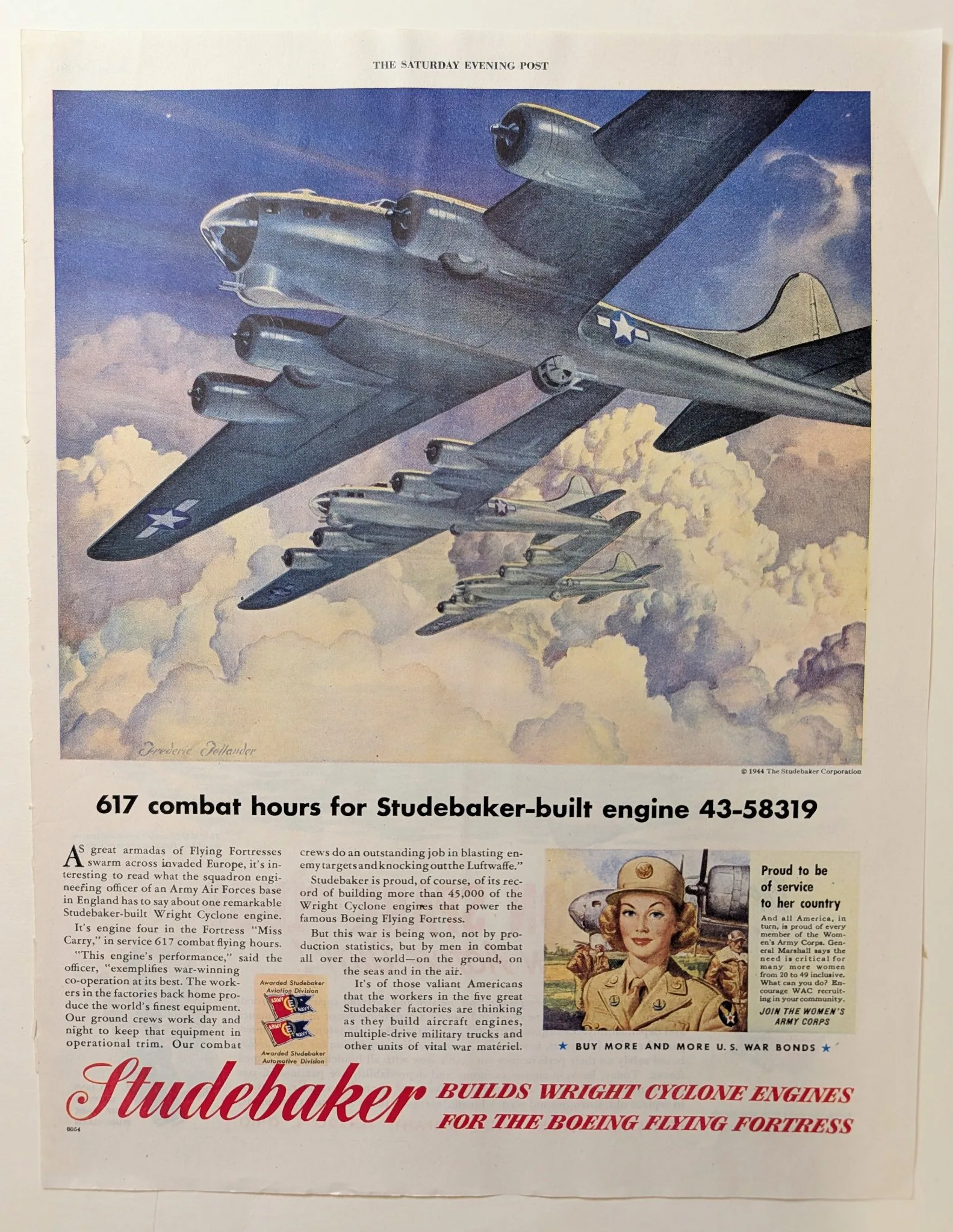
1944 Studebaker — "617 Combat Hours for Studebaker-Built Engine 43-58319" Magazine Advertisement
Object and source. The Record Institute holds the physical page: a single full-page colour Studebaker advertisement, from the owner's collection, photographed by the owner. The sheet carries its origin at the top — the masthead of The Saturday Evening Post — and its date within the artwork, in the painting's printed Studebaker copyright of 1944; the Institute accordingly catalogues the page to that year. The advertisement is attributed to The Saturday Evening Post from the page masthead; the issue date is unconfirmed. A small code, "6054", stands at the lower left; its meaning is not documented, and it is not read as a date. What the page shows and says. A colour painting fills the upper two-thirds: Flying Fortresses ride above a bright sea of cloud, the nearest seen from below, glass nose and four engines catching the light. Within the clouds at lower left the painter signed his name in script — Frederic Tellander. Below, the headline announces "617 combat hours for Studebaker-built engine 43-58319". The body copy presents it as the service record of "Miss Carry"'s number four engine, and quotes an unnamed engineering officer in England who praised it as "war-winning co-operation at its best". Hours and testimonial alike are the advertisement's own claims; no independent record of either has been found. The copy also claims more than 45,000 engines built, the company's figure at printing. Set into the text are the Army-Navy "E" pennants of the Aviation and Automotive Divisions; only the Aviation pennant bears a white star. At the right, a panel headed "Proud to be of service to her country" shows a smiling woman in WAC uniform, inviting women from 20 to 49 to join her. An appeal to buy more U.S. War Bonds and the red sign-off — "Studebaker builds Wright Cyclone engines for the Boeing Flying Fortress" — close the page. Historical setting. Studebaker of South Bend, Indiana — a maker of cars — had become a builder of aircraft engines under licence, with contracts from January 1941 and plants at South Bend, Fort Wayne, Chicago and Los Angeles. The engine was Wright's Cyclone R-1820, whose R-1820-97 form powered the B-17F and B-17G. By the war's end Studebaker had built 63,789 engines, and in the war's last twenty months every new Flying Fortress engine came from Studebaker Aviation. The bomber the advertisement names was real: "Miss Carry" was a B-17F of the 390th Bomb Group, 570th Bomb Squadron, based at Framlingham, England; two databases give her different serials, so this catalogue states none. The pennants were real honours: the Army-Navy "E", the industrial award for war-production excellence established in July 1942, came to the Aviation Division in May 1943 and the Automotive Division on 23 May 1944. The Aviation pennant's white star is a renewal star, for continued outstanding performance; since the page shows both pennants, it cannot predate late May 1944 — an inference from the award dates, a lower bound only. The WAC panel belongs to the same season: on 6 April 1944 General George C. Marshall ordered an intensified drive to build up the Women's Army Corps, whose ages of 20 to 49 the panel repeats. Its wording, which puts the urgency in Marshall's mouth, is the advertisement's own attribution; the memorandum supports the drive, not the quotation. Visual language and intended audience. Frederic Tellander, who painted the Fortresses, was born in Paxton, Illinois, in 1878, became a noted Chicago artist, painted in Paris between the wars, and exhibited ninety-three times at the Art Institute of Chicago between 1910 and 1941. He painted numerous Studebaker advertisements during the war, above all its B-17 pages. His painting here is luminous rather than martial: the bombers move through golden cloud and clear sky, heavy machines rendered with a landscape painter's tenderness, and his signature rests inside the painted sky itself, as a landscape artist signs a canvas. The page around the painting is built like a small ceremony of gratitude — testimonial, honours, an invitation to serve, an appeal to lend — addressed to the readers of a family weekly. Studebaker had no car to sell them in 1944; what the page offers instead is fellowship in a common effort, and it takes the reader's part in that effort seriously. Documentary significance. As evidence, the page binds in one sheet the three worlds the war had joined: factory, front and home. It preserves the Army-Navy "E" iconography at a precise, legible moment — one division's pennant already renewed with a star, the other's newly awarded — a small printed detail that carries its own chronology. It documents women's war service recruited inside a corporation's advertisement, in the very season of Marshall's drive. It preserves, in a mass medium, a signed painting by a documented American artist whose wartime commercial work is now collected in its own right. And in the curator's reading, its very structure is the message: painting, testimonial, pennants and panel repeat, in miniature, the chain of cooperation the officer's words praise — the workers who built, the crews who flew, and the community asked to send its daughters and buy its bonds. Curator's conclusion and limits. What cannot be said is recorded plainly. The exact issue of the Post is unconfirmed; the 617 hours, the engine and the testimonial remain the advertiser's claims, unverified against any surviving log; "Miss Carry"'s serial is disputed; Tellander's death year is given variously as 1968 and 1977, so it is omitted; and the code 6054 keeps its meaning. The class is A — a mass-campaign page raised one class by the artist's genuine signature within the painting. What survives is the thing itself: a single sheet of wartime paper, printed for one week's reading in 1944, which has carried Tellander's Fortresses and his signature in the clouds across eighty years. References / Sources S1 — Richard Norton Gallery, "Frederic Tellander (American, 1878–1977)" — https://Richardnortongallery.com/artists/frederic-tellander S2 — Aero Vintage Books, "Studebaker B-17 Artwork: A Personal Story" — https://www.aerovintage.com/2024/03/29/studebaker-b-17-artwork-a-personal-story/ S3 — Invaluable, Frederic Tellander artist page (dates given as 1878–1968; Studebaker advertisement lithograph records) — https://www.invaluable.com/artist/tellander-frederic-nfv3myn1q0/ S4 — Smithsonian National Air and Space Museum, Wright Cyclone R-1820-97 (Studebaker) — https://airandspace.si.edu/collection-objects/wright-cyclone-r-1820-97-studebaker-radial-9-engine/nasm_A19660459000 S5 — Military Trader, "Studebaker and the rest of the WWII story" — https://www.militarytrader.com/mv-101/studebaker-and-the-rest-of-the-wwii-story S6 — Madd Doodler, "Studebaker and the War Effort" — https://www.madddoodler.com/studebaker-and-the-war-effort S7 — "The Studebaker Corporation During World War II", Texas State University thesis (citing the South Bend Tribune, 13 May 1943 and May–June 1944) — https://digital.library.txst.edu/server/api/core/bitstreams/79f752e1-21ac-4b1e-8d4d-7976c42a882d/content S8 — George C. Marshall Foundation, "Marshall and W.A.C. Recruitment" — https://www.marshallfoundation.org/articles-and-features/marshall-w-c-recruitment/ S9 — B-17 databases (unit and base agreed; aircraft serial in conflict) — https://www.destinationsjourney.com/boeing-b-17-flying-fortress-nose-art-page-2/ ; https://b17flyingfortress.de/datenbank/aktuelle-eintraege/page/156 S10 — Maurer Maurer (ed.), Air Force Combat Units of World War II, 390th Bombardment Group entry; Treadwell, The Women's Army Corps (U.S. Army Center of Military History, 1954)
Category: Firearms & Military
Year: 1944
Rarity Class: A
Paper & Print Condition
The condition record rests on the owner's photographs of the physical page; no separate handling examination has been supplied, and the verso has not been photographed. The object is a single magazine leaf, printed in colour. The colour halftone screen is clearly legible in the macro views, resolving the painting into fine dot grain. The sheet shows light, even age toning in the unprinted margins, and gentle undulation along the edges with a soft handling wave across the lower part of the sheet, visible in the full-page photograph. Colours remain strong, and the image field appears clean: no tears, folds or losses are visible in the photographs. Physical dimensions were not supplied and are not recorded. Assessment is limited to what the photographs show.
Provenance & Rarity
The Institute holds the physical original, a single magazine page from the owner's collection, photographed by the owner; no acquisition documentation was supplied for this record. The page is an original period printing, not a reproduction. Its publication is identified from the sheet itself: the masthead of The Saturday Evening Post runs across the top, and the painting carries the printed copyright of The Studebaker Corporation, dated 1944; the exact issue is unconfirmed. The rarity class is recorded as A. The page is mass-campaign work produced for wide magazine circulation, and on scarcity alone it would sit at Class B; it is raised one class because the painting carries the genuine hand-applied signature of its artist, Frederic Tellander, within the artwork — the Institute's standing rule for signed work — and the attribution is independently documented. Copies of Studebaker's wartime advertisements survive in the paper trade, and no survival census exists. The page's significance — a signed Tellander painting, documented Army-Navy "E" honours, and a WAC recruiting panel on one sheet — is recorded in the article, separately from scarcity.
Rarity & Condition Summary