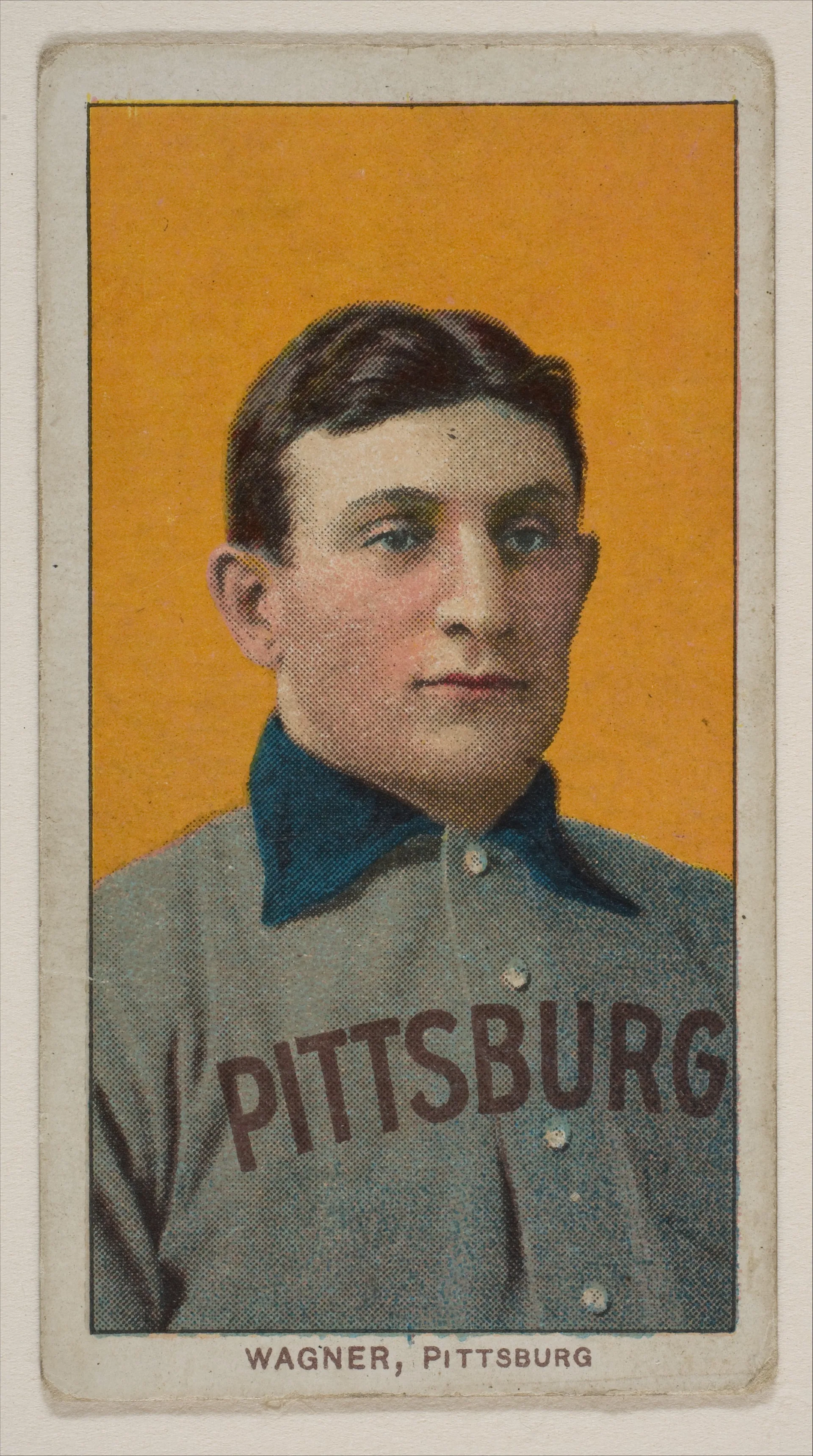
Honus Wagner, Pittsburgh — The T206 Baseball Card (1909–1911)
This record presents the most famous baseball card ever printed: the portrait of Honus Wagner of Pittsburgh from the White Border series — the set collectors know by Jefferson Burdick's catalogue code, T206 — issued by the American Tobacco Company between 1909 and 1911 [S1]. The card itself is held by The Metropolitan Museum of Art in New York, in the Jefferson R. Burdick Collection; it is reproduced here from the Museum's public-domain scan, with credit, because the Library of Congress collection behind this Institute's survey of America's first baseball cards holds no Wagner at all [S1][S5]. The card measures 2 5/8 by 1 7/16 inches — a sheet of printed paper small enough to hide under a playing card, made to be slipped inside a pack of cigarettes [S1]. Look at the portrait first. Wagner fills the frame against a flat yellow-orange ground, turned three-quarters toward the viewer, in the white uniform of Pittsburgh with PITTSBURG lettered across the chest in red. Below the portrait, a caption line reads WAGNER, PITTSBURG — the city's name spelled without its final "h", as the card has it. There is no stadium, no bat, no action: a face, a uniform, a colour field. The image began as a photograph — the set's portraits, Wagner's among them, were based on photographs by Carl Horner — and the American Lithographic Company of New York translated those photographs into layered colour lithographs, printed with dyes imported from Germany of a quality the National Postal Museum singles out [S1][S3]. One card went into each pack; the backs carried advertisements for sixteen brands of cigarettes and loose tobacco, Sweet Caporal and Piedmont among them [S1][S3]. The set around this portrait was the largest of the tobacco-card era: 523 cards by the National Postal Museum's count, "nearly 525 color portraits" in the Library of Congress's description [S3][S5]. It was produced at the height of the American Tobacco Company's power — the trust that had revived pack inserts, premiums and coupons in 1907, opening what the Postal Museum calls the second great era of American tobacco cards, and that the Supreme Court dissolved in 1911, the set's final year [S3]. Wagner's card should have been one portrait among hundreds. Instead its printing was cut short, because the player objected — on that point the sources agree. On the reason, they divide, and this record keeps the two accounts separate, as the institutions that preserve them do [S1][S3]. The first account is the famous one. The Met records that the card "is extremely rare because the player apparently did not want tobacco products to be sold to children, who were avidly collecting sports cards, and quickly pulled it from production"; the historian Dave Jamieson notes that Wagner's descendants have promoted this theory [S1]. Period evidence survives: The Sporting News reported on 24 October 1912 that the company had offered the sportswriter John Gruber a ten-dollar fee to arrange the Pirates' sittings, that Wagner refused permission — and that he sent Gruber a cheque for ten dollars of his own money to cover the lost fee, with the words: "I don't want my picture in any cigarettes, but I also don't want you to lose the 10 dollars, so I'm enclosing my check for that sum." Gruber never cashed the cheque [S3]. The second account is about money. Jamieson, in the Met's own podcast, offers the alternative "that he felt like he deserved some money for his image being used" — in an era when players received little or nothing for their likenesses [S1]. The Postal Museum records the sceptics' evidence: Wagner was known to smoke cigars and chew tobacco; his image had appeared on a cigar-box lid of about 1897, on a cigar advertising card, in a 1909 Murad cigarette advertisement and on a 1910 cigar box — though the Museum also notes those uses were either made without his permission or sold products not aimed at children [S3]. The honest summary is Jamieson's: "We don't exactly know why." What is certain is the result — a portrait stopped early, and a card that the whole hobby would spend a century chasing [S1]. How many survive is likewise a matter of attributed estimates, and this record prints them as such: the Met's essay on the Burdick Collection gives 57 copies known to exist; Jamieson, in the Museum's podcast, puts survival at "probably somewhere between fifty and one hundred" [S1][S2]. No verified count of the original printing exists, and none is claimed here [GAP-02]. The copy in this record carries its own distinction: it belongs to the collection of Jefferson Burdick (1900–1963), the Syracuse electrician who began collecting at ten and, from 1947, gave the Met his entire life's gathering — some 303,000 advertising inserts, postcards and posters, including more than 30,000 baseball cards — then spent fifteen years at the Museum arranging it into albums at a small oak desk in the department [S1][S2]. The card's object number, 63.350.246.206.378, still carries his system inside it: 206 is the T206 set number, from the American Card Catalog in which Burdick classified every American card series — the taxonomy collectors still use [S1][S4]. Three limits frame this record, and they are stated rather than filled. The Met serves no image of the back of its copy, so which of the sixteen brand advertisements this particular card carries cannot be known from the record [GAP-01]. No institutional source gives a verified print run for the Wagner portrait [GAP-02]. And the Met's own catalogue currently serves no downloadable image for this object at all; the reproduction used here is the Museum's scan as published on Wikimedia Commons, where the underlying 1909–1911 card is public domain by age — the chain of custody for the image is recorded in this record's evidence ledger, and no claim is made that the file came from Met Open Access [GAP-04]. What the record can say plainly is what the Met says of the object itself: in the greatest collection of printed cards ever assembled by one man, this is "the rarest card" [S1]. References / Sources [S1] The Metropolitan Museum of Art — object page and podcast transcript, "Honus Wagner, Pittsburgh, National League, from the White Border series (T206) for the American Tobacco Company", object 63.350.246.206.378 — metmuseum.org/art/collection/search/413556 [S2] The Metropolitan Museum of Art — "Ephemera in the Jefferson R. Burdick Collection", Perspectives — metmuseum.org/perspectives/ephemera-in-the-jefferson-r-burdick-collection [S3] Smithsonian National Postal Museum — Stephen Wong, "T206 Honus Wagner" — postalmuseum.si.edu/t206-honus-wagner-psa-5-baseball-card [S4] National Baseball Hall of Fame — "#Shortstops: Judging Baseball Cards" — baseballhall.org/discover/shortstops/judging-baseball-cards [S5] Library of Congress — "About the Benjamin K. Edwards Collection of Baseball Cards" — loc.gov/collections/baseball-cards/about-this-collection/ Image credits — every image in this record: The Metropolitan Museum of Art, New York — The Jefferson R. Burdick Collection, Gift of Jefferson R. Burdick. Detail views are crops of the Museum's scan of the same object; the three fellow portraits shown for context (Walter Johnson, Rube Waddell, Chief Bender) come from the same collection at the Met (via Wikimedia Commons, CC0).
Category: Sports & Outdoors
Year: 1909
Rarity Class: S
Paper & Print Condition
The record is a digital presentation of the card held by The Metropolitan Museum of Art, made from the Museum's scan; no physical handling by this Institute is claimed. In the scan, the card presents as a complete White Border portrait: the yellow ground is even, the uniform lettering and the caption line are sharp, and the white border is intact on all four sides. The lithography's flat colour and fine registration are clearly legible at enlargement — the portrait's photographic origin remains visible in the modelling of the face. The Met catalogues the sheet at 2 5/8 × 1 7/16 inches and records it mounted in the Burdick albums; condition beyond what the scan shows is the holding institution's to state, and is not asserted here.
Provenance & Rarity
The card was issued by the American Tobacco Company, 1909–1911, and passed into the collection formed by Jefferson R. Burdick, who gave it to The Metropolitan Museum of Art with his collection (object 63.350.246.206.378, The Jefferson R. Burdick Collection, Gift of Jefferson R. Burdick). It remains at the Met; The Record Institute presents its public-domain scan for study, with the credit above, and claims no ownership of the object. Rarity is assessed as Class S under the Institute's method. The production was stopped early at the player's objection; survival is estimated by the holding institution at 57 copies known (The Met, Perspectives), with a published range of fifty to one hundred (Jamieson). The Met calls the card the rarest in the Burdick Collection, and its position in the culture of collecting — the defining object of the tobacco-card era, catalogued by the man who invented the taxonomy — is recorded here as contextual significance, which under the Institute's method supports the class. Auction prices play no part in the assessment and none are cited.
Rarity & Condition Summary