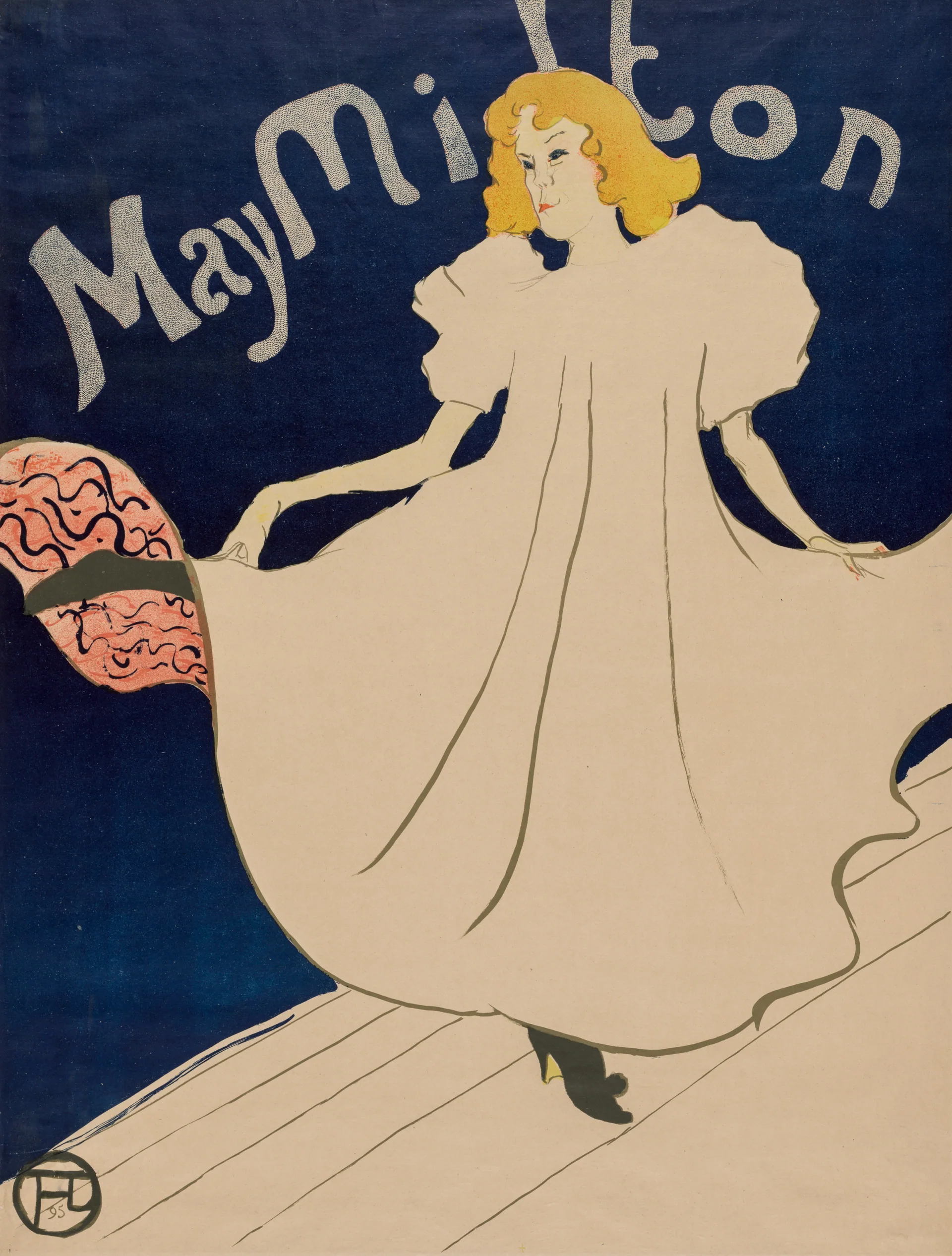
May Milton, 1895: Toulouse-Lautrec's Poster for the Dancer Who Vanished
The poster reproduced here is the Cleveland Museum of Art's impression of May Milton, a colour lithograph designed by Henri de Toulouse-Lautrec and printed in Paris in 1895 by Edward Ancourt. The Museum catalogues the sheet at 79.5 by 61.5 centimetres and releases its image under CC0; the print is number 356 in Loys Delteil's catalogue of Lautrec's printed work. It is not a picture of a performance. It is the advertisement for one — the entire surviving fame of an English dancer, compressed into a single sheet. What the sheet shows is radical economy. Against a ground of deep ultramarine, Milton stands on stage boards drawn as a steep diagonal, holding her skirt out with both hands so that the white dress becomes a sail of unprinted paper, modelled by little more than contour. Her face, in three-quarter view, looks downward, almost absent-minded — the Victoria and Albert Museum's description calls her "a rather fey young woman, swirling her skirts". Her name arches behind her in enormous stippled letters, white spatter-work cropped by the top edge of the sheet, and at the lower left sits Lautrec's monogram in its circle, dated 95. At the left edge the pink, black-patterned back of a chair cuts into the composition, and beneath the hem of the dress a single black shoe with a yellow heel escapes onto the boards. There is no venue, no date, no programme. The poster sells a name and a silhouette, and trusts Paris to do the rest. The setting was the café-concert Paris of the mid-1890s, where the illustrated poster — the affiche artistique — had become the city's public art, protected by law since 1881 and collected by connoisseurs who sometimes took impressions straight from the printer. Lautrec, who had announced himself in 1891 with his Moulin Rouge poster, was its presiding genius: a small company of posters among the roughly 350 lithographs of his printed oeuvre. May Milton was an English dancer appearing at the Moulin Rouge, one of the café-concerts where Lautrec kept his nightly court. The Cleveland Museum records that she was the romantic partner of May Belfort, the Irish singer whose own Lautrec poster — red dress, cradled cat — belongs to the same year and the same small circle. The commission for Milton's poster came through friendship: the Yale University Art Gallery records that Jane Avril, the Moulin Rouge's reigning star and Lautrec's closest friend among its performers, persuaded the artist to design it, and the V&A records that Milton commissioned the sheet to advertise her coming tour of the United States. A poster for export, then — made to precede a dancer across the Atlantic and paste her name on American walls before she arrived. Its visual language is the language of that ambition. Five colours only — the deep blue, the white of the dress, the yellow of hair and heel, the pink of the chair, the black of line and shoe — laid down with brush and spatter lithography, the crachis stipple that gives the lettering its chalky sparkle. Lautrec crops the stage, tilts the floor, and lets the dress do what a column of type could not: the poster is legible at fifty paces as pure shape — blue, white, a name — and rewards approach with the small, wry details of the face and the shoe. It is advertising designed by a man who understood that a Parisian wall was a gallery with traffic in front of it. The documentary significance of the sheet is sharpened by everything that did not survive. Of May Milton's dancing, her American tour, her life after the mid-1890s, the record in the sources consulted for this entry is close to silence; she is, effectively, this poster. Even the poster had a second life she could not have foreseen: Pablo Picasso admired it, and six years later painted it hanging on the wall in The Blue Room (1901), his portrait of a Paris interior now in the Phillips Collection — the advertisement already promoted to art, quoted by the next century's defining painter. The Institute files the record as Class A: the edition was small (the poster's second state is catalogued at one hundred impressions), the image is a canonical work of the affiche era, and impressions — the reason it is not rarer — rest today in Cleveland, New York, London and New Haven. The dancer vanished. The advertisement, printed to last a season, is what immortality she got. Two limits belong on the record. The course of the American tour the poster announced — its dates, cities and reception — is thinly documented in the sources opened for this entry, and this text asserts nothing about it. And sheet dimensions vary slightly between impressions (the Yale sheet is trimmed); the dimensions given are those of the Cleveland impression reproduced here. References / Sources [S1] The Cleveland Museum of Art — Open Access record 1952.10: catalogue data, catalogue raisonné numbers, CC0 status, and the Museum's account of Milton, the Moulin Rouge and the American tour. [S2] Yale University Art Gallery — "May Milton", acc. 1968.89: printer Edward Ancourt; Jane Avril's role in the commission; Picasso and The Blue Room. [S3] Victoria and Albert Museum — "May Milton", E.1375-1931 and CIRC.273-1964: five colours; second state; monogram signature; commission for the American tour; Picasso. [S4] The Metropolitan Museum of Art — "May Milton", 63.663.6: medium and dimensions of a further impression.
Category: Art & Museums
Year: 1895
Rarity Class: A
Provenance & Rarity
Henri de Toulouse-Lautrec (1864–1901) · May Milton · Paris, 1895 — Colour lithograph in five colours, printed by Edward Ancourt. An English dancer at the Moulin Rouge, advertised for an American tour she would not be remembered for — but the poster was. Picasso pinned it to the wall of The Blue Room six years later. The Cleveland Museum of Art, 1952.10.