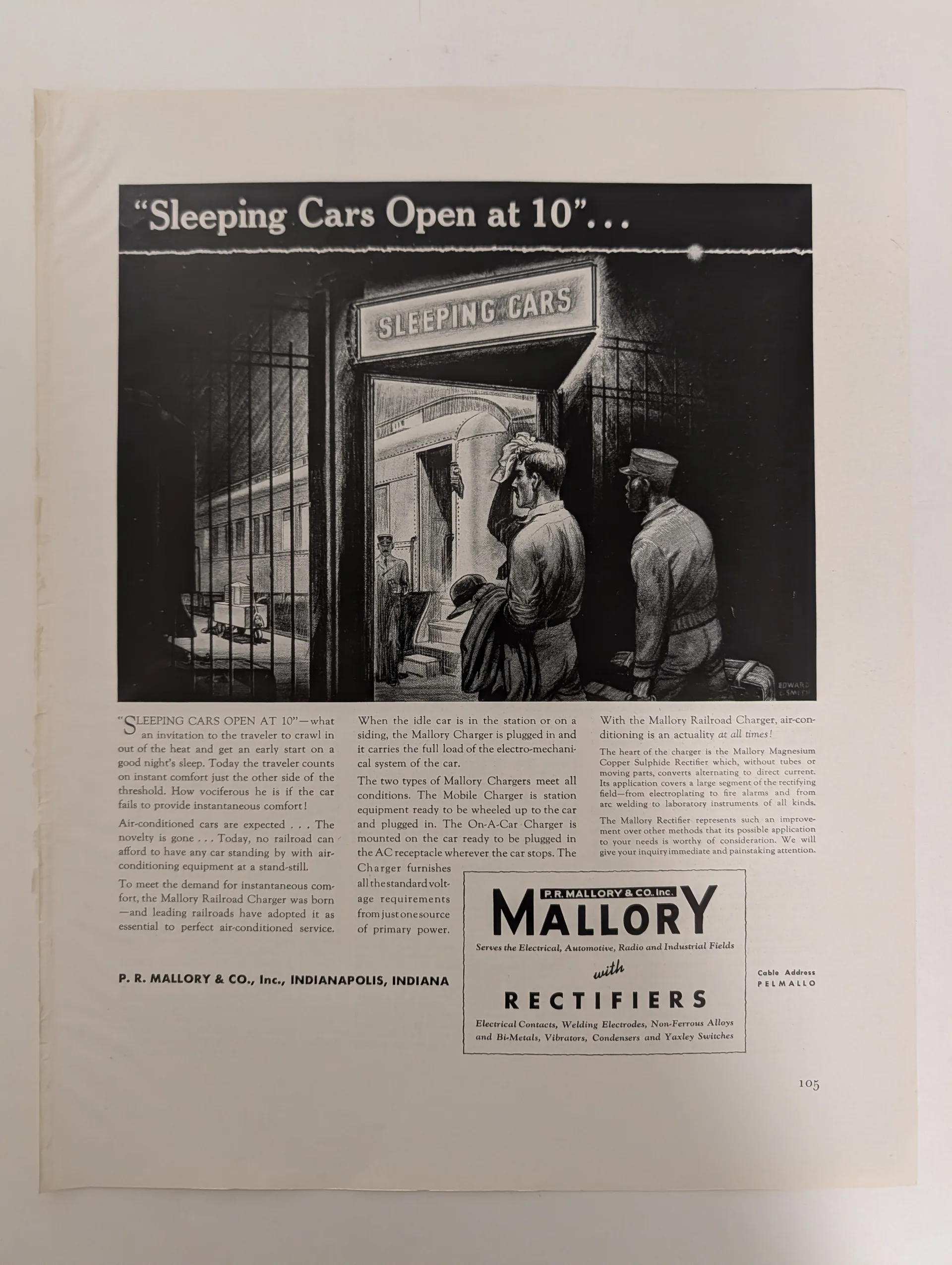
Undated P.R. Mallory & Co. "Sleeping Cars Open at 10" Rectifier Advertisement
Paragraph 1 — Visual Description: The supplied images show a single portrait magazine leaf printed in black on an off-white stock, photographed loose on a light surface with wide unprinted margins at all sides. The upper half is dominated by a large dark halftone illustration of a nighttime railway scene, headlined across its top in white serif capitals: "Sleeping Cars Open at 10"… A hanging illuminated sign reading "SLEEPING CARS" is fixed above an open doorway through which a heavyweight sleeping car with a rounded roof and clerestory windows is visible, bathed in light. In the right foreground a traveler in shirtsleeves, hat in one hand and coat over his arm, mops his brow with a handkerchief; beside him a uniformed porter in a cap stands with luggage (a suitcase is legible at the lower right corner). A second uniformed figure stands in the car doorway at center. At left, behind a vertical-barred fence, a passenger train with lit windows stretches into the dark, and a wheeled equipment cart stands on the platform. The entire scene is rendered in high-contrast chiaroscuro, with the sign's glow the principal light source. A printed signature in dotted halftone caps sits at the lower right of the illustration, reading "EDWARD" over a second line consistent with "C. SMITH" — described here as a printed signature only; no biographical attribution is made. Below the illustration, body copy runs in three serif columns, and a boxed company panel at the lower right carries the large sans-serif word "MALLORY" with "P. R. MALLORY & CO., Inc." reversed out of a black band. The numeral "105" appears at the lower right margin. No publication name and no year are printed on the sheet as photographed. Paragraph 2 — Printed Text & Marks: The illustration headline reads: ""Sleeping Cars Open at 10"…"; the hanging sign reads "SLEEPING CARS". The three-column body copy reads, column one: ""Sleeping cars open at 10" — what an invitation to the traveler to crawl in out of the heat and get an early start on a good night's sleep. Today the traveler counts on instant comfort just the other side of the threshold. How vociferous he is if the car fails to provide instantaneous comfort! Air-conditioned cars are expected . . . The novelty is gone . . . Today, no railroad can afford to have any car standing by with air-conditioning equipment at a stand-still. To meet the demand for instantaneous comfort, the Mallory Railroad Charger was born — and leading railroads have adopted it as essential to perfect air-conditioned service." Column two: "When the idle car is in the station or on a siding, the Mallory Charger is plugged in and it carries the full load of the electro-mechanical system of the car. The two types of Mallory Chargers meet all conditions. The Mobile Charger is station equipment ready to be wheeled up to the car and plugged in. The On-A-Car Charger is mounted on the car ready to be plugged in the AC receptacle wherever the car stops. The Charger furnishes all the standard voltage requirements from just one source of primary power." Column three: "With the Mallory Railroad Charger, air-conditioning is an actuality at all times! The heart of the charger is the Mallory Magnesium Copper Sulphide Rectifier which, without tubes or moving parts, converts alternating to direct current. Its application covers a large segment of the rectifying field — from electroplating to fire alarms and from arc welding to laboratory instruments of all kinds. The Mallory Rectifier represents such an improvement over other methods that its possible application to your needs is worthy of consideration. We will give your inquiry immediate and painstaking attention." The boxed panel reads "P. R. MALLORY & CO., Inc. / MALLORY / Serves the Electrical, Automotive, Radio and Industrial Fields / with / RECTIFIERS / Electrical Contacts, Welding Electrodes, Non-Ferrous Alloys and Bi-Metals, Vibrators, Condensers and Yaxley Switches". Beneath the columns at lower left: "P. R. MALLORY & CO., Inc., INDIANAPOLIS, INDIANA". At lower right: "Cable Address / PELMALLO", and the page numeral "105". Under the designation-parsing rule, the printed "105" supports page number 105 and nothing further. No copyright line, publication name, or date is resolvable at the supplied resolution; this is a limit of the reproduction, not evidence that none was printed. Paragraph 3 — Maker Context: The printed credits name one entity, treated here at the minimum the credit supports: "P. R. MALLORY & CO., Inc., INDIANAPOLIS, INDIANA" is the advertiser, and the boxed panel "MALLORY … with RECTIFIERS" identifies the product line as rectifiers, listing further lines (electrical contacts, welding electrodes, non-ferrous alloys and bi-metals, vibrators, condensers and Yaxley switches). Whether P. R. Mallory & Co. commissioned, produced, or only placed the advertisement cannot be determined from the credit line alone and requires downstream verification. The illustration carries a printed signature reading "EDWARD" over a second line consistent with "C. SMITH" (Moderate confidence on the reading); the signature is described as a printed mark only, and no artist identity, biography, or attribution is asserted on the basis of the signature alone. No agency, printer, or publication credit is visible. Paragraph 4 — Geographic & Audience Context: The printed credit places the advertiser in Indianapolis, Indiana, United States, with the cable address "PELMALLO" — a mark of a firm doing business beyond its home office by telegraph. The advertisement's argument is addressed to railroad purchasing and engineering decision-makers: it speaks of "leading railroads" having adopted the charger, of standard-voltage requirements, and of inquiry handled with "immediate and painstaking attention." The headline's "Sleeping Cars Open at 10" names a concrete station practice — opening the sleeping car for boarding well before departure — and the copy's emphasis on "instantaneous comfort" positions the product inside the economics of air-conditioned passenger service. No date is printed; dating evidence internal to the sheet is limited to the technology described (air-conditioned sleeping cars, a magnesium copper sulphide rectifier with no tubes or moving parts), and no year is asserted here. Paragraph 5 — Visual Language Analysis: The visual language is commercial dramatic realism: a photomechanical halftone illustration worked in near-black tones, with a single warm-lit focal point — the "SLEEPING CARS" sign and the lit car doorway — cutting through night. The advertisement opens with the problem before the product: the sweating traveler wiping his brow is the grievance, and the sign is the promise. Type hierarchy does the selling work in the lower half: the enormous sans-serif "MALLORY" anchors the company panel, while the body copy's three columns argue in the voice of a technical sales letter — problem, specification, and invitation to inquire. The composition's night setting is functional: it stages the moment ("Sleeping Cars Open at 10") when the idle car's own power is shut down and the charger's value becomes legible to a railroad officer reading the page. Paragraph 6 — Function & Archival Significance: The leaf functioned as business-to-business sales literature placed in a periodical (page 105), aimed at converting railroad officers and electrical engineers into inquirers for a rectifier product. Its argument has three moves, all printed on the page: normalize the expectation (air-conditioned sleeping cars are now expected, the novelty gone), name the operational gap (an idle car in the station or on a siding has its air-conditioning equipment at a stand-still), and present the Mallory Railroad Charger — in Mobile and On-A-Car types, built around a magnesium copper sulphide rectifier — as the installed answer. What the artifact documents that other sources do not is the selling language of electrified rail comfort in its own period terms: "instantaneous comfort," the traveler's vociferous complaint, the charger "plugged in" wherever the car stops. The leaf is photographed loose; its original assembly cannot be inferred from its present state, and no publication, date, or circulation is asserted.
Category: Art & Museums
Rarity Class: B
Paper & Print Condition
The black key — illustration linework, body type, rules, and the company panel — appears visually crisp at the supplied resolution, with tonal gradation stepping from the lit sign and car doorway down to solid night blacks; halftone dot structure is resolvable in the signature close-up, consistent with photomechanical halftone reproduction (Moderate confidence). The paper reads as an off-white or cream uncoated stock with an even, light age-toning across the unprinted margins. The full-page view shows slight waviness along the left sheet edge and a small dark mark near the top margin above the headline. Likely process: probable letterpress text with a halftone illustration block (physical examination required for confirmation). Confidence: Moderate. Minimum distinguishable colour separations resolvable in the supplied image: 1 (black key). This is a floor, not a count. No handling or storage history is inferred from the observed toning, edge waviness, or the top-margin mark.
Provenance & Rarity
Source media observed: a single black-and-white magazine advertisement leaf, numbered "105" in the lower right margin, photographed as a loose sheet. The publication name, date of issue, original acquisition record, prior ownership, and the circumstances under which this leaf left its issue are undocumented in the supplied material: [AWAITING CURATORIAL ASSIGNMENT]. No rarity assessment is made here: [AWAITING CURATORIAL ASSIGNMENT — C–OMEGA scale]. No comparative survival claim is advanced for periodical advertisement leaves without documented holdings data.
Rarity & Condition Summary
The leaf presents as an intact single sheet with crisp linework and legible tonal illustration; the unprinted margins carry an even, light age-toning, slight waviness is visible along the left edge in the full-page view, and a small dark mark appears near the top margin above the headline. The printed text — including the three-column body copy, the boxed MALLORY panel, the cable address PELMALLO, and the page number "105" — is fully legible at the supplied resolution. The rarity half of this summary is [AWAITING CURATORIAL ASSIGNMENT]; nothing in the observed condition is used here to imply scarcity or to grade the object.