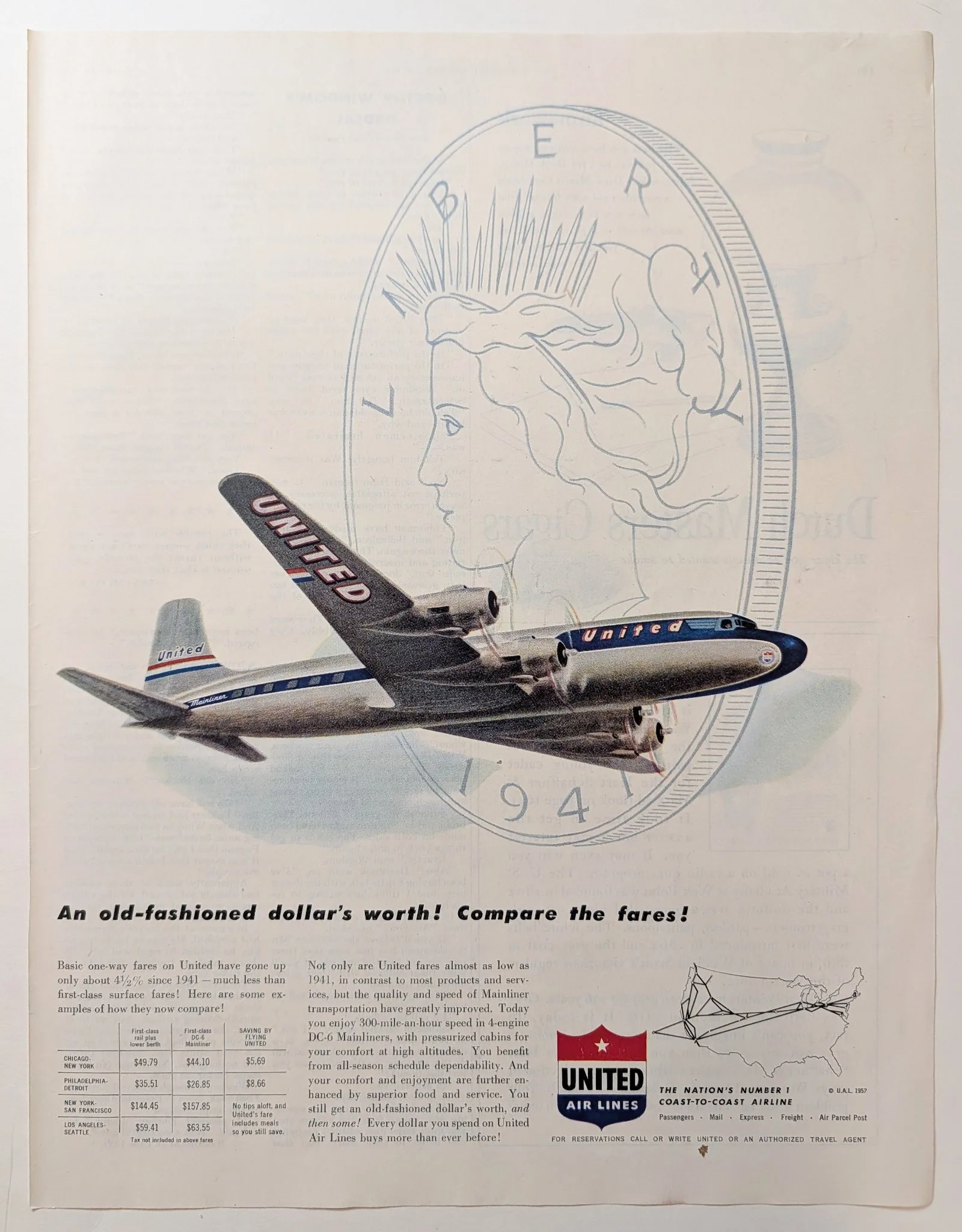
1952 United Air Lines "An Old-Fashioned Dollar's Worth!" DC-6 Mainliner Magazine Advertisement
Object and source. This is a full-page color magazine advertisement for United Air Lines, printed in 1952 — the page itself carries the line "© U.A.L. 1952" (U.A.L. = United Air Lines). The headline reads "An old-fashioned dollar's worth! Compare the fares!" and the page promotes United's DC-6 "Mainliner" service on its coast-to-coast routes. The source magazine and issue are unidentified: the owner's physical copy is a clipped full page with no masthead visible, supplied to TRI as photographs of the recto only. No verso was supplied. What the page shows and says. The composition is dominated by a giant pale watermark of a United States silver dollar: Liberty's head in profile facing left with flowing hair, the word "LIBERTY" around the upper rim, and a date at the bottom reading "194[1]" — the first three digits clearly legible, the final digit partly covered by the aircraft. Bursting through this ghost-currency is a color illustration of a four-engine Douglas DC-6 in United's polished-metal livery, shown in three-quarter front view with all engines running: "UNITED" in large red serif letters on the wing, "United" on the nose, and the script word "Mainliner" on the rear fuselage. Below the headline, two columns of body copy argue that "Basic one-way fares on United have gone up only about 4½% since 1941" — a claim presented here exactly as the advertisement states it, not as a verified fact. Beside the copy sits a fare table set like a ledger, comparing "First-class rail plus lower berth" against "First-class DC-6 Mainliner" on four routes: Chicago–New York, 49.79 USD by rail against 44.10 USD by United, a saving of 5.69 USD; Philadelphia–Detroit, 35.51 USD against 26.85 USD, saving 8.66 USD; New York–San Francisco, 144.45 USD against 157.85 USD; and Los Angeles–Seattle, 59.41 USD against 63.55 USD. For the two routes where flying costs more, the table answers: "No tips aloft, and United's fare includes meals so you still save." A footnote adds that tax is not included. The lower right carries United's red-white-and-blue heraldic shield with a white star, an outline map of the continental United States webbed with black route lines, and the line "THE NATION'S NUMBER 1 COAST-TO-COAST AIRLINE." Beneath run the services — "Passengers · Mail · Express · Freight · Air Parcel Post" — and the instruction "FOR RESERVATIONS CALL OR WRITE UNITED OR AN AUTHORIZED TRAVEL AGENT." Historical setting. In 1952 United was one of America's "Big Four" domestic trunk carriers, operating in an era when interstate airline fares were set under federal authority — the Civil Aeronautics Act of 1938 gave the government control of airline tariffs and rates, exercised through the Civil Aeronautics Board from 1940 [S3]. Airlines could not simply raise or cut fares at will. That is what makes this advertisement structurally possible as an argument: between 1941 and 1952 the general American price level rose roughly 80 percent (BLS CPI-U annual averages, 14.7 to 26.5) [S2], while air fares sat under regulation. Whether or not the ad's "4½%" figure can be independently verified — it cannot be, from the records identified for this article, and it stands here as an advertising claim — the airline genuinely had a "we held the line" story to tell. The aircraft is the Douglas DC-6, the backbone of the postwar airline expansion: a stretched, pressurized development of the DC-4, powered by four Pratt & Whitney R-2800 "Double Wasp" radial engines, cruising at roughly 300 to 315 miles per hour depending on variant [S4]. Commercial service began on 27 April 1947, flown by United and American; 704 were built across all variants. "Mainliner" was United's own fleet brand name, applied across its DC-3s, DC-4s, and DC-6s — individual aircraft carried city names — and was not a Douglas technical designation [S7]. The DC-6's first year was shadowed by a fleet-wide grounding in November 1947 after an inflight fire destroyed United Flight 608 at Bryce Canyon, Utah, on 24 October 1947; the cause was found and the fleet returned to service in March 1948 [S5]. Four years later, copy boasting "all-season schedule dependability" was not filler — it was a point the industry had earned back. The fare table's rail column is equally period-correct. "First-class rail plus lower berth" priced the Pullman sleeper — the DC-6's real competitor on long routes. In 1952 the traveler choosing between Chicago and New York was genuinely choosing between the sleeping car and the pressurized cabin. Visual language and intended audience. The giant coin is the argument made visible: money, made literal, with the airplane flying out of the dollar. The fare table is set like an audited ledger — exact cents, ruled columns — so that the typography itself performs honesty. The route map is spare black line-work on a plain national outline: visual proof of "coast-to-coast." The palette is disciplined — metal grays and blues for the machine, a pale blue wash for the coin, one red-and-blue shield as the accent. It says engineering you can trust. The intended reader is the fare-paying traveler of 1952, the business or leisure passenger weighing rail against air, being told that the modern choice is also the thrifty one. Documentary significance. Two things make this page worth keeping. First, the fare table is primary price evidence of the regulated-fare era: four route pairs with exact dollar figures, including the Pullman rail column that prices a whole vanished mode of travel. Second — and this is the article's true subject — the giant 1941 dollar never existed. No United States dollar coin of any type was ever minted dated 1941: Peace dollars were issued only in 1921–1928 and 1934–1935, and no circulating dollar coins were produced at all from 1936 to 1970 [S1]. The artist could not photograph a real 1941 dollar because none existed, so the art department simply invented one, modeling its Liberty loosely on the Peace dollar. It is a beautiful, honest-in-intent falsehood: the coin is real as a symbol and counterfeit as a specimen. An advertisement about inflation, built around a coin the mint never made — that is the story this page tells about 1952. Curator's conclusion and limits. This is a document of the regulated-fare era and of postwar America's inflation anxiety, preserved in the exact year its argument was made. The 1952 date is fixed by the page's own copyright line. What remains unknown: the source magazine and issue, the advertising agency of record, and the illustrating artist — the page carries no signature, and no name is attached anywhere in this record. The ad's fare arithmetic is presented as the advertiser's claim, not as TRI-verified fact. References / Sources [S1] U.S. Mint records; Yeoman's Red Book — Peace dollar mint dates 1921–1928, 1934–1935; no circulating dollar coins 1936–1970; no dollar coin dated 1941 ever issued. [S2] U.S. Bureau of Labor Statistics, CPI-U annual averages (1982–84=100): 1941 = 14.7; 1952 = 26.5. [S3] Civil Aeronautics Act of 1938 (52 Stat. 973), Title IV; Civil Aeronautics Board authority from 1940 (Reorganization Plan No. IV). [S4] National Air and Space Museum type records; Boeing/McDonnell Douglas DC-6 history; Francillon, McDonnell Douglas Aircraft since 1920 — DC-6 specs, service entry 27 April 1947, 704 built. [S5] CAB Accident Investigation Report — United Flight 608, Bryce Canyon, Utah, 24 October 1947; fleet grounding November 1947; return to service March 1948. [S6] Leo Burnett–United "Fly the Friendly Skies" documentation (1965 only); Smithsonian NMAH Archives Center, N.W. Ayer records (agency unverified for this ad). [S7] United fleet-naming records — "Mainliner" as United's commercial fleet brand across DC-3/DC-4/DC-6 types. [S8] United pre-jet-era heraldic shield identity, consistent with early-1950s advertising (logo debut year not primary-sourced; not stated).
Category: Airlines
Year: 1952
Rarity Class: B
Paper & Print Condition
Single full-page magazine leaf, examined from photographs only; no direct physical examination was supplied. The sheet is printed in offset lithography — the halftone dot structure of the process is visible in close-up photographs of the fuselage lettering. Colors remain strong: the aircraft rendering holds its metal grays and blues, and the red-white-and-blue shield logo is unfaded. The paper shows the even, light toning of early-1950s coated magazine stock; no tears, folds, or losses are visible in the supplied images. One small brown age spot is visible near the bottom margin, below the reservations line. The pale blue coin watermark is an intentional printed design element, not fading or discoloration. Page edges appear complete with no cropping of printed content. Verso was not photographed and its condition is unrecorded.
Provenance & Rarity
The source magazine and issue are unidentified — the owner's physical copy is a clipped full page with no masthead, supplied to TRI as recto photographs. The page is an original 1952 printed advertisement, not a reproduction; its date is fixed by the printed line "© U.A.L. 1952." No acquisition documentation was supplied for this draft, and no ownership history prior to the current owner is recorded. The advertising agency of record and the illustrating artist are both unidentified; the page carries no signature or agency key. Rarity class B, curator-assessed: this is unsigned commercial work from a major carrier's large magazine campaign, which argues against a higher class — yet the documentary payload is well above average. The fare table preserves exact 1941/1952 air and Pullman rail prices across four routes, constituting primary price evidence of the federally regulated-fare era, and the invented 1941 dollar coin gives the piece a genuinely original curatorial story. No survival census exists for this insertion; the assessment rests on campaign commonness weighed against documentary distinction, not on a counted population.
Rarity & Condition Summary