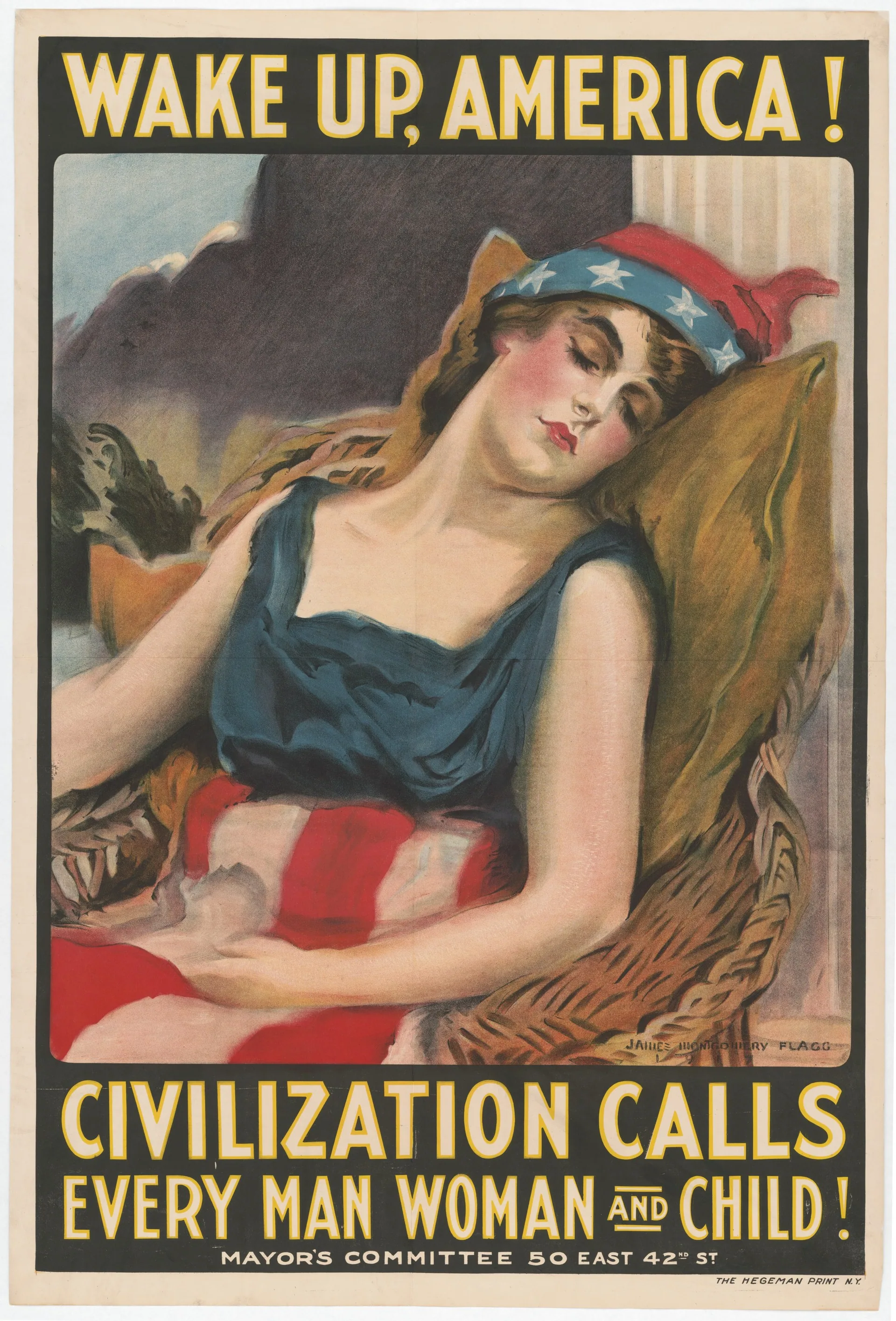
Wake Up, America!: Flagg's Sleeping Columbia, April 1917
The sheet reproduced here is the Library of Congress's file of James Montgomery Flagg's first summons of the First World War: "Wake up America! Civilization calls every man, woman and child!" The Library catalogues it under the title the sheet itself carries, dates it 1917, and describes a single print — a color lithograph, sheet 103.8 by 69.8 centimetres — filed at POS - US .F63, no. 30, with no known restrictions on publication. The Institute's Flagg file already holds the pointing Uncle Sam in its second, 1940s service. This record is the companion and the elder: the same artist, in the month America went to war, working not for the Army but for a city — showing the nation itself asleep, not the state accusing the citizen. What the sheet shows is a deliberate scandal, beautifully painted. Beneath a headline in yellow capitals on black — "WAKE UP, AMERICA!" — Columbia, the personification of America and Liberty, is fast asleep. She dozes in a wicker chair, her head sunk on a gold cushion against a fluted classical column, eyes closed, one arm slack across the red-and-white stripes of the flag spread over her lap. She wears a dark blue sleeveless dress and the Phrygian cap of liberty, its blue band set with white stars, the red point fallen sideways in sleep. Behind her, heavy storm clouds bank up over a darkened landscape. Flagg's name stands in the image at the lower right, painted into the wicker of the chair. The Library's exhibition caption identifies the model as the actress Mary Arthur: a real, contemporary face lent to the allegory — not a goddess at a distance, but a young woman of 1917, asleep while the weather changes. The moment that produced the sheet can be dated almost to the day. After two and a half years of neutrality, the United States entered the war on 6 April 1917. New York answered through its Mayor's Committee on National Defense, which fixed 19 April — the anniversary of Lexington and Concord, and of Paul Revere's ride — as "Wake Up, America" Day, built around a midnight ride through Manhattan and a Fifth Avenue parade. The Library's caption records that this poster was featured in that day, thirteen days after the declaration. The sheet itself preserves the machinery of the occasion: beneath the footline, small type gives the committee's address, "Mayor's Committee 50 East 42nd St", and the lower margin carries the printer's imprint, "The Hegeman Print N.Y." It is at once a work of art and a piece of civic paperwork — an alarm printed for a committee that had a fortnight to wake a city. Flagg in April 1917 stood at the hinge of his career. The pointing Uncle Sam he had painted for a magazine cover in 1916 was about to become the Army's emblem and the most reproduced image of the war; this poster, made in the same weeks, shows the other half of his gift — not caricature at full shout, but a magazine illustrator's tenderness put to civic use. The Library's records tag the sheet in its census of American war posters ("Promotional goal: U.S. J44"), and the sheet has kept its standing: exhibited in American Treasures of the Library of Congress in 2002 and in the 2016 survey "World War I: American Artists View the Great War", and catalogued among the canonical American posters of the war. As visual language, the poster works by inversion. The recruiting image is supposed to shout; this one sleeps, and the shout is displaced into the type — two bands of yellow capitals framing a silence. Every prop is an argument. The column and the liberty cap name the stakes in the classical language the footline makes explicit: civilization. The storm at the left is the European war arriving on the weather. And the sleeper is the addressee: not the soldier, who is barely implied, but "every man woman and child" — the whole civilian nation, summoned before the federal poster machine existed. Where the pointing Uncle Sam abolishes the distance between state and citizen by singling the viewer out, this sheet works from the other side: the viewer is the only one awake in the picture, and the duty to act passes from the image to the person looking at it. The Institute files the record as Class B, and the reasoning, as ever, is the point. This was a mass-produced campaign sheet, printed for street posting; but large sheets pasted outdoors in April 1917 had a life measured in weeks, so survival is far thinner than the printing, while the design's canonical standing keeps it from any higher claim to scarcity. A curator's limits close the record. No print-run figure for the poster survives in the Library's record or in the institutional literature consulted, and none is invented here; dealer descriptions of the sheet as among the rarest of war posters are saleroom language and are not relied on. One caution on the name: Flagg made a second design for the same day, a lantern-bearing woman in the part of Paul Revere, circulating under a near-identical title. This record is the sleeping Columbia, identified by its footline, its committee line and the Hegeman imprint. The signature in the image is part of the printed plate, not a hand-applied autograph, and is given no weight in the assessment. ### References / Sources [S1] Library of Congress — item record 91726511 (LCCN 91726511): title, date 1917, medium and sheet size, call number POS - US .F63, no. 30 (C size) [P&P], reproduction numbers incl. LC-DIG-ppmsca-40985, rights advisory, notes ("Promotional goal: U.S. J44. 1917."; "Mayor's Committee, 50 East 42nd St."; exhibitions 2002 and 2016). [S2] Library of Congress — exhibition caption, "James Montgomery Flagg's Call To Arms" (exhibition "World War I …"): entry into the war on 6 April 1917 after two and a half years of neutrality; the poster featured in "Wake Up, America" Day, New York City, 19 April, thirteen days later; Mary Arthur the model for Columbia; the sleeping figure, Phrygian cap, fluted column and storm clouds as catalogued there. [S3] The sheet itself, as imaged by the Library (LC-DIG-ppmsca-40985): headline and footline texts; "Mayor's Committee 50 East 42nd St"; printer's imprint "The Hegeman Print N.Y."; the artist's name in the image at lower right. [S4] American Revolution Institute (Society of the Cincinnati) — "Wake Up America Day" collection note: the Mayor's Committee on National Defense commissioned Flagg's Wake Up America Day work; the day began at midnight on 19 April with Jean Mohle's ride through Manhattan calling men to enlist. [S5] Swann Galleries — specialist catalogue entry for this design ("Wake Up, America! / Civilization Calls", 1917, The Hegeman Print, New York): sheet size concordant with the Library's; literature citations (Meyer, James Montgomery Flagg, p. 68; Rawls, Wake Up for Liberty!, cover and frontispiece; Theofiles 7).
Category: Firearms & Military
Year: 1917
Rarity Class: B
Provenance & Rarity
James Montgomery Flagg (1877–1960) · Wake up America! · New York, April 1917 — Thirteen days after the declaration of war, New York asked its citizens to wake the nation itself. Flagg's Columbia — modelled by the actress Mary Arthur — sleeps in the Stars and Stripes while storm clouds gather. Library of Congress, item 91726511.