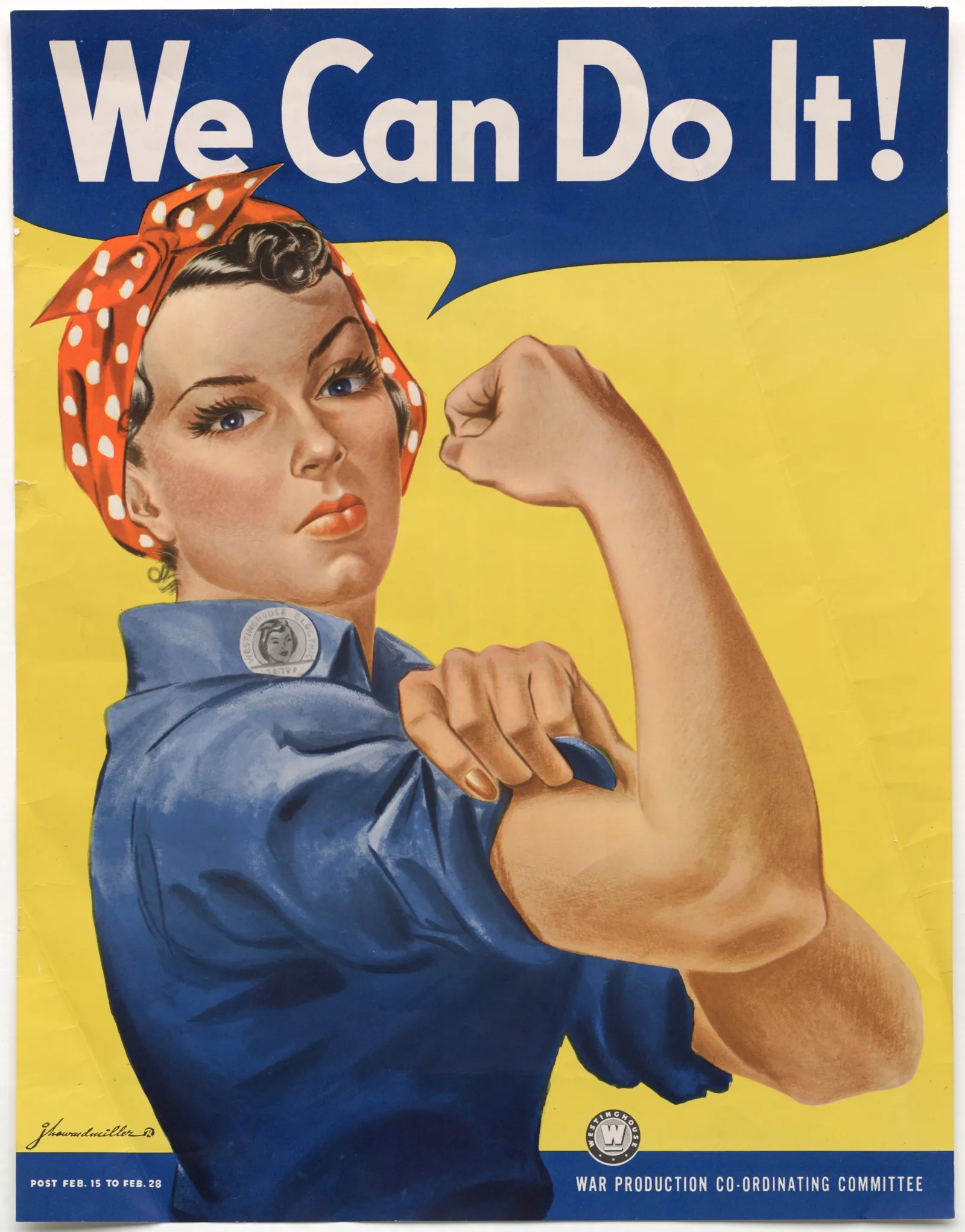
"We Can Do It!" — J. Howard Miller's Westinghouse Poster, 1943
This record presents the most famous factory poster of the Second World War — a poster almost nobody saw during the war. "We Can Do It!" was drawn by the Pittsburgh commercial artist J. Howard Miller (1898–1985) for the Westinghouse Electric & Manufacturing Company, and it survives as a photomechanical print of 22 by 17 inches, catalogued by the National Archives and Records Administration among the records of the War Production Board (item 179-WP-1563) [S1][S2]. The Institute presents the Archives' scan here, with credit: the poster itself hangs in no gallery of ours, and its wartime life was spent pinned inside factories that pressed plasticised helmet liners [S3][S4]. Look at the image as its first audience saw it. A young woman in a blue work shirt and a red-and-white polka-dot headscarf turns out of the frame toward the viewer, her right sleeve rolled, her forearm raised and flexed; above her, in white capitals on a yellow ground, WE CAN DO IT! The collar of her shirt carries an employee badge. At the lower left, the artist signed his name in the plate; along the foot runs the credit of the War Production Coordinating Committee — and, easily missed, a printer's instruction that dates the whole object: "Post Feb. 15 to Feb. 28" [S1]. She is not selling anything, and she is not recruiting anyone. She is speaking to people who already have the job. That instruction is the key to the poster's real history. In 1942 Westinghouse's internal War Production Coordinating Committee hired Miller, through an advertising agency, to produce a series of work-incentive posters for its own factories; each design hung for about two weeks before the next replaced it [S2][S4]. "We Can Do It!" took its turn in February 1943 — the fifteenth to the twenty-eighth, by its own printed instruction — addressing employees whose morale, not whose enlistment, was the company's concern [S1][S3]. The secondary literature puts the printing at no more than 1,800 copies; no figure from the company or the Archives was found for this record, and the number is printed here as an attribution, not a count [GAP-02]. It was not a government poster, not an Office of War Information campaign, and it had nothing to do with the public drives its image would later come to symbolise [S3]. Then it vanished. When its two weeks ended, the poster went the way of factory notices; for nearly forty years it existed only in the files. The woman in it had no name — the poster gives her none — and the name the world would later give her belonged to somebody else's picture: "Rosie the Riveter" comes from a 1942 song and from Norman Rockwell's Saturday Evening Post cover of 29 May 1943, a different and still-copyrighted image that this record deliberately does not reproduce [S3]. Miller's worker became "Rosie" only in the 1980s, probably — as the National Archives itself notes — when the poster resurfaced: reproduced in a 1982 Washington Post Magazine article about posters in the Archives' collection, it was taken up as a feminist emblem, printed on everything, and fixed in the public mind as the face of the wartime woman worker [S1][S4]. Smithsonian magazine put it on its cover in March 1994; the United States Postal Service issued it as a 33-cent stamp in February 1999, adding the words "Women Support War Effort" [S4]. The question of who modelled for the figure is a small history of how myths attach to paper, and this record keeps it in its attributed, unsettled state. For thirty years the model was widely said to be Geraldine Hoff Doyle, a Michigan factory worker who believed she recognised herself in a 1942 photograph of a woman at a lathe and concluded the photograph had inspired Miller [S3]. In 2015–16 the Seton Hall scholar James J. Kimble recovered that photograph's original caption slip: the woman at the machine was Naomi Parker, photographed at Naval Air Station Alameda, California, on 24 March 1942 [S3]. But whether Miller worked from that photograph at all cannot be proved or disproved — he left no record of his source, and a Westinghouse historian who knew him said he preferred live models — so neither woman can be confirmed as the model, and the honest caption for the face on this poster is that we do not know whose it is [S3][S4]. Two further limits are stated rather than filled. The Archives catalogues the poster only to circa 1942–1943 — February 1943 is its documented display window, not a verified day of creation [GAP-01]. And its rights history is more interesting than a government poster's would be: this was a private company's commission, not a federal work, and its public-domain standing rests on the National Archives' own item-level determination — access and use both "Unrestricted" — together with its publication without a copyright notice; the full assessment is recorded in this record's evidence ledger [S1]. What is certain is the paradox the paper carries: an image made for a few thousand factory workers, for fourteen days, became — forty years late — one of the most recognised pictures on earth. References / Sources [S1] National Archives and Records Administration — Catalog record NAID 535413, "We can do it!", item 179-WP-1563, Records of the War Production Board (RG 179) — catalog.archives.gov/id/535413 [S2] Smithsonian National Museum of American History — object record, "We Can Do It!" (accession 1985.0851.05) — si.edu/object/we-can-do-it (nmah_538122) [S3] James J. Kimble — "Does It Matter Who the Real Rosie the Riveter Was?", JSTOR Daily — daily.jstor.org/does-it-matter-who-the-real-rosie-the-riveter-was/ [S4] Smithsonian Magazine — "The Riveting Story of an American Icon" — smithsonianmag.com/smart-news/how-rosie-riveter-got-famous-180967415/ Image credit — every image in this record: J. Howard Miller, "We Can Do It!", 1943. National Archives and Records Administration, NAID 535413 (item 179-WP-1563), Records of the War Production Board, Record Group 179. Detail views are crops of the Archives' scan of the same poster.
Category: Firearms & Military
Year: 1943
Rarity Class: A
Paper & Print Condition
The record is a digital presentation made from the National Archives' preservation scan (photomechanical print, copy status "Preservation" in the Archives' catalogue); no physical handling by this Institute is claimed. In the scan the sheet presents complete: the yellow headline field, the blue of the work shirt and the red polka-dot headscarf hold strong, even colour; the artist's signature at lower left and the committee credit and posting instruction along the foot are legible; the sheet's edges and corners read clean. The Archives catalogues the physical poster at the National Archives at College Park — Still Pictures; condition beyond what the scan shows is the holding institution's to state, and is not asserted here.
Provenance & Rarity
The poster was commissioned by the Westinghouse Electric & Manufacturing Company through its War Production Coordinating Committee and produced in 1942–43; the file copy from which the Archives' scan derives is held among the Records of the War Production Board (Record Group 179) at the National Archives at College Park, and a physical copy is also held by the Smithsonian National Museum of American History (accession 1985.0851.05). The Record Institute presents the Archives' public scan for study, with the credit above, and claims no ownership of the object. Rarity is assessed as Class A under the Institute's method. The printing was a single internal factory issue: displayed for two weeks in February 1943 and replaced, with an attributed run of no more than 1,800 copies in the secondary literature [GAP-02]; it was never publicly distributed in its period, and original printings survive in small numbers against an image reproduced beyond counting. The artist's signature appears in the plate as printed; under the Institute's rule a printed signature earns no uplift, and none is applied — the class rests on scarcity, survival and significance. No auction prices are cited.
Rarity & Condition Summary