Birth of Brands / EP.01 / Levi's
The 68-Dollar Idea That Created Blue Jeans — The Levi's Story
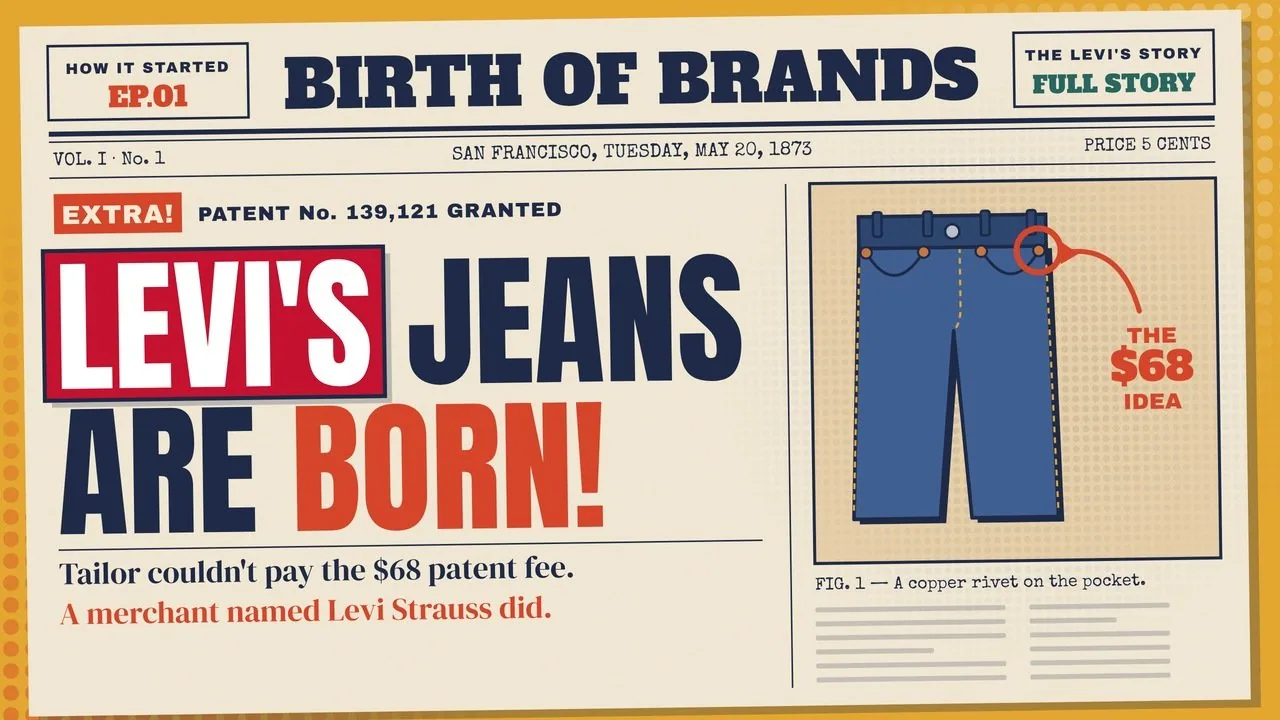
A tailor couldn't pay the 68-dollar patent fee, so his fabric supplier paid it instead — and blue jeans were born.
Short video
Long video
Chronology
Timeline
- Reno, Nevada, around 1870. Jacob Davis was a tailor who made tents, wagon covers and work clothes for miners, and his customers kept coming back with the same complaint: their pockets ripped out under strain. Davis already used copper rivets to fasten straps on horse blankets, so he tried setting the same rivets at the pocket corners and the base of the fly of a pair of work pants, first made for a woodcutter whose wife had asked him for trousers that would not fall apart. The riveted pants held, word spread, and Davis knew he had something worth protecting.
- What he did not have was the money. A patent cost 68 dollars, so in 1872 Davis wrote to his fabric supplier in San Francisco, dry-goods merchant Levi Strauss, and proposed they take out the patent together. Strauss agreed. On May 20, 1873, the United States Patent Office granted them Patent No. 139,121 for an "Improvement in Fastening Pocket-Openings." The riveted "waist overall" was the first blue jean, and Davis moved to San Francisco to oversee production.
- What he did not have was the money. A patent cost 68 dollars, so in 1872 Davis wrote to his fabric supplier in San Francisco, dry-goods merchant Levi Strauss, and proposed they take out the patent together. Strauss agreed. On May 20, 1873, the United States Patent Office granted them Patent No. 139,121 for an "Improvement in Fastening Pocket-Openings." The riveted "waist overall" was the first blue jean, and Davis moved to San Francisco to oversee production.
- The design kept evolving. The leather Two Horse patch arrived in 1886. In 1890 the patent expired, and the company began assigning lot numbers to its products: the famous copper-riveted waist overalls became lot 501. Why 501? Nobody knows. The company's early records were lost in the San Francisco earthquake of 1906, and the number's origin went with them.
- The design kept evolving. The leather Two Horse patch arrived in 1886. In 1890 the patent expired, and the company began assigning lot numbers to its products: the famous copper-riveted waist overalls became lot 501. Why 501? Nobody knows. The company's early records were lost in the San Francisco earthquake of 1906, and the number's origin went with them.
- The design kept evolving. The leather Two Horse patch arrived in 1886. In 1890 the patent expired, and the company began assigning lot numbers to its products: the famous copper-riveted waist overalls became lot 501. Why 501? Nobody knows. The company's early records were lost in the San Francisco earthquake of 1906, and the number's origin went with them.
Dossier
Levi's began with a tailor who couldn't afford a 68-dollar patent fee.
Reno, Nevada, around 1870. Jacob Davis was a tailor who made tents, wagon covers and work clothes for miners, and his customers kept coming back with the same complaint: their pockets ripped out under strain. Davis already used copper rivets to fasten straps on horse blankets, so he tried setting the same rivets at the pocket corners and the base of the fly of a pair of work pants, first made for a woodcutter whose wife had asked him for trousers that would not fall apart. The riveted pants held, word spread, and Davis knew he had something worth protecting.
What he did not have was the money. A patent cost 68 dollars, so in 1872 Davis wrote to his fabric supplier in San Francisco, dry-goods merchant Levi Strauss, and proposed they take out the patent together. Strauss agreed. On May 20, 1873, the United States Patent Office granted them Patent No. 139,121 for an "Improvement in Fastening Pocket-Openings." The riveted "waist overall" was the first blue jean, and Davis moved to San Francisco to oversee production.
The design kept evolving. The leather Two Horse patch arrived in 1886. In 1890 the patent expired, and the company began assigning lot numbers to its products: the famous copper-riveted waist overalls became lot 501. Why 501? Nobody knows. The company's early records were lost in the San Francisco earthquake of 1906, and the number's origin went with them.
A 68-dollar fee Davis could not pay became the most famous pair of pants on Earth.
Sources and further reading
- U.S. Patent No. 139,121, "Improvement in Fastening Pocket-Openings" (Google Patents) — Source
- Levi Strauss & Co., company historian Tracey Panek, "The Truth — and Exaggerations — of LS&Co." — Source
- Levi Strauss & Co., official company timeline (PDF) — Source
- Smithsonian Magazine, "The Origin of Blue Jeans" — Source
- Smithsonian Institution, "Levi Strauss Jeans" — Source
- Encyclopedia.com, "Levi-Strauss & Co." (International Directory of Company Histories) — Source
- Wikipedia, "Levi's jeans" (CC BY-SA) — Source