Birth of Brands / EP.02 / Coca-Cola
Nine Glasses a Day — The Coca-Cola Story
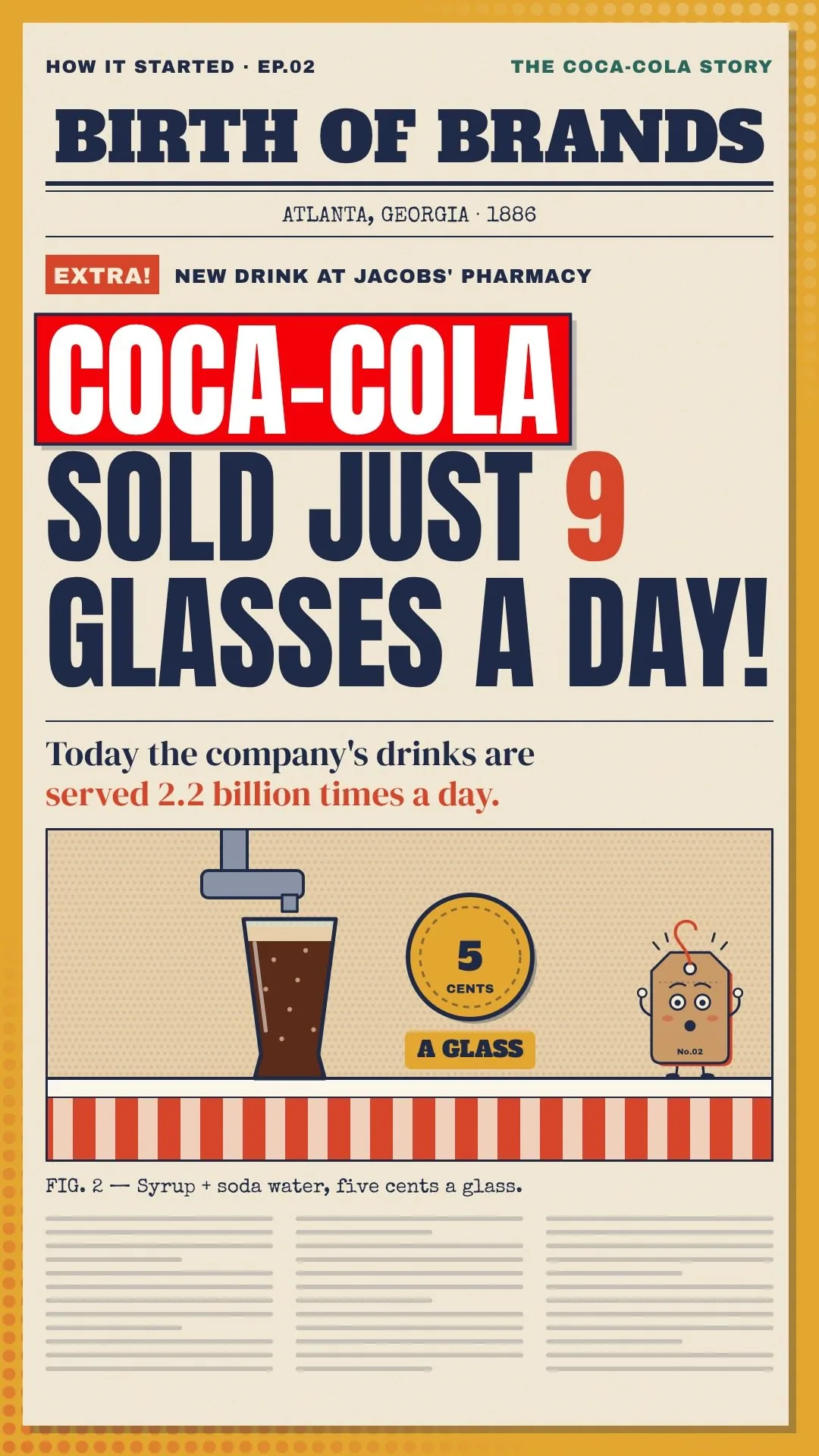
Coca-Cola began as a pharmacist's tonic that sold just nine glasses a day.
Short video
Chronology
Timeline
- Atlanta, 1885. Dr. John Stith Pemberton, a pharmacist and Civil War veteran, was doing well with Pemberton's French Wine Coca, a coca wine sold as a nerve tonic. Then Atlanta and Fulton County voted for prohibition, and the wine in his tonic became illegal. Pemberton went back to his kettle and rebuilt the drink without alcohol: a sweet syrup flavored with coca leaf and kola nut, designed for the soda fountain.
- On May 8, 1886, he carried a jug of the syrup down the street to Jacobs' Pharmacy. Mixed with carbonated water, it sold for five cents a glass, and across its first year it averaged nine glasses a day. Pemberton's bookkeeper, Frank Mason Robinson, named it Coca-Cola, after its two signature ingredients, and penned the name in the flowing Spencerian script that is still the trademark today.
- Pemberton never saw it succeed. Sick and short of money, he sold his interest in pieces through 1887 and 1888. Asa Griggs Candler, an Atlanta pharmacist and businessman, quietly bought the shares one by one, and by 1891 he owned the whole business for a total of about 2,300 dollars. Pemberton died on August 16, 1888. His newspaper death notice praised him as the oldest druggist of Atlanta and one of its best-known citizens. It did not mention Coca-Cola.
- Pemberton never saw it succeed. Sick and short of money, he sold his interest in pieces through 1887 and 1888. Asa Griggs Candler, an Atlanta pharmacist and businessman, quietly bought the shares one by one, and by 1891 he owned the whole business for a total of about 2,300 dollars. Pemberton died on August 16, 1888. His newspaper death notice praised him as the oldest druggist of Atlanta and one of its best-known citizens. It did not mention Coca-Cola.
- Pemberton never saw it succeed. Sick and short of money, he sold his interest in pieces through 1887 and 1888. Asa Griggs Candler, an Atlanta pharmacist and businessman, quietly bought the shares one by one, and by 1891 he owned the whole business for a total of about 2,300 dollars. Pemberton died on August 16, 1888. His newspaper death notice praised him as the oldest druggist of Atlanta and one of its best-known citizens. It did not mention Coca-Cola.
- Candler made sure the world did. He blanketed America with coupons, clocks and calendars, and the drink spread fountain by fountain. In 1894, Joseph Biedenharn, a candy-store owner in Vicksburg, Mississippi, began putting Coca-Cola into glass bottles. Then, in 1899, two Chattanooga lawyers, Benjamin F. Thomas and Joseph B. Whitehead, talked Candler into selling them the exclusive bottling rights for most of the United States. The price was one dollar, which Candler never bothered to collect. That one-dollar contract created the franchise bottling system that put Coke within reach of nearly everyone on Earth.
- Candler made sure the world did. He blanketed America with coupons, clocks and calendars, and the drink spread fountain by fountain. In 1894, Joseph Biedenharn, a candy-store owner in Vicksburg, Mississippi, began putting Coca-Cola into glass bottles. Then, in 1899, two Chattanooga lawyers, Benjamin F. Thomas and Joseph B. Whitehead, talked Candler into selling them the exclusive bottling rights for most of the United States. The price was one dollar, which Candler never bothered to collect. That one-dollar contract created the franchise bottling system that put Coke within reach of nearly everyone on Earth.
Dossier
Coca-Cola began as a pharmacist's tonic that sold nine glasses a day.
Atlanta, 1885. Dr. John Stith Pemberton, a pharmacist and Civil War veteran, was doing well with Pemberton's French Wine Coca, a coca wine sold as a nerve tonic. Then Atlanta and Fulton County voted for prohibition, and the wine in his tonic became illegal. Pemberton went back to his kettle and rebuilt the drink without alcohol: a sweet syrup flavored with coca leaf and kola nut, designed for the soda fountain.
On May 8, 1886, he carried a jug of the syrup down the street to Jacobs' Pharmacy. Mixed with carbonated water, it sold for five cents a glass, and across its first year it averaged nine glasses a day. Pemberton's bookkeeper, Frank Mason Robinson, named it Coca-Cola, after its two signature ingredients, and penned the name in the flowing Spencerian script that is still the trademark today.
Pemberton never saw it succeed. Sick and short of money, he sold his interest in pieces through 1887 and 1888. Asa Griggs Candler, an Atlanta pharmacist and businessman, quietly bought the shares one by one, and by 1891 he owned the whole business for a total of about 2,300 dollars. Pemberton died on August 16, 1888. His newspaper death notice praised him as the oldest druggist of Atlanta and one of its best-known citizens. It did not mention Coca-Cola.
Candler made sure the world did. He blanketed America with coupons, clocks and calendars, and the drink spread fountain by fountain. In 1894, Joseph Biedenharn, a candy-store owner in Vicksburg, Mississippi, began putting Coca-Cola into glass bottles. Then, in 1899, two Chattanooga lawyers, Benjamin F. Thomas and Joseph B. Whitehead, talked Candler into selling them the exclusive bottling rights for most of the United States. The price was one dollar, which Candler never bothered to collect. That one-dollar contract created the franchise bottling system that put Coke within reach of nearly everyone on Earth.
Today, the Coca-Cola Company serves around 2.2 billion drinks a day. That figure counts every drink the company sells, not Coca-Cola alone, but it all started with nine glasses a day in one Atlanta pharmacy.
Sources and further reading
- The Coca-Cola Company, "The Birth of a Refreshing Idea" — Source
- Encyclopedia.com, "Coca-Cola Company" (International Directory of Company Histories) — Source
- Museum of Arts & Sciences, Daytona Beach, "John 'Doc' Pemberton and His Amazing Medicine" — Source
- Smithsonian Magazine, "May Anniversaries" — Source
- University of Southern California, "History of the Soda Fountain: Coca-Cola" — Source