Remember How Your Mother…, 1916: Schlitz in Brown Bottles, San Francisco Chronicle
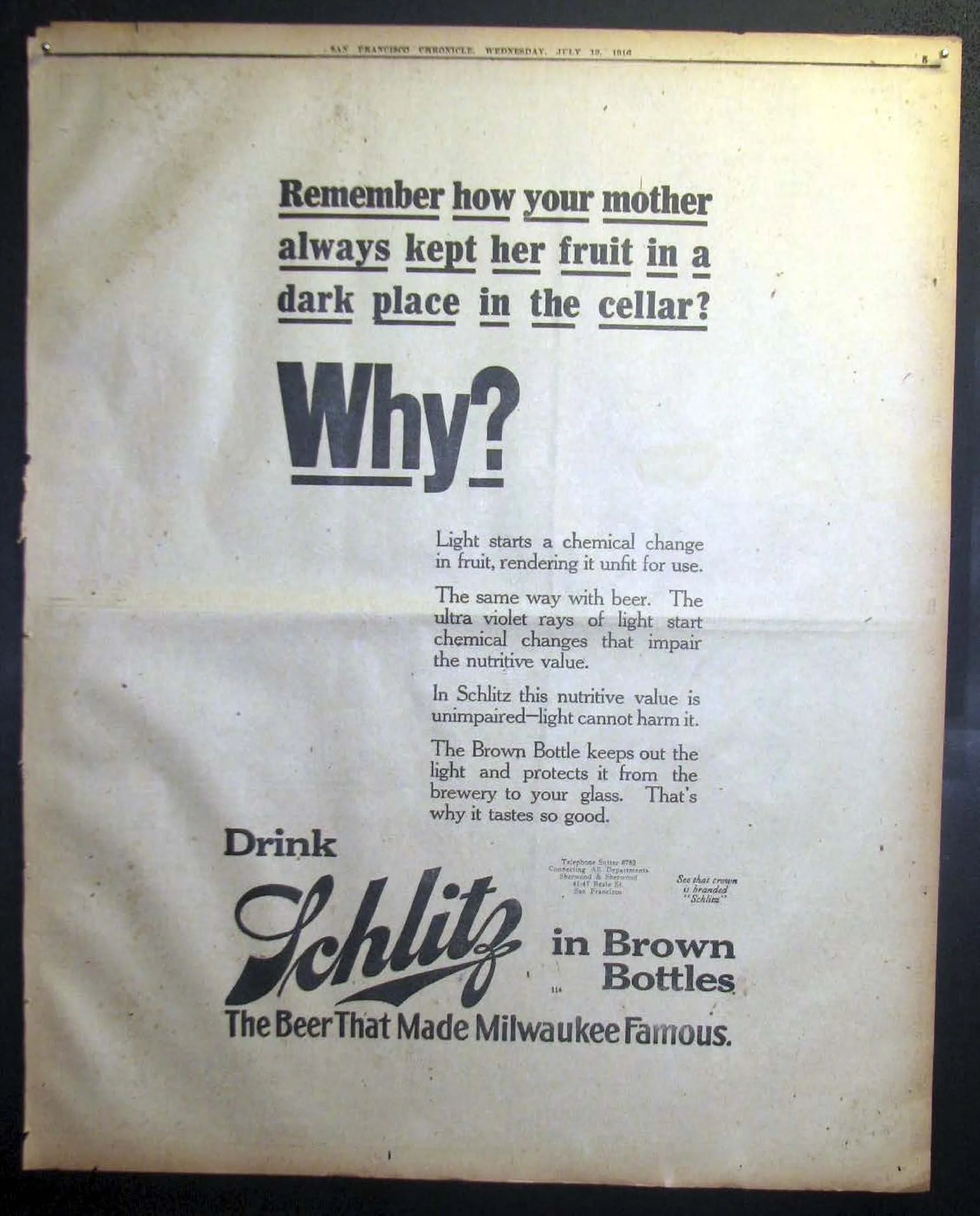
The page reproduced here is a full-page advertisement for the Jos. Schlitz Brewing Company in the San Francisco Chronicle of Wednesday, 19 July 1916 — the date stands in the page's own masthead line, with the page number 5 at the upper right [S1]. It is an advertisement with no picture in it at all. A Milwaukee brewer bought an entire page of a San Francisco daily and filled it with one question, one enormous word, four short paragraphs and a signature. The image used here is the collector-archive scan of that page, preserved by the National Association of Breweriana Advertising; the underlying advertisement, published in 1916, is public domain [S1]. Everything the page asserts about light, fruit and beer is the advertiser's own argument, and this entry presents it as exactly that — a sales claim of 1916, not a finding of this Institute. Read the page as its first readers did, from the top. The headline, every word underlined for emphasis, asks: "Remember how your mother always kept her fruit in a dark place in the cellar?" Beneath it, set at poster size, a single word: "Why?" The answer follows in a narrow column of body copy, and it deserves quoting as printed: "Light starts a chemical change in fruit, rendering it unfit for use. The same way with beer. The ultra violet rays of light start chemical changes that impair the nutritive value. In Schlitz this nutritive value is unimpaired — light cannot harm it. The Brown Bottle keeps out the light and protects it from the brewery to your glass. That's why it tastes so good." The page closes with its signature block: "Drink Schlitz in Brown Bottles", the word Schlitz in flowing script, and beneath, the slogan the company had used since the early 1890s — "The Beer That Made Milwaukee Famous" [S3]. Small print beside the signature names the local machinery of distribution: Sherwood & Sherwood, 41–47 Beale Street, San Francisco, "Telephone Sutter 6783", and the instruction "See that crown is branded 'Schlitz'". The campaign behind the page was sustained, not occasional. The same brown-bottle argument — "Schlitz in Brown Bottles", in one 1913 insertion phrased "made pure, kept pure" — ran in the Buffalo Express of 19 September 1913, where the full newspaper page survives alongside the advertisement's extracted form, and again in Judge magazine on 31 October 1914 [S2]. By 1916 the pitch was a fixture of Schlitz's national advertising. The company paying for it stood at the top of its industry: Schlitz had passed Pabst in 1902 to become America's largest brewer, at about a million barrels a year, and it would hold the first or second place in American brewing for decades to come [S3]. This page is what that confidence looked like in print — a brewer so secure that it could spend a full page not on thirst, sociability or price, but on the colour of its glass. The page's rhetoric repays attention. It opens in the reader's childhood kitchen, with a mother's household practice, and borrows that remembered authority for a factory product: what the cellar did for fruit, the brown bottle does for beer. Its science is the period's advertising science — "ultra violet rays", "chemical change", "nutritive value" — offered in the advertiser's voice and quoted here as his claim, in an era when a full newspaper page could carry a single argument at walking pace, with white space doing the shouting. Notably, the bottle itself is never shown. The bottle the whole campaign was built around exists on this page only as two words, "Brown Bottles", inside the signature line; the argument has entirely replaced the object. As a document, the page preserves three things at once. It records the scale of pre-Prohibition beer advertising, when a brewer could buy a metropolitan full page to discuss light. It records the structure beneath the national brand — a San Francisco distributor's name, address and telephone number set into a Milwaukee advertisement, because the beer still reached the glass through local hands. And it records a promise: that what left the brewery would reach the drinker unimpaired, protected "from the brewery to your glass". The promise is why the page still matters, because the company's later history is the story of that promise being broken from inside. From the late 1960s Schlitz cut weeks out of the brewing cycle and changed its ingredients in small steps, meaning each one to pass unnoticed [S3]. When the beer that resulted drew complaints, Schlitz quietly recalled the beer — more than 10 million bottles and cans. The recall cost 1.4 million dollars. In 1982 Schlitz was sold to Stroh, and the independent company behind this page came to an end [S3]. None of that is visible in 1916, and this entry does not pretend otherwise; but a full page bought to swear that the beer in the bottle was protected is the sharpest possible baseline against which to read what followed. The full story is told in the Institute's Journal account, "What Happened to Schlitz? The Beer That Made Milwaukee Famous", and in the Dead Brands case file on this site. Two limits belong on the record: no agency, writer or printer is credited on the page and none has been established; and the page's statements about light and nutritive value are reproduced as the advertiser's claims of 1916, not endorsed as evidence here. References / Sources [S1] San Francisco Chronicle, Wednesday 19 July 1916, page 5 — the page itself, per its masthead line; scan preserved in the NABA (National Association of Breweriana Advertising) collector archive; Schlitz PD Advertising Reserve licence log, item 11: underlying advertisement published 1916, PD-US-expired; dimensions 4709 × 5846 px. [S2] Schlitz PD Advertising Reserve licence log, items 8–10: the same "Schlitz in Brown Bottles" campaign — Buffalo Express full page, 19 September 1913; the 1913 advertisement extract ("made pure, kept pure"); Judge magazine, 31 October 1914. [S3] Dead Brands No. 32 (Schlitz) fact log: F3 (America's largest brewer, 1902, about a million barrels a year), F4 (the slogan introduced in the early 1890s), F6 (first or second in American brewing into the 1970s), F9–F10 (the later reformulation, in the log's approved wording), F14 (the recall, in its locked wording), F18 (the 1982 sale to Stroh). Sources there: Encyclopedia of Milwaukee; Milwaukee Journal Sentinel; New York Times; Knoedelseder, Bitter Brew (2012).
Category: Alcohol
Year: 1916
Rarity Class: B
Paper & Print Condition
This entry is assessed from the collector-archive scan of the page, not from direct examination of a physical copy, and the scan itself shows how the page was captured: the sheet is photographed pinned flat at its top corners against a dark ground. Within the scan the page shows overall toning consistent with aged newsprint, a horizontal fold across its middle, scattered small spots, and uneven edges; the headline, body copy and signature block are fully legible throughout. The advertisement is letterpress newspaper printing set entirely in type — headline, display word, body column and signature — with no halftone or illustration to assess. Whether the fold and spotting belong to the archived copy or to its handling before scanning cannot be determined from the surrogate, and no statement about other copies of this issue is made.
Provenance & Rarity
The advertisement appeared in the San Francisco Chronicle of Wednesday, 19 July 1916 (page 5, per the masthead line on the page); the digital surrogate comes from the National Association of Breweriana Advertising collector archive, and the underlying 1916 advertisement is public domain. The Record Institute holds no physical copy and claims no acquisition history for one. The page was one insertion in a sustained national campaign for Schlitz in Brown Bottles, documented in the same archive in the Buffalo Express of 1913 and in Judge magazine of 1914. Rarity is assessed at Class B: newspaper pages survive in institutional runs and the campaign ran in multiple publications, which argues against a higher class, but a full-page, type-only pre-Prohibition advertisement in a major metropolitan daily is a substantial survival as a readable whole, and its documentary value — the complete text of the brown-bottle argument, with its distributor imprint — is high. Significance is assessed separately from scarcity, as throughout this catalogue.
Rarity & Condition Summary