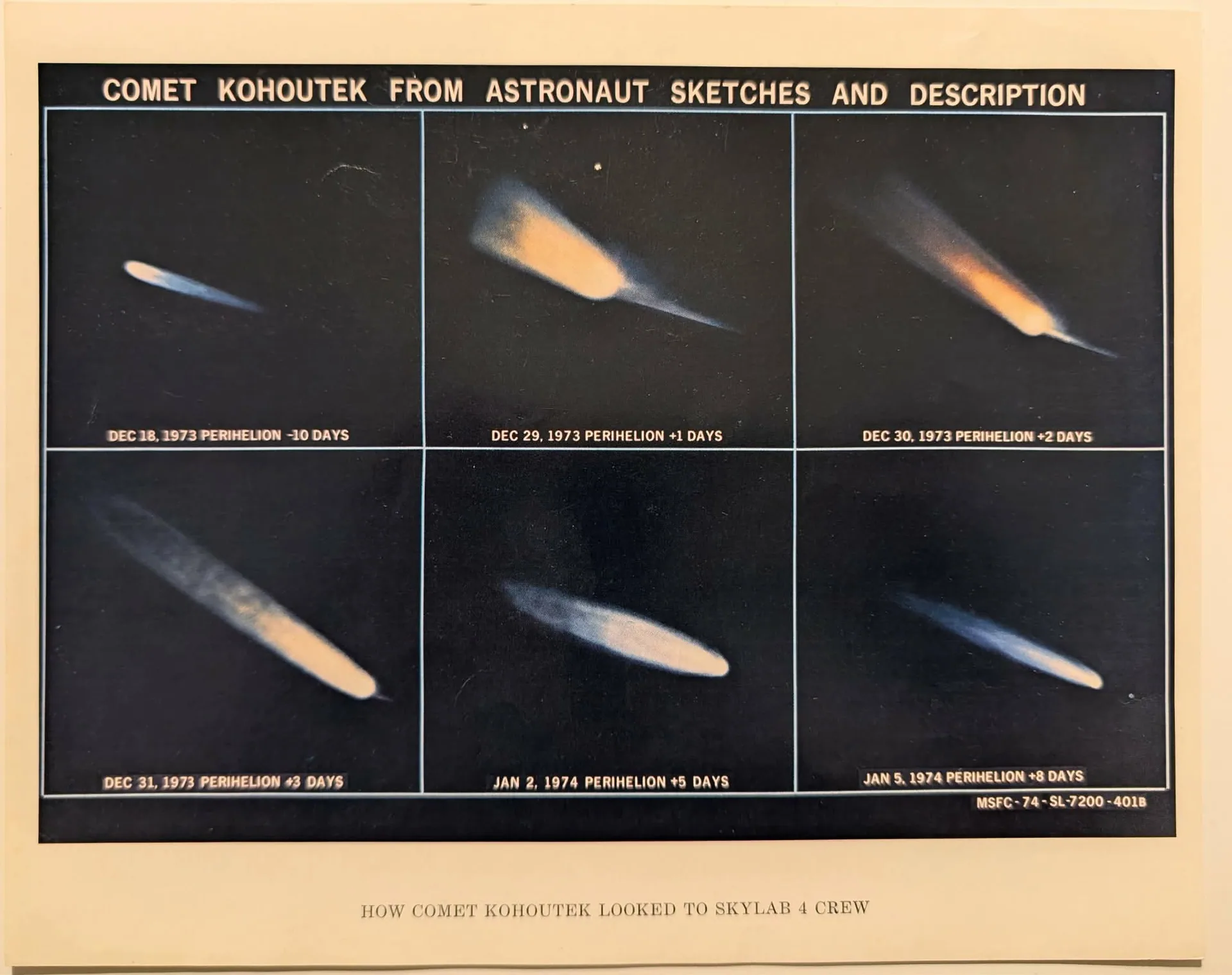
1974 NASA Lithograph "How Comet Kohoutek Looked to Skylab 4 Crew"
1974 NASA Lithograph "How Comet Kohoutek Looked to Skylab 4 Crew" is a vintage Lithographs / Prints artifact by NASA (National Aeronautics and Space Administration) / U.S. Government Printing Office from 1974, preserved in The Record Institute Ephemera Archive.
Category: Lithographs / Prints
Brand: NASA (National Aeronautics and Space Administration) / U.S. Government Printing Office
Year: 1974
Rarity Class: C
Capturing one of the most anticipated yet publicly misunderstood celestial events of the 1970s, this official NASA photolithograph translates the orbital observations of the Skylab 4 crew into a striking six-panel scientific record. Published in 1974 by the U.S. Government Printing Office, the artifact bridges human spaceflight and ground-based astronomy, immortalizing the fleeting, violent passage of Comet Kohoutek through the unique medium of astronaut hand-sketches.
Quick Read
Mission Context: Documents the progression of Comet Kohoutek (C/1973 E1) as observed by astronauts Gerald Carr, Edward Gibson, and William Pogue during the Skylab 4 mission in 1973–1974. Visual Evidence: Features a six-panel grid tracking the comet from 10 days before perihelion to 8 days after, specifically utilizing graphic translations of astronaut hand-sketches rather than photographs. Provenance Marks: Explicitly dated and sourced by the imprint "U.S. GOVERNMENT PRINTING OFFICE: 1974", alongside NASA publication codes "JSCL-121" and "MSFC-74-SL-7200-401B". Historical Irony: Captures the scientific reality of a comet that provided unprecedented data to orbital researchers, despite being heavily hyped and ultimately disappointing to naked-eye observers on Earth. Printing Method: Executed via standard CMYK halftone offset photolithography on medium-weight, durable cardstock intended for educational distribution.
Summary
Capturing one of the most anticipated yet publicly misunderstood celestial events of the 1970s, this official NASA photolithograph translates the orbital observations of the Skylab 4 crew into a striking six-panel scientific record. Published in 1974 by the U.S. Government Printing Office, the artifact bridges human spaceflight and ground-based astronomy, immortalizing the fleeting, violent passage of Comet Kohoutek through the unique medium of astronaut hand-sketches.