时间旅行者的档案:1964款斯图贝克小众车型阵容 - 特种汽车的绝望诞生
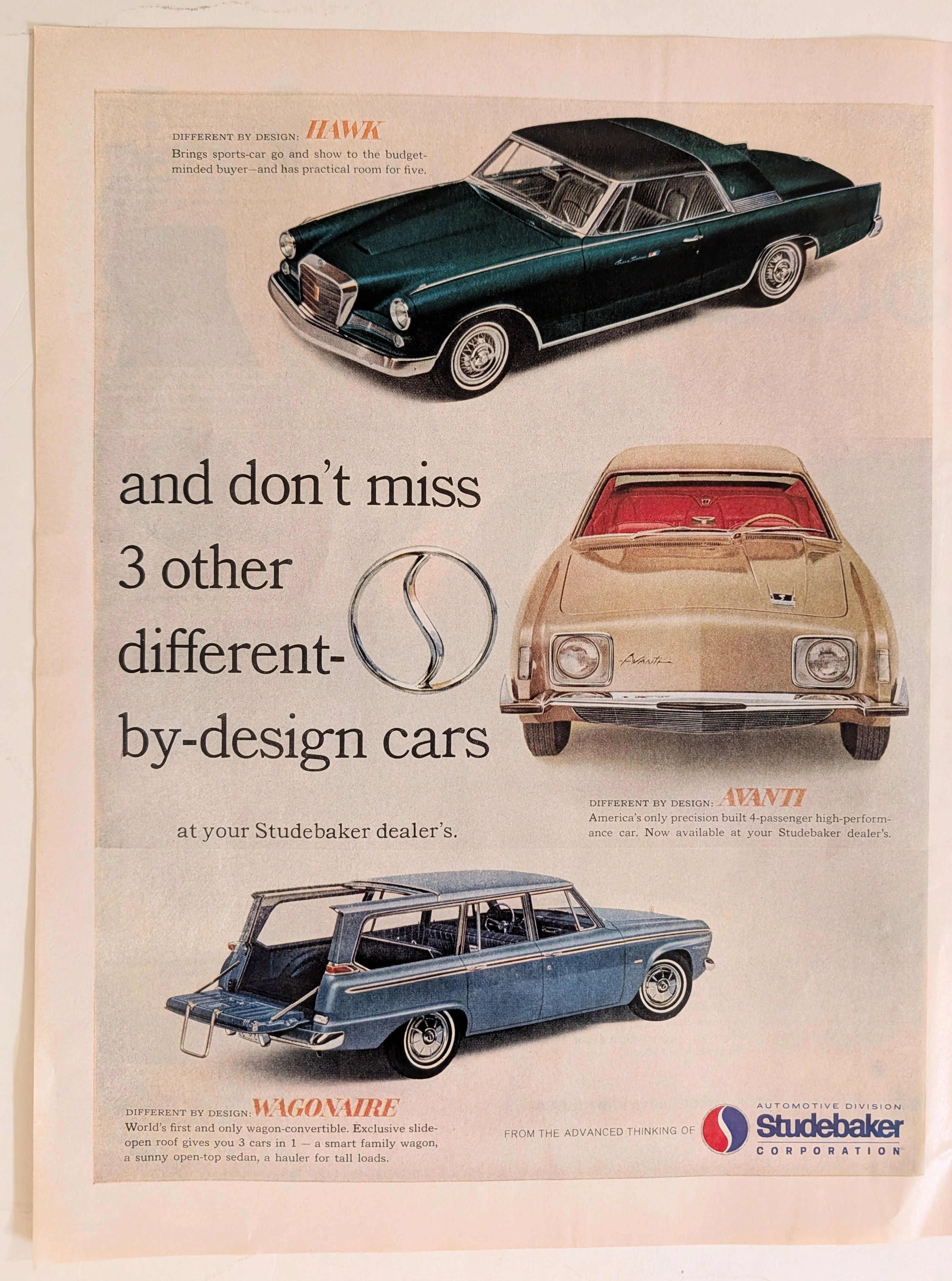
曾经,这是一种不对称的工业战争策略。 一个被逼入绝境的企业,放弃中心战场,转而在边缘地带进行殊死搏斗。 1963年末,斯图贝克公司(Studebaker Corporation)认识到了一个致命的真相:在庞大的大众市场上,他们已经完全无法与底特律“三大巨头”那种垄断级别的规模相抗衡。 他们造不出比雪佛兰或福特更好、更便宜的标准家庭轿车。 因此,他们的生存,完全取决于去制造那些通用汽车(General Motors)永远不敢制造的东西。 这则广告,正是该战略在物理层面的具象化展现。它展示了三台风格迥异、高度专业化的机器。 一台玻璃纤维超级跑车。一台注重预算的欧式大型GT跑车。一台带有可滑动车顶的旅行车。 这是一本汇集了异常与畸变的目录。 如今,这件遗物是20世纪60年代一条进化死胡同的化石记录,但同时,它又赫然矗立,成为了现代汽车工业版图的一份极具预言性质的蓝图。 这里所记录的“历史性巨变(Shift)”是哲学和结构层面的。它记录了一个绝望的汽车制造商,从“全能型汽车(universal car)”概念,精准转向“生活方式型汽车(lifestyle vehicle)”的那个确切时刻。 斯图贝克试图在纯粹的财务绝望中,凭空发明出“利基市场(niche market,即小众市场)”。他们为极其特定的消费者群体,打造了高度针对性的解决方案——半个世纪后,这一策略将成为全球汽车工业的绝对标准。他们只是早生了四十年,并为自己的先见之明付出了生命的代价。
Category: Automotive
Brand: Studebaker
The History
寡头垄断的绞索与边缘战略 要理解这件文件所承载的深远分量,就必须剖析1964年美国汽车市场那冷酷无情的运转机制。战后无限扩张的时代,已经凝固成了一个坚不可摧的寡头垄断局面。通用汽车、福特和克莱斯勒主宰着美国公众的欲望。他们通过规模经济,生产出数以百万计的、迎合大众口味且极其传统的车辆,实现了这一统治。他们占据了钟形曲线最庞大的中心位置。 在印第安纳州南本德(South Bend)那些老旧的、多层砖砌工厂里运营的斯图贝克,面临着资本枯竭和经销商网络萎缩的困境。他们的产量拼不过底特律,价格也拼不过。由其濒死的总裁舍伍德·H·艾格伯特(Sherwood H. Egbert)所批准的战略,是一种极端的差异化战略。如果他们无法占领中心,他们就要试图去统治边缘。 这一整页广告完美地概括了这一信条。在“因设计而与众不同(DIFFERENT BY DESIGN)”的统一旗帜下,该公司展示了三款在美学血统上几乎毫无关联的车辆。它们不是一个具有凝聚力的车系家族;它们是一组高度特定的工具,被设计用来捕获被碎片化的消费者子集。这就是“超级细分市场(hyper-segmentation)”的诞生。斯图贝克正试图通过转型为一家生产奇特车型的精品制造商,来求得生存。 Avanti:钢铁世界里的玻璃纤维狂热之梦 锚定在页面右侧、沐浴在柔和金属金色中的,是斯图贝克 Avanti。旁边的文字傲慢地将其标记为“美国唯一一款精密制造的4座高性能汽车”。Avanti 不仅仅是一辆车;它是一位垂死的高管所抛出的一记绝望的“万福玛利亚(Hail Mary)”式传球。 舍伍德·艾格伯特意识到品牌需要注入巨大的兴奋感,于是聘请了传奇的工业设计师雷蒙德·罗维(Raymond Loewy)。罗维在加利福尼亚州棕榈泉(Palm Springs)的一栋出租屋里组建了一个小型团队,在短短几周内就设计出了 Avanti。最终诞生的车辆,彻底颠覆了当时马路上的任何车型。 分析一下这件遗物中提供的图像。Avanti 没有传统的进气格栅。它从底部吸气,这是一种领先时代数十年的空气动力学概念。引擎盖上有一个不对称的凸起,那是为了给斯图贝克 V8 发动机的机械增压器腾出空间。车身完全由玻璃纤维构成,由生产早期雪佛兰科尔维特(Corvette)车身的那家公司进行模压。这样做不仅仅是为了减轻重量,更是因为斯图贝克缺乏为复杂的钢材冲压件开模所需的庞大资金。 Avanti 是一个滚动的悖论。它使用了斯图贝克 Lark 那沉重、陈旧的底盘,却配备了内置的防滚架、软包内饰和标配的卡钳式盘式制动器。它是一台建立在经济型轿车骨架上的高速 GT 跑车,包裹在一个太空时代的复合材料外壳中。它旨在吸引那些富有、性格独特、拒绝凯迪拉克或林肯那种臃肿镀铬装饰的买家。它最终未能拯救公司(主要归咎于玻璃纤维的生产延误),但它成功地成为了20世纪最重要的工业设计之一。 Hawk:中西部预算下的欧洲伪装 位于页面顶部、以深邃且正式的绿色呈现的,是斯图贝克 Hawk。配套的文字宣传它能“为注重预算的买家带来跑车的性能与外观”。这辆车代表了一种截然不同的生存策略:大师级“拉皮改款(facelift)”的艺术。 Hawk 的底层架构可以追溯到1953年。为了在几乎为零的研发预算下,让这辆车在十年后依然保持相关性,斯图贝克求助于另一位工业设计巨头——布鲁克斯·史蒂文斯(Brooks Stevens)。具有讽刺意味的是,史蒂文斯正是“计划性淘汰(planned obsolescence)”一词的创造者,然而在这里,他的任务却是要去对抗它。 史蒂文斯将20世纪50年代 Hawk 那种俯冲、充满曲线的线条,通过做减法和方正化处理进行了现代化改造。他移植了一个让人联想到福特雷鸟(Ford Thunderbird)的正式、方正的车顶线条。最引人注目的是,他重新设计了前脸。仔细观察插图中的格栅。它是一个高大、直立、大量镀铬的视觉中心。当时,斯图贝克是梅赛德斯-奔驰在美国的经销商。史蒂文斯刻意模仿了梅赛德斯-奔驰豪华轿车那种严谨、带有贵族气息的进气格栅。 他将一辆过时的、50年代的美国双门轿跑车,变成了一辆散发着欧洲大型GT跑车(Gran Turismo)那种精致、大陆气息的车辆。这是一种财富的幻觉。Hawk 是为那些渴望拥有进口豪华车视觉声望,但财务能力却只买得起国产代步车的消费者而设计的。这是一次纯粹的人口统计学定位练习,利用设计作为一种心理杠杆,从抱负不凡的中产阶级那里榨取销量。 Wagonaire:多功能性的悖论与滑动车顶 在页面底部,以一种充满实用主义的蓝色为基调,停放着 Wagonaire。它被骄傲地宣称为“世界上第一款也是唯一一款旅行-敞篷车(wagon-convertible)”。在展示的三款车中,Wagonaire 也许是最具悲剧色彩,也是最具预言性的。 再次由布鲁克斯·史蒂文斯设计的 Wagonaire,试图去解决一个美国公众实际上并未明确提出的问题。它的特点是后部车顶区域可以手动(或选装电动)向前滑动,锁定在车顶的前半部分。这在后轴上方创造了一个露天的载货区。文字解释了它的实用性:“3 车合 1 —— 一辆智能的家庭旅行车,一辆阳光明媚的敞篷轿车,一辆用于装载高大货物的运输车。” 斯图贝克瞄准的是一个极其特定、微观的利基市场。他们是在为需要运送直立式电器的制冷设备维修工、运输高大树木的苗圃老板,或者想要享受露天体验又不愿牺牲乘客容量的冲浪者制造汽车。 然而,工程现实却是一场噩梦。滑动车顶的机械结构极易发生灾难性的漏水。排水管会被碎屑堵塞,在暴雨中淹没载货区。但是,抛开机械故障不谈,Wagonaire 在哲学概念上是极其聪明的。它是现代跨界 SUV (Crossover SUV)和多用途车辆的直接精神祖先。它认识到消费者的生活是多面性的,他们可能需要一台单一的机器,来适应快速变化的场景。 历史的转折:小众营销的黎明 这张褪色的单页纸上所记录的历史性巨变,是具有丰碑意义的。它代表了单一汽车战略的死亡。几十年来,底特律的成功在于告诉消费者他们想要什么,生产高度标准化的、围绕同一主题的变体车型。 被逼入绝境、流血不止的斯图贝克,颠覆了这种范式。他们寻找底特律盔甲上的缝隙。他们寻找那些异常者、局外人,寻找那些“三大巨头”认为利润太低而不愿去追求的具体使用场景。他们试图聚合十几个微观的小众市场,来维持一个单一的企业实体。 他们失败了。1964年工业经济的引力实在太强大了。公众不想要滑动车顶;他们想要福特 Country Squire。他们不想要玻璃纤维的怪物;他们想要庞蒂亚克 GTO。然而,如果你审视今天的汽车版图,斯图贝克的信条已经是这片土地上的绝对法则。如今每一个主要的汽车制造商都在生产极度细分的跨界轿跑、越野豪华皮卡和高性能家庭旅行车。“全能型汽车”已经死了。小众特种车辆至高无上。这则1964年的广告证明了斯图贝克拥有对未来完全正确的愿景。他们只是缺乏时间、资本和机械执行力,未能活到亲眼看见那个未来的降临。
The Paper
对这件遗物进行详尽的物理分析,揭示了世纪中叶大批量商业出版物印刷的标准。承印基材是一种标准的、轻质的机制涂布杂志纸,重量可能在 55 到 65 GSM(克/平方米)之间。纸张经过了轻度的压光处理,提供了最低限度的表面光泽,这是为了在承载复杂的半色调网点时,防止油墨过度晕染所必需的。 无情的岁月老化过程,在纸张纤维严重的氧化中显露无疑。20世纪60年代商业印刷所用廉价木浆固有的酸性,导致整个页面出现了均匀且严重的泛黄。曾经纯白的背景已经退化成了一种深沉的、具有档案感(archival)的奶油色调。 印刷方法是四色轮转胶印工艺(web offset lithography)。在放大镜下,CMYK(青、品红、黄、黑)的网花图案清晰可见,特别是在 Hawk 深邃的绿色和 Avanti 金属质感的金色渲染中。油墨的吸收保持着惊人的稳定性。套印(registration)——四个独立色版的机械对齐——得到了极其严格的控制,使得钢丝辐条轮毂盖精细、复杂的线条,以及精致的衬线排版字体,依然保持锐利。物理层面的纸张是脆弱且转瞬即逝的;它真正的重量,完全来源于它所永久记录的那个绝望而又充满预言性的企业战略。
The Rarity
评级:Class A (具有深刻的语境价值) 就纯粹的物理稀缺性而言,这张单页广告并不算异常罕见。作为1963年底和1964年初各大全国性期刊的一个组成部分,数以百万计的完全相同的副本被印刷和发行。纸制品收藏家和汽车历史学家仍然可以轻易获得它。 然而,基于其极其深刻的语境和历史价值,这件遗物获得了决定性的 Class A 评级。它的稀有性在于,它充当了一家垂死企业最终战略的一份高度浓缩、视觉化的“论文声明”。你极难找到一份单独的企业文件,能够如此完美地浓缩一种全新营销哲学——利基车辆细分市场(niche vehicle segment)——的诞生,而这种哲学完全脱胎于绝对的工业绝望。罗维激进的未来主义与史蒂文斯务实的废物利用并置在一起,将这件遗物从一份单纯的产品目录,升华为了记录不对称工业求生战术的初级历史档案。
引用本文
- MLA
- Naodhinsuk, Ronin. “时间旅行者的档案:1964款斯图贝克小众车型阵容 - 特种汽车的绝望诞生.” The Record Institute, 5 April 2026, https://therecord.institute/cn/journal/the-time-travellers-dossier-1964-studebaker-specialty-lineup-the-desperate-birth-of-the-niche-vehicle.
- APA
- Naodhinsuk, R. (2026, April 5). 时间旅行者的档案:1964款斯图贝克小众车型阵容 - 特种汽车的绝望诞生. The Record Institute. https://therecord.institute/cn/journal/the-time-travellers-dossier-1964-studebaker-specialty-lineup-the-desperate-birth-of-the-niche-vehicle
- CHICAGO
- Naodhinsuk, Ronin. 2026. “时间旅行者的档案:1964款斯图贝克小众车型阵容 - 特种汽车的绝望诞生.” The Record Institute, April 5, 2026. https://therecord.institute/cn/journal/the-time-travellers-dossier-1964-studebaker-specialty-lineup-the-desperate-birth-of-the-niche-vehicle.