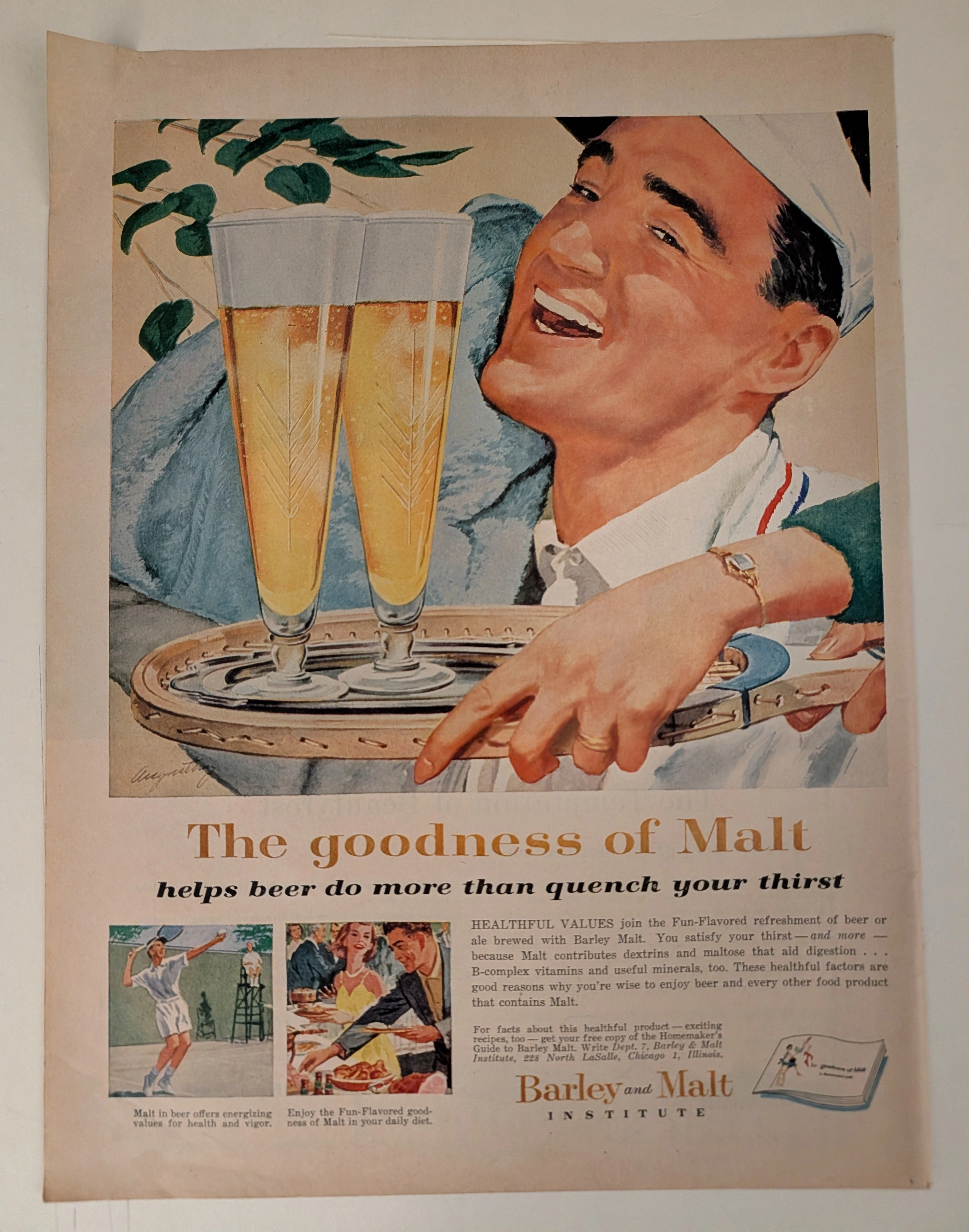
The Time Traveller's Dossier: How a 1959 Beer Ad Turned Alcohol into 'Health Food' – Barley and Malt Institute Advertisement
History is not written; it is printed. Before digital algorithms dictated human behavior, societal engineering was executed through the calculated geometry of the four-color offset press. The artifact before us is not merely an advertisement; it is a weaponized blueprint of middle-class aspiration. This museum-grade archival dossier presents an academic deconstruction of a 1959 print advertisement
Category: Beverage
The History
To decode the sociological architecture embedded within this printed artifact, it is mandatory to contextualize the macroeconomic landscape of the United States in 1959. The post-war era, characterized by unprecedented economic expansion, required industries to aggressively recalibrate their public narratives. For the brewing sector, this meant navigating the lingering cultural trauma of the Prohibition Era (1920–1933) while simultaneously targeting a newly affluent demographic. Part 1: The Binary Shift: Saloon vs. Suburbia The narrative architecture of this artifact is built upon a strict, u
The Paper
As a physical entity, this tear sheet is an unrepeatable record of mid-century analog printing. The medium-weight coated magazine stock was engineered for mass distribution, yet its current state demands evaluation through the Japanese aesthetic philosophy of wabi-sabi (侘寂)—the recognition of beauty in impermanence and the natural progression of time. Visual Forensics & Substrate Analysis: Examining the extreme close-ups of this artifact reveals the mechanical heartbeat of the 1950s press. Under magnification, the illusion of photorealism shatters into a precise, mathematical galaxy of CMYK h
The Rarity
Rarity Class: A Within archival parameters, this artifact holds a definitive Class A designation. The paradox of mid-century print ephemera lies in its initial mass production versus its extreme current scarcity. Magazines of the 1950s were quintessential disposable media, destined for the incinerator or the recycling bin. The survival of this specific page—enduring over six decades without yielding to moisture damage, destructive handling, or structural center creases—is an archival anomaly. Finding a specimen that retains its original pigment saturation while bearing only the natural, authen