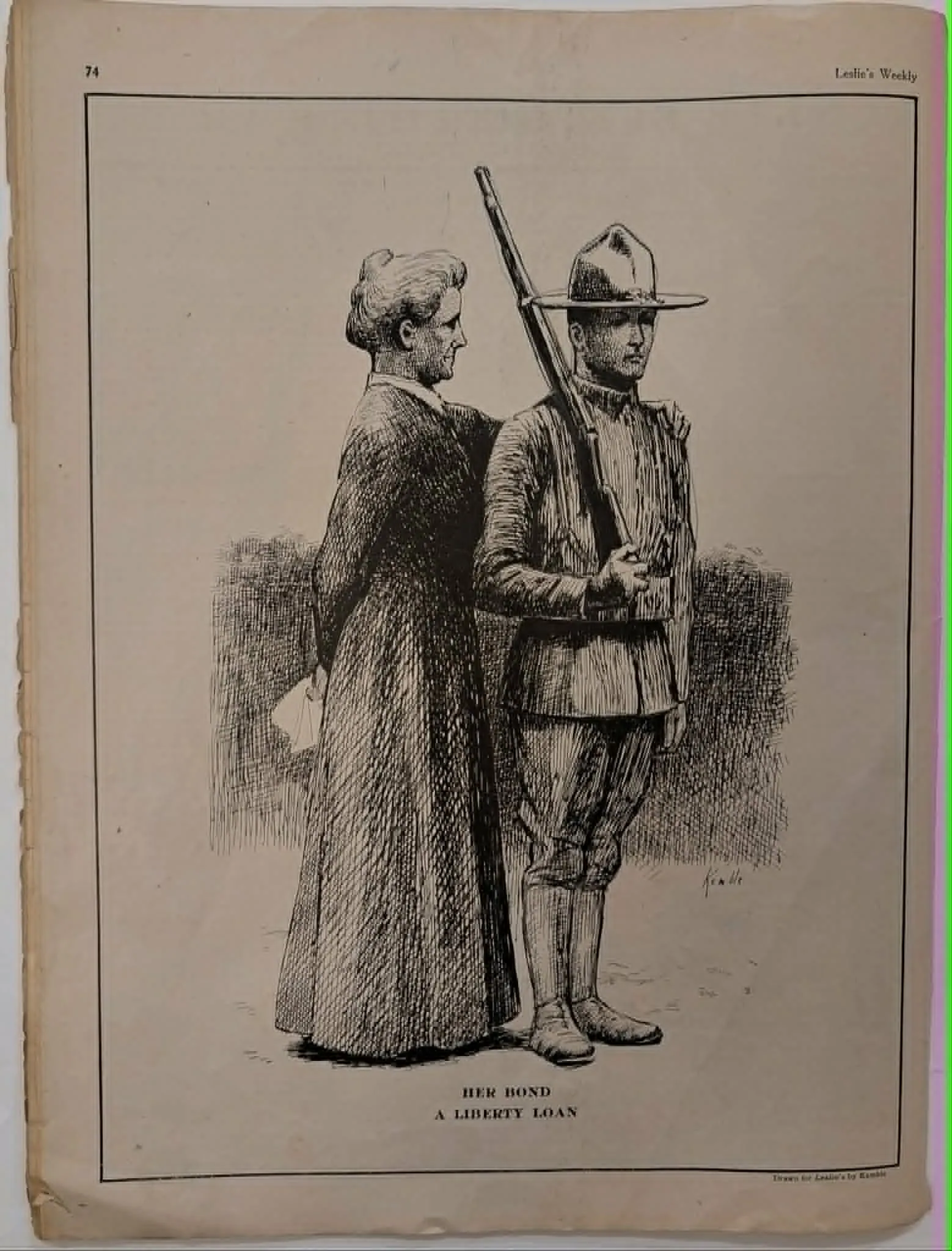
The Time Traveller's Dossier : Leslie's 1917 - The Weaponization of Maternal Grief
Look at the date. 1917. The global theater is locked in a mechanized stalemate. Before this precise epoch, the financial architecture of war was an institutional burden. Monarchies and treasuries funded standing armies through distant taxation and foreign debt. The civilian was a spectator to the economics of slaughter. They offered their sons, but their wallets remained largely insulated from the
Category: Other
The History
The Economics of Industrial Slaughter To comprehend the profound weight of this artifact, one must first dissect the financial fracture of the world in 1917. For three years, Europe had been caught in a thermodynamic meat grinder. The concept of localized, maneuver-based warfare had been entirely obliterated by the invention of the machine gun, the high-explosive artillery shell, and the war of attrition. When the United States abandoned its desperate isolationism and entered the fray in April 1917, it faced a logistical and economic nightmare. The nation was fundamentally unprepared for the s
The Paper
To handle this artifact is to interface with ephemeral architecture. It was explicitly designed for temporary consumption, not archival permanence. The substrate is a mass-produced, highly acidic wood pulp, likely resting between 50 and 65 GSM. In 1917, the priority was volume and speed of distribution. Over a century of existence, we observe the inevitable chemical degradation. The lignin within the wood fibers has oxidized violently upon prolonged exposure to ultraviolet light and atmospheric changes, resulting in the distinct, brittle browning creeping in from the frayed edges. Yet, this au
The Rarity
Classification: Class B This artifact is not classified in the higher tiers like SSS or Omega, as Leslie's Weekly was a mass-produced publication with hundreds of thousands of copies in circulation during the war. However, its rarity is derived entirely from its immense contextual value. Surviving copies from the exact months of the Liberty Loan drives are increasingly scarce due to the self-destructing nature of the acidic paper. Its true value lies not in a speculative auction house hammer price, but in its absolute purity as an unedited, real-time primary source document of state-sponsored