The Time Traveller's Dossier : Murakami - The Superflat Shift
There was a wall. For centuries, the boundary between fine art and commercial product was heavily fortified. On one side stood the gallery: sterile, quiet, demanding reverence. On the other side stood the marketplace: loud, transactional, ephemeral. This artifact records the exact moment that wall was demolished. It did not fall to a siege. It was painted over in thirty-three vibrant colors. We ar
Category: Other
The History
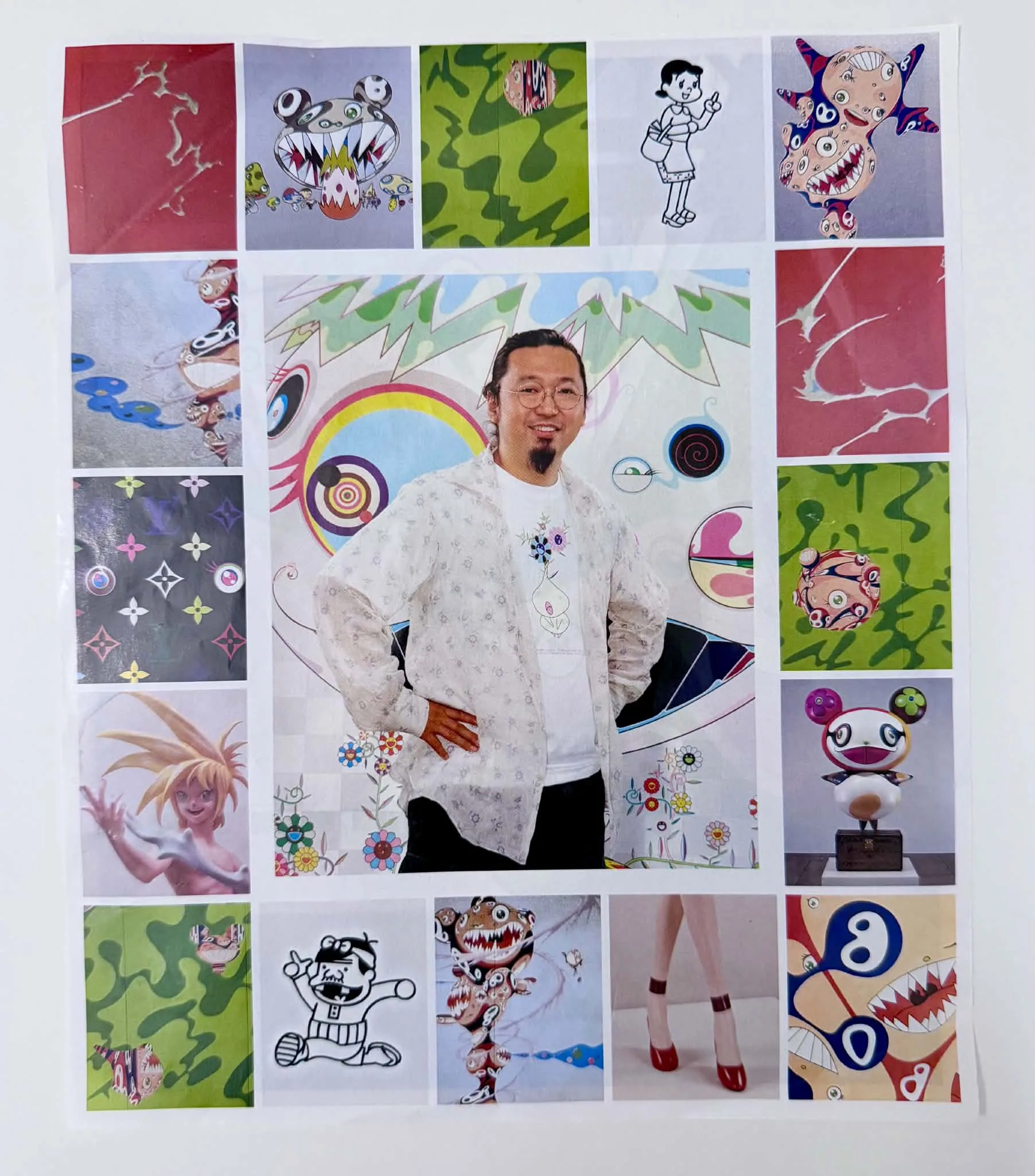
The Architecture of a Flattened Reality History is rarely defined by seamless transitions. It is defined by fractures, collisions, and the synthesis of opposing forces. To understand the artifact presented—a composite record of Takashi Murakami’s visual language—one must first understand the psychological landscape of post-war Japan. The dropping of the atomic bombs did more than level cities; it leveled the societal hierarchies that had governed Japan for centuries. The rigid structures of the past were vaporized. In the vacuum that followed, a new culture emerged, built on the rapid consumpt
The Paper
The physical artifact presents as a contemporary archival print, likely a retrospective editorial spread or gallery exhibition index. An analysis of the surface reveals it is printed on a heavy, coated stock, approximately 130 to 150 GSM. The coating allows for maximum ink holdout, essential for the dense saturation required by the Superflat aesthetic. Close examination of the macro images reveals distinct offset lithographic halftone patterns. The precision of the rosette structures in the CMYK printing is critical here; the exactness of the mechanical reproduction mirrors the artist's own ph
The Rarity
Classification: Class A This specific composite artifact is not a one-of-a-kind original painting, which dictates its classification. It is a reproductive document. However, its value is entirely contextual. It acts as an encyclopedic index of a pivotal cultural shift. While mass-produced gallery guides or editorial features hold low intrinsic market value, their archival worth increases exponentially as they become the primary physical evidence of how an aesthetic movement was communicated to the masses during its inception. It is a map of a revolution, capturing the exact coordinates where a