The Time Traveller's Dossier : Murakami's Inflatables - The Spatial Invasion of Superflat
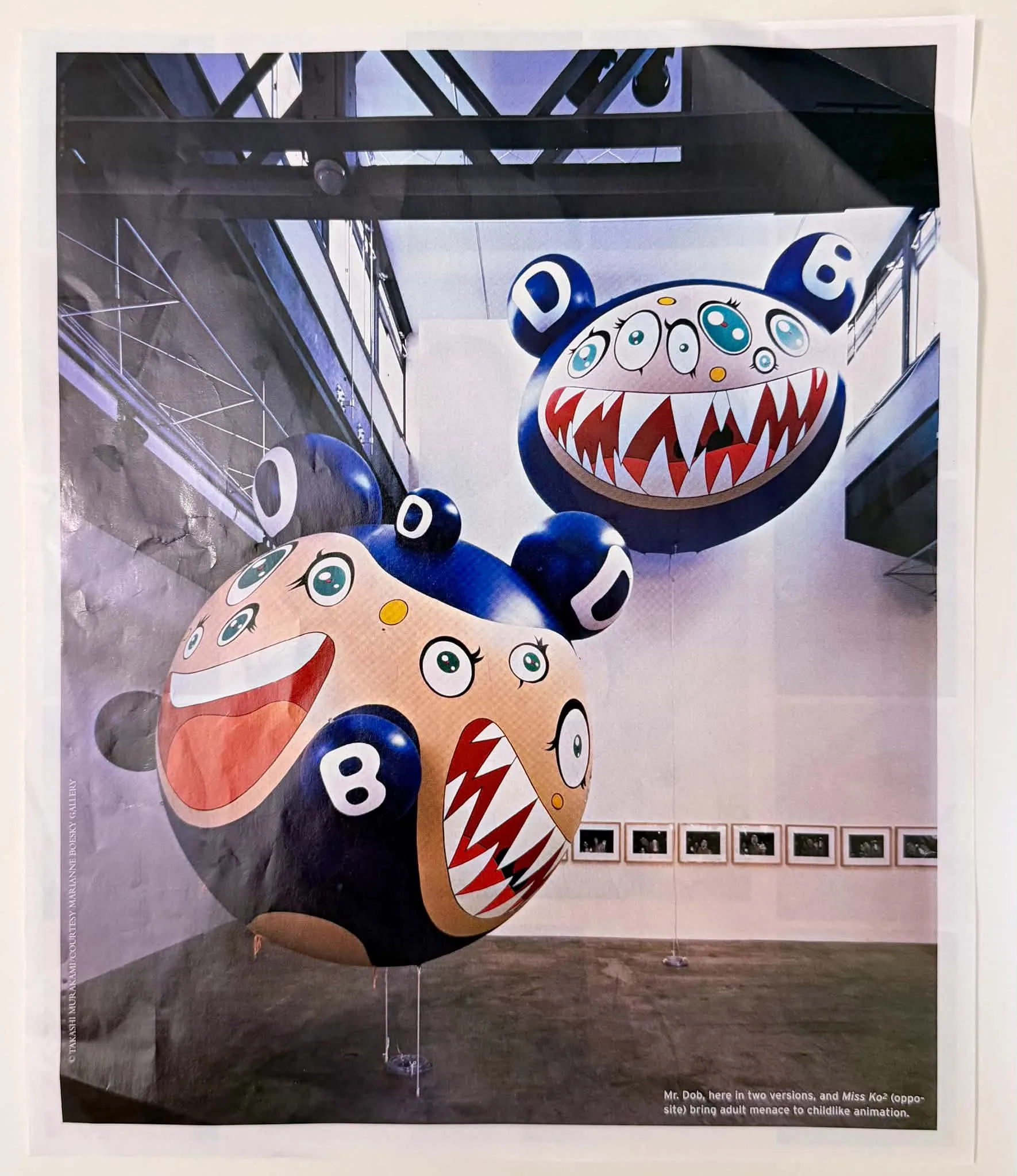
Before this artifact, the philosophy of "Superflat" was strictly confined to two dimensions. It existed on canvas. It existed on paper. It existed on screens. It was a critique of a society lacking depth, delivered through a medium that literally possessed none. After this artifact, the flat universe inhaled. It inflated. It breached the physical dimension. Captured across these magazine pages is
Category: Fashion
The History
The Dimensional Paradox: Inflating the Flat To understand the historical gravity of the installations documented in this artifact, one must first grasp the foundational paradox of the artwork itself. Takashi Murakami’s entire conceptual framework, known as "Superflat," was a sociological diagnosis masquerading as an aesthetic movement. He argued that post-war Japanese society, having been leveled by atomic destruction and subsequently rebuilt by extreme American capitalism, had lost its cultural and historical depth. The hierarchy between high art and low culture had been flattened entirely. T
The Paper
This artifact is a physical page excised from a commercial art publication, likely a high-end magazine or an exhibition retrospective catalog. It is not a digital apparition; it is a tangible piece of history. The substrate is a standard commercial coated stock, estimated to be between 100 and 115 GSM in weight. The glossy finish was chemically engineered to hold the ink precisely on the surface rather than letting it bleed into the paper fibers. This ensures maximum color saturation and razor-sharp line definition—a vital, non-negotiable requirement for reproducing the hyper-synthetic, plasti
The Rarity
The intrinsic value of this artifact does not lie in its material scarcity or raw physical components. As a page torn from a commercially distributed publication, thousands of identical copies were printed and circulated globally. Its true rarity is entirely contextual, informational, and historical. It earns a Class B classification because it operates as a primary source document capturing a highly specific, volatile moment in the evolution of contemporary art. It records the precise visual language, the stark gallery setting, and the critical vocabulary (such as the term "adult menace") use