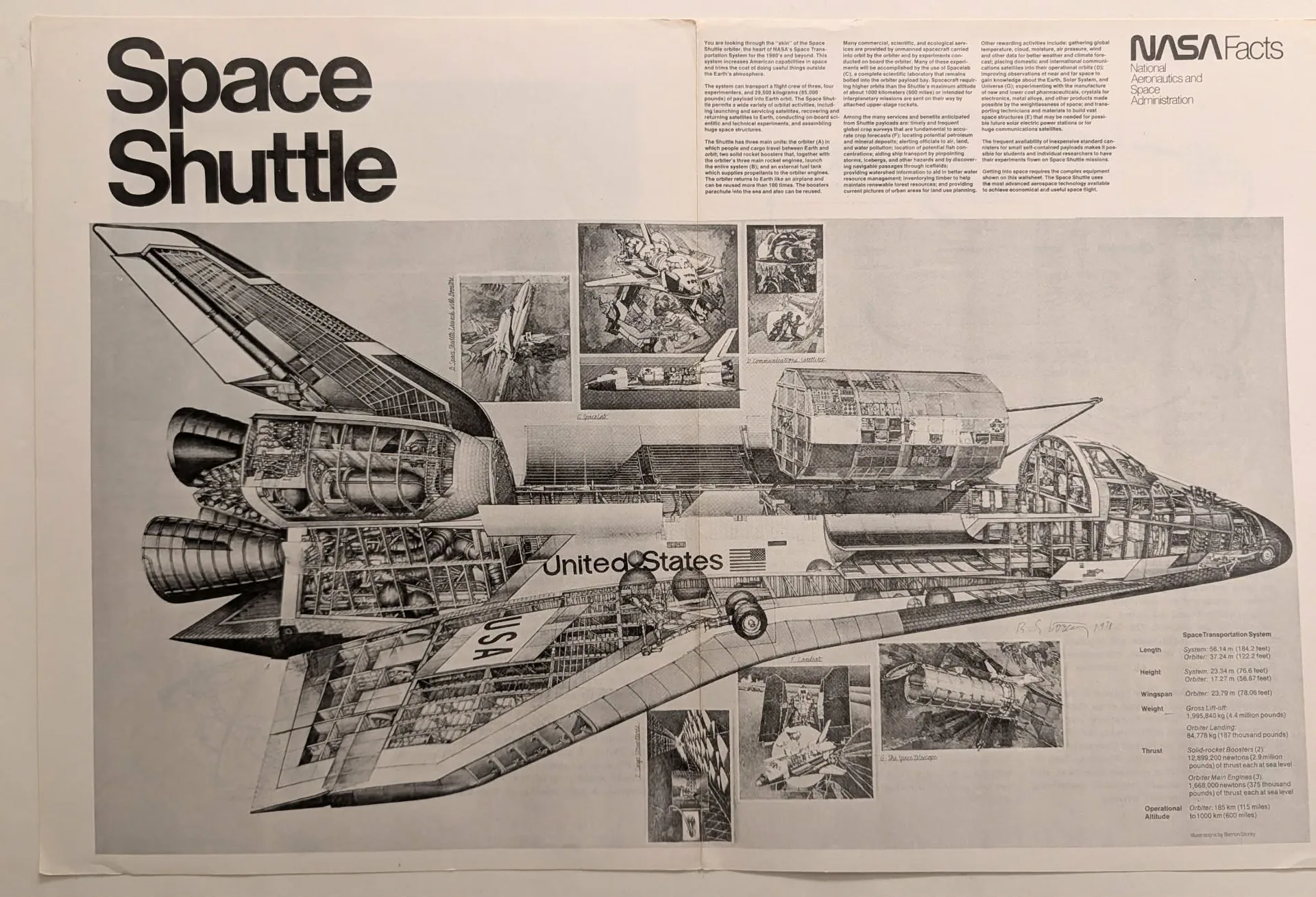
The Time Traveller's Dossier : Space Shuttle - Engineering the Reusable Void
Before this ink dried, spaceflight was an entirely disposable endeavor. We built monolithic monuments of aluminum and fire, hurled them into the unforgiving abyss, and let them burn in the atmosphere or sink to the bottom of the ocean. The paradigm of the 1960s was magnificent, but it was fundamentally, economically unsustainable. Then came the shift. The concept of the orbital workhorse. The spac
Category: Technology
Brand: NASA
The History
The Context of 1978: The Hangover of Apollo To understand the profound weight of this document, we must first isolate its temporal coordinates. The year is 1978. The echoing triumph of the Apollo moon landings has faded into a distant, complex memory. The American public is exhausted. The decade has been battered by the geopolitical hangover of the Vietnam War, crippling oil crises, and relentless economic stagflation. The blank-check era of the space race, fueled by pure Cold War ideological warfare, is definitively over. The National Aeronautics and Space Administration (NASA) faced an exist
The Paper
To touch this document is to touch the bureaucratic optimism of the late 1970s. The physical medium is a standard, uncoated offset paper, likely chosen for its cost-effectiveness in mass distribution. It lacks the glossy sheen of modern promotional materials, favoring a utilitarian matte finish. The printing relies on a monochromatic black ink process, utilizing halftone dot matrices to render the complex shading of the illustrations. Time has interacted chemically with this artifact. The distinct yellowing along the margins, known in archival terms as foxing, and the subtle softening of the p
The Rarity
Classification: Class A. Millions of these NASA Facts sheets were likely printed and distributed to schools, press members, and aerospace contractors during the late 1970s. However, finding a surviving copy possessing this level of structural integrity—free from severe tearing or moisture damage—elevates its status. Its true rarity, however, lies in its immense contextual value. It acts as the definitive bridge between the experimental Apollo hangover and the STS operational era. It is a primary source document capturing the exact moment the United States redefined its relationship with the co