The Time Traveller's Dossier: The Sanctuary of the Highway – The 1968 Ford LTD and the Democratization of Silence — The Record Institute JournalThe Time Traveller's Dossier: The Sanctuary of the Highway – The 1968 Ford LTD and the Democratization of Silence — The Record Institute JournalThe Time Traveller's Dossier: The Sanctuary of the Highway – The 1968 Ford LTD and the Democratization of Silence — The Record Institute JournalThe Time Traveller's Dossier: The Sanctuary of the Highway – The 1968 Ford LTD and the Democratization of Silence — The Record Institute Journal
1 / 4

✦ 4 图片 — 点击图片查看高分辨率

2026年3月23日

The Time Traveller's Dossier: The Sanctuary of the Highway – The 1968 Ford LTD and the Democratization of Silence

AutomotiveBrand: FordPhoto: Unknown (Uncredited Commercial Photographer & Art Director / J. Walter Thompson Advertising Agency)Illustration: Unknown (Uncredited Commercial Photographer & Art Director / J. Walter Thompson Advertising Agency)

历史

To fully appreciate the immense historical gravity, cultural magnitude, and sociological importance of this artifact, one must meticulously contextualize the psychological, economic, and infrastructural landscape of the American driver in 1968. This was a year characterized by intense domestic and international turmoil; the sociopolitical fabric of the United States was vibrating with the anxieties of the Vietnam War, civil rights struggles, and generational shifts. Concurrently, the physical landscape of America was being radically permanently altered by the Federal-Aid Highway Act, which was rapidly pouring millions of tons of concrete to create the Interstate Highway System.

Within this noisy, turbulent, and concrete-heavy environment, the American consumer developed a profound psychological desire for a sanctuary. They craved a controlled, isolated environment. The Ford Motor Company, possessing an exceptionally astute reading of this sociological undercurrent, responded not merely with a car, but with a mobile isolation chamber. The 1968 Ford LTD represented the pinnacle of this philosophy.

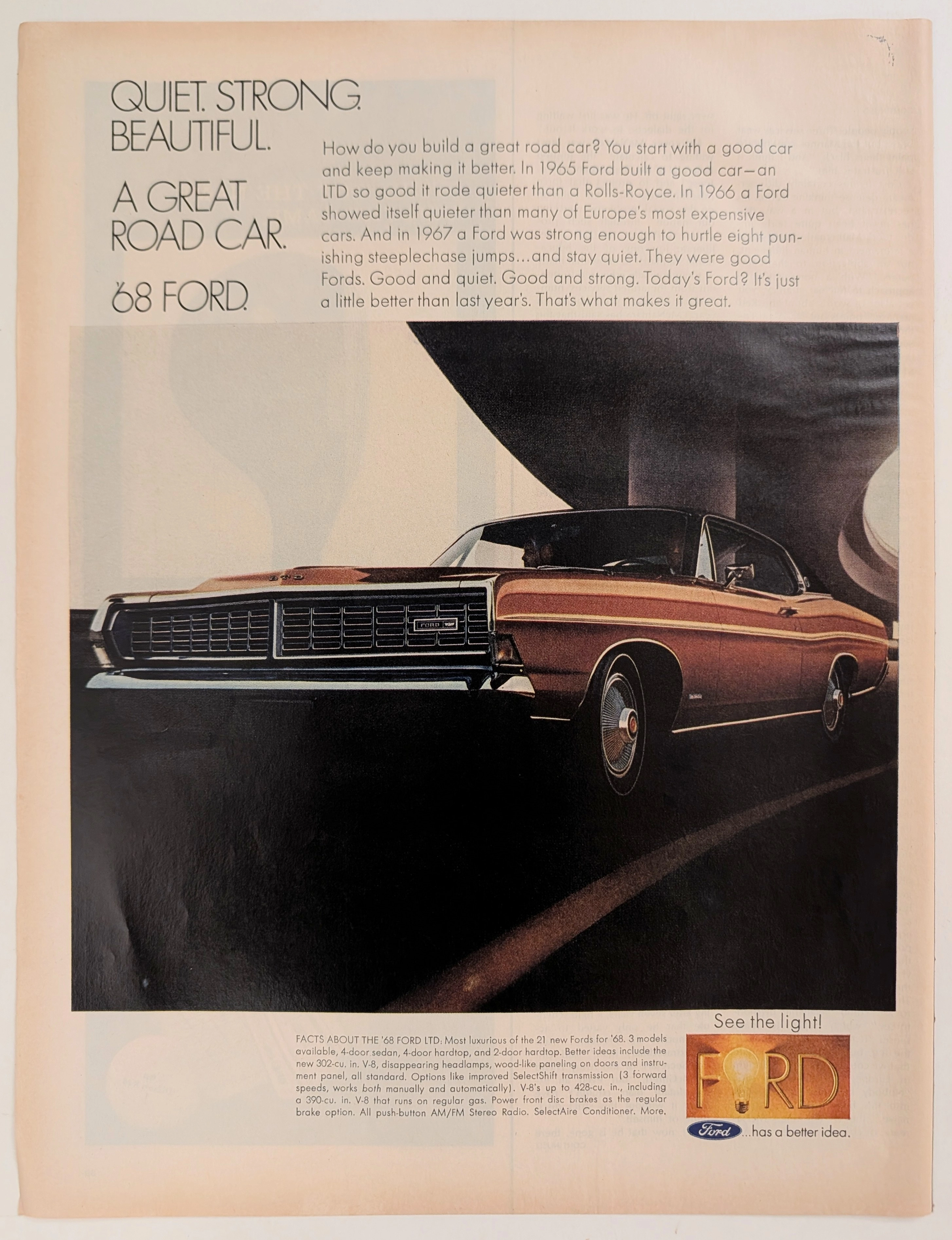
The bold, authoritative typography anchoring the top left of the artifact reads: "QUIET. STRONG. BEAUTIFUL. A GREAT ROAD CAR.". The deliberate placement of "QUIET" as the very first adjective is a monumental departure from traditional automotive marketing, which typically prioritized speed, horsepower, or aggressive styling. Ford was selling the absence of noise. The advertising copy delves deeply into this legendary engineering narrative, referencing a marketing campaign that began three years prior: "In 1965 Ford built a good car—an LTD so good it rode quieter than a Rolls-Royce".

This specific claim—that a mass-produced, middle-class American sedan was acoustically superior to the bespoke, hand-built pinnacle of British automotive aristocracy—was one of the most audacious and successful marketing strategies of the 20th century. Ford actually hired acoustic engineers to measure the decibel levels of an LTD against a Rolls-Royce Silver Cloud, utilizing the scientific data to democratize the concept of luxury. The copy in this 1968 artifact reminds the consumer of this continuous legacy, noting that in 1966 it was quieter than European cars, and in 1967 it was strong enough to survive "eight punishing steeplechase jumps... and stay quiet". Ford was not just selling a vehicle; they were selling an impenetrable fortress of domestic tranquility.

The visual composition of the advertisement brilliantly reinforces this narrative of the "Great Road Car." The 1968 Ford LTD 2-door hardtop is photographed parked beneath the massive, sweeping, brutalist curves of a modern concrete highway overpass. The lighting is moody and cinematic, casting the harsh infrastructure in deep shadows while the warm, metallic bronze paint of the car gleams with sophisticated elegance. This deliberate juxtaposition highlights the car as a refined, beautiful haven amidst the cold, unforgiving reality of modern American infrastructure. The car features "disappearing headlamps," a hallmark of high-end 1960s automotive design that allowed the front grille to appear as a single, unbroken, and menacingly wide horizontal graphic element, further emphasizing its sleek, aerodynamic isolation.

Furthermore, the artifact documents a critical shift in corporate branding via the secondary focal point at the bottom right of the page: the "See the light!" inset. This macro section highlights the legendary "Ford ...has a better idea" campaign. The visual substitution of the letter 'O' in FORD with a glowing, incandescent lightbulb was a stroke of genius. During an era when competitors like Chevrolet and Pontiac were heavily focused on muscle and brute force, Ford positioned itself as the intellectual automaker. They were selling innovation, smart engineering, and "better ideas"—such as the optional "push-button AM/FM Stereo Radio," the "SelectAire Conditioner," and "Power front disc brakes" detailed in the fine print. The lightbulb symbolized that buying a Ford was not an act of passion, but an act of supreme, calculated intelligence.

纸张

As a physical entity, this printed artifact functions as a living, breathing, and profound record of mid-twentieth-century graphic reproduction and substrate chemistry. Under exceptional, high-magnification macro-lens examination, this document reveals the stunning complexity and mathematical precision of analog color printing.

The extraordinary macro photograph of the LTD's wheel hubcap and lower fender provides a textbook visualization of a CMYK halftone rosette pattern. The intricate, radial spokes of the hubcap, the deep shadows of the wheel well, and the metallic glint of the central red emblem are not solid colors, but are meticulously constructed from a precise, mathematically rigorous galaxy of microscopic ink dots. Cyan, Magenta, Yellow, and Key (Black) inks are elegantly and systematically layered at highly specific angles to trick the human eye and the biological visual cortex into perceiving a continuous, vibrant, and dimensional photographic reality out of mere clusters of ink. This overlapping dot pattern constitutes the unforgeable mechanical fingerprint of the pre-digital analog offset printing press.

Yet, the most profound and impactfully beautiful factor elevating the immense value of this artifact in the contemporary global collector's market is the natural, organic, and entirely irreversible process of Material Degradation. The expansive margins and the overall paper substrate exhibit a genuine, unavoidable "Toning." This gradual, chronological transition from the original bright, bleached manufactured paper to a warm, antique ivory and golden hue is caused by the slow, relentless chemical oxidation of Lignin—the complex organic polymer that naturally binds cellulose fibers together within the raw wood pulp of the paper. As the substrate is exposed to ambient oxygen and ultraviolet light over a span of nearly six decades, the molecular structure of the lignin gracefully breaks down. This naturally evolving patina represents the absolute core of the wabi-sabi aesthetic. It is precisely this authentic, unreplicable degradation that acts as the primary engine driving up its market value exponentially among elite curators and collectors, as it provides the ultimate, irrefutable scientific proof of the artifact's historical authenticity and its delicate journey through time.

稀有度

RARITY CLASS: B (Very Good Archival Preservation with Natural Margin Toning)

Evaluated under the most exacting, rigorous, and uncompromising archival parameters established by The Record Institute, this artifact is definitively and securely designated as Class B.

The remarkable and defining paradox of mid-century commercial ephemera is that these specific documents were produced by the millions as explicitly and intentionally "disposable media." Inserted into high-volume consumer publications of 1968, they were inherently destined by their very nature to be briefly observed, casually folded, and ultimately discarded into the recycling bins of history. For a full-page, graphically intensive automotive advertisement to survive entirely intact from the late 1960s without catastrophic structural tearing, without destructive moisture staining, or without the fatal, irreversible fading of the delicate, light-sensitive halftone inks constitutes a highly significant statistical archival anomaly.

The structural integrity of this paper remains exceptionally sound. While the rich analog colors—particularly the warm bronze of the car's paint and the deep, moody blacks of the concrete shadows—remain astonishingly vibrant, there is a beautiful, mathematically even, natural lignin oxidation reflecting its era. This displays a pronounced, warm ivory patina heavily along the top and side margins. This environmental interaction does not detract from its immense value; rather, it authentically validates the document's chronological journey. The sheer sociopolitical weight of the subject matter—the definitive documentation of Ford’s "Quiet" luxury campaign during a tumultuous era of American history—makes this a highly prized, museum-worthy piece of automotive heritage, requiring acid-free, UV-protected conservation framing to ensure its historical permanence.

视觉冲击

The aesthetic brilliance and psychological power of this artifact lie in its masterful execution of "Brutalist Juxtaposition." The art director has deliberately constructed a visual hierarchy that contrasts the cold, unforgiving reality of modern infrastructure with the warm, isolated sanctuary of the automobile.

The composition is heavily dominated by the massive, sweeping curves of the concrete highway overpass that looms over the vehicle. This heavy, shadowy, and almost oppressive architectural element serves a profound psychological purpose: it represents the noisy, chaotic outside world from which the 1968 consumer desperately wished to escape. In brilliant, stark contrast, the Ford LTD sits below it, bathed in warm, cinematic light. The rich bronze paint and the unbroken, sleek horizontal lines of the disappearing headlamp grille project an aura of impenetrable, sophisticated tranquility.

The typography anchors this visual narrative with absolute authority. The top-left quadrant commands immediate attention with the heavy, clean sans-serif declaration: "QUIET. STRONG. BEAUTIFUL. A GREAT ROAD CAR.". This immense typographic weight is perfectly counterbalanced in the bottom-right quadrant by the glowing, almost magical inset of the "See the light!" lightbulb logo. This creates a flawless, diagonal focal path across the entire page—guiding the eye from the authoritative promise of silence, across the sleek sanctuary of the vehicle, and down to the glowing symbol of intellectual engineering. It is a textbook integration of moody environmental photography and psychological corporate branding.

分享此档案

档案继续

继续探索

双城协定:解读1982年Bacardi & Coca-Cola珍罕广告(S级)

双城协定:解读1982年Bacardi & Coca-Cola珍罕广告(S级)

深入美国消费主义历史,本博物馆级分析将带您领略1982年Bacardi与Coca-Cola联名广告的标志性魅力。这件Class S级别的档案珍品,捕捉了从插画黄金时代向1980年代商业摄影工作室风格的决定性转变。探索“Cuba Libre”的全球政治遗产,以及Coca-Cola经典瓶身不朽凝结效果背后的模拟实景技术。

时光旅者档案:脆弱的幻象与六十年代美学之构筑

时光旅者档案:脆弱的幻象与六十年代美学之构筑

在严谨的博物馆级分析之下,这件令人叹为观止、保存完好的“双页历史遗物”源自1960年代初期美国出版界那个迷人而高度精巧的世界。它呈现了一幅引人注目、视觉震撼的露华浓(Revlon)“Touch & Glow”乳霜粉底(creme soufflé makeup)广告。 这件“原始艺术文献”不仅仅是一则化妆品推广;它更是对世纪中期女性理想深刻的社会学蓝图。广告中掷地有声的文案,宣称这款化妆品专为“今日娇柔面庞”(today's fair and fragile face)而设,完美地概括了那个时代所推崇的审美:一种贵族式的瓷器般精致,与1960年代初期标志性的醒目、图形化眼妆形成鲜明对比。 至关重要的是,这件文物记录了查尔斯·露华浓(Charles Revson)心理营销的绝对天才。通过明确地为模特搭配“梵克雅宝珠宝”(JEWELS BY VAN CLEEF & ARPELS)(经右下角微小字体的署名及精美的珍珠/钻石耳环证实),露华浓巧妙地将其平易近人的消费级化妆品与欧洲高级珠宝的最高殿堂紧密相连。 这幅从一本被遗忘的期刊装订中抢救出来的宽幅双页广告,印刷在本质上呈酸性、大众市场的木浆纸上。它目前正经历着一场缓慢而宏伟的化学降解。这种自然氧化——体现在温暖的象牙色光泽和中央接缝的细腻老化中——将一次性商业信息转化为一件不可替代、可供装裱的世纪中期美容史“原始艺术文献”。

超越时代:1978年 Heuer Chronosplit Manhattan GMT 腕表

超越时代:1978年 Heuer Chronosplit Manhattan GMT 腕表

通过一份珍贵的1978年杂志广告,重新探索这款终极模拟-数字混合腕表——该广告作为单页剪报被精心保存。

发布者

The Record Institute

分类匹配

相关文章

时光旅人档案:大萧条深渊中的傲慢与创新 — related article
阅读文章

时光旅人档案:大萧条深渊中的傲慢与创新

在严谨的博物馆级分析下,这件文物是一件保存完好的历史遗珍,源自20世纪最黑暗的经济深渊:美国大萧条。这件原始艺术文献取自1931年出版的《The Saturday Evening Post》杂志,刊载了一幅气势恢宏的整版广告,呈现了Sheaffer's "Balance" Lifetime Pen(Sheaffer's "Balance" 终身钢笔)。 这件作品是深刻的社会学与工业标志。1931年,在全球经济崩溃之际,W.A. Sheaffer却逆势而上,大胆地推广一款革命性的流线型奢华书写工具,定价高达惊人的15美元。广告明确强调了“White Dot”终身保修和刻有主人签名(“John Adams”)的14K实心黄金“Autograph”装饰环。在大规模贫困的时代,这无疑是一堂关于憧憬式营销的杰出课程。 在物理层面,这份近百年的木浆文献,以其令人叹为观止的姿态,印证了日本侘寂(wabi-sabi)美学。它展现出严重的、触目惊心的边缘创伤、深刻的边缘缺失、深琥珀色的氧化,以及左侧边缘显著的湿渍。这种极端的模拟衰变,将原本大规模生产的商业印刷品,升华为一件不可替代、备受追捧的原始艺术文献,它以实体形式承载着其90年历史旅程的累累印记。

时光旅行者档案:资本主义的建筑师与废墟美学 — related article
阅读文章

时光旅行者档案:资本主义的建筑师与废墟美学

经严谨的博物馆级分析,这件文物是一件意义深远的“历史遗珍”,源自美国企业崛起绝对巅峰时期。这份“原始艺术文献”是《FORTUNE》杂志的封面,明确标注日期为1963年9月。它呈现了一幅雄伟而富有表现力的手绘肖像,描绘了通用汽车帝国的传奇缔造者Alfred P. Sloan Jr.。 这件文物由备受赞誉的美国插画家Robert Weaver倾力绘制,其签名清晰可见,它在视觉上为杂志连载Sloan的权威商业回忆录《My Years with General Motors》提供了核心支撑。这部著作至今仍是现代企业管理和去中心化组织结构的奠基性经典。 从时间的侵蚀中抢救出来并作为独立的“档案文物”得以保存,《Fortune》杂志所使用的优质厚磅模拟纸张,正经历着令人惊叹的化学降解过程。它展现出严重的边缘磨损、锯齿状的纸张缺失以及沿边框深层的生物氧化。这种辉煌的衰败将一份大规模生产的商业期刊,转化为一件不可替代、可直接装裱的“原始艺术文献”——它印证了即使是最伟大的资本主义帝国,也终将面临脆弱的消亡。

The Time Traveller's Dossier: 绝对权力的笔迹学 – 35位美国总统签名与总统印章的法医学解剖 — related article
阅读文章

The Time Traveller's Dossier: 绝对权力的笔迹学 – 35位美国总统签名与总统印章的法医学解剖

最高行政权力的行使,绝不仅仅通过建造宏伟的纪念碑式建筑、动员庞大的武装力量或在就职演说中发表华丽的修辞来证明。通常情况下,绝对权威最极致的物理显现,被极其精准地捕捉在笔尖与纸张发生物理摩擦的那零点几秒的决定性瞬间:即一位领袖挥毫签下其“名字(Signature)”的那一刻。签名是政治意志最纯粹、最暴力的物理投射;它是宣战、解放数百万奴隶以及批准人类探索星辰大海的终极法律文书。今天,摆在 The Record Institute 面前,等待进行博物馆级(Museum-grade)法医学解剖的这件历史文物(Artifact),是一件极其罕见且深邃的教育类印刷品。它采用了极具视觉统治力的反转平版印刷(Reverse Lithography)技术——在深邃、充满威严的深海军蓝(Navy Blue)背景上,白色的文本如同耀眼的星光般剥离而出。画面的绝对中心是“美国总统印章(Seal of the President of the United States)”,而围绕着这枚神圣印章呈放射状向外无限延伸的,是美国历史上前35位登顶权力最高峰的总统们的传真签名。 这份代表着全球最高学术标准的骨灰级档案,将以显微镜级别的恐怖精度对这件文物进行绝对解剖。我们将对这35位总统的签名进行逐一的个体法医学拆解(Individual Forensic Breakdown),深度探索那些如镜子般反射出他们的人格特质、教育背景以及他们所塑造的历史时代的笔迹学(Graphological)结构。此外,我们还将无情解码这种放射状视觉设计背后的深层工程逻辑,并对这种反色印刷基材进行最严苛的材料科学分析。在那个没有数字字体和电子授权的纯模拟时代,领袖的笔迹就是他们终极的“视觉DNA”。我们将潜入这片深蓝色墨水海洋的底层,细致入微地探索纸张老化的化学机制——那种散发着极其迷人的 侘寂 (Wabi-sabi) 美学的氧化过程,正是这一化学反应,充当了核心引擎,在当今的顶级收藏市场中呈指数级地疯狂推高其市场价值。

The Time Traveller's Dossier: 通用汽车的巅峰 – 惊艳外观与入微细节 (Looks and Closer Looks) — related article
阅读文章

The Time Traveller's Dossier: 通用汽车的巅峰 – 惊艳外观与入微细节 (Looks and Closer Looks)

在二十世纪中叶的美国,汽车从来都不只是一种纯粹实用的交通工具;它是一块巨大的、滚动的画布,投射出工业的骄傲、技术的进步以及消费者不断演变的身份认同。今日,优雅且安全地陈列于 The Record Institute 分析台上的这件历史文献 (Artifact),是一幅气势恢宏的、大画幅的 通用汽车 (General Motors, GM) 双页印刷广告,其历史可追溯至 20 世纪 60 年代末至 70 年代初。这份文件完全超越了传统汽车目录的界限。它作为一个高度复杂、具有双重叙事 (Dual-narrative) 维度的文化镜像而存在:左页捕捉了与激进的女性赋权新时代交织在一起的、对“外观 (Looks)”发自内心的视觉渴望;而右页则以“入微细节 (And closer looks)”解剖了机械与电子领域的精湛技艺,全面展示了 GM 旗下专业制造部门构成的庞大生态系统。 ​这份世界级水准的综合卷宗将在最为严谨的历史、社会学与材料科学评估参数下,对这件文献进行细致入微、毫不妥协且极具深度的解析。我们将破译“卓越标志 (Mark of Excellence)”活动背后巨大的工业分量,分析女性模特量身定制的裤装作为女性解放象征的深刻社会学意义,并解剖定义了现代驾驶体验的九项革命性汽车技术的内部构造。此外,当我们深入探究这种模拟印刷史料的化学与物理基础时,我们将揭示 CMYK 半色调网点 (Halftone rosettes) 的精确机械指纹,以及纸张基材优雅的自然氧化过程。视觉怀旧、世纪中叶商业艺术造诣与时间永恒的化学反应的精准交汇,孕育出了一种宁静的 侘寂 (Wabi-sabi) 美学——这一自然且不可逆转的现象作为核心引擎,在全球顶级的复古汽车史料与工业设计收藏圈中,呈指数级地推高其市场价值。

The Time Traveller's Dossier: 记忆的照明 (The Illumination of Memory) – Kodak Instamatic 104 与闪光泡 (Flashcube) 革命 — related article
阅读文章

The Time Traveller's Dossier: 记忆的照明 (The Illumination of Memory) – Kodak Instamatic 104 与闪光泡 (Flashcube) 革命

二十世纪中叶美国国内家庭体验的演变,与普通公民记录这些体验的能力有着千丝万缕的联系。今日,优雅且安全地陈列于 The Record Institute 分析台上的这件历史文献 (Artifact),是一份引人注目的、关于 Kodak Instamatic 104 相机的全版印刷广告,其历史可追溯至 20 世纪 60 年代中期。这份文件完全超越了消费电子营销的标准界限。它作为一个高度复杂、具有多维深度的文化与历史镜像,精确反射出摄影化学与照明的复杂性被工程学彻底消除的那个时代。它被明确地打包,并销售给美国公众——这不再仅仅是一台机械设备,而是对时间本身毫不费力的捕捉。 这份世界级水准的综合卷宗将在最为严谨、毫不妥协且极其详尽的历史学、社会学与材料科学评估参数下,对这件文献进行深度解析。我们将把绝大部分的分析焦点倾注于其深远的历史引力上,破译“Your sun, the flashcube (你的太阳,闪光泡)”这一叙事中蕴含的绝妙营销心理学,分析乔治·伊士曼 (George Eastman) 遗产所带来的巨大社会学影响,并解剖该相机平易近人的设计背后丰富的符号学。此外,当我们深入探究这种模拟印刷史料的化学与物理基础时,我们将揭示 CMYK 半色调网点 (Halftone rosettes) 的精确机械指纹,以及纸张基材优雅的自然氧化过程。最后,我们将评估其档案重要性,探索视觉怀旧、世纪中叶商业艺术造诣与时间永恒的化学反应的精准交汇,是如何孕育出一种宁静的 侘寂 (Wabi-sabi) 美学的——这一自然且不可逆转的现象作为核心引擎,在全球顶级的复古商业史料与世纪中叶生活方式收藏圈中,呈指数级地推高其市场价值。

时光旅人档案:优雅之肇始与绝迹的1,500美元圣杯 — related article
阅读文章

时光旅人档案:优雅之肇始与绝迹的1,500美元圣杯

博物馆级分析的文物是一件保存完好的历史遗物,源自模拟出版的黄金时代——一本《PLAYBOY》杂志的复古期刊(约1960年代末至1970年代)。其中刊登了一则引人注目、极尽精密的广告,推介现代人类历史上最具革命性的男士香水之一:Christian Dior EAU SAUVAGE 淡香水。 这份原始艺术文献不仅仅是为一款男士护理产品做广告;它更是一个重大文化范式转变的具象历史标志。在它于1966年问世之前,男士香水普遍厚重、麝香浓郁且辛辣刺鼻。由传奇调香大师Edmond Roudnitska调制的Eau Sauvage,通过将Hedione(一种轻盈、明亮的合成茉莉化合物)引入男士香水领域,打破了这一陈旧格局,从而永久改变了全球香水行业的发展轨迹。 至关重要的是,此文物中描绘的原始中世纪配方和特定的罗纹玻璃瓶设计已永久停产并失传。受严格化学法规(例如禁止使用天然橡苔)驱动的现代重新配方,已永远改变了Roudnitska的原始杰作。因此,现存的这一确切年代的复古香水瓶已获得神话般的“圣杯”地位,目前在全球收藏品市场中,其价格高达1,500美元。这使得这则保存完好的广告从一张商业印刷品,升华为一件无价的历史溯源——一份已灭绝奢侈品的“出生证明”。 从毁坏中抢救出来并作为独立的档案文物保存,中世纪时期固有的酸性光面纸张正在经历缓慢而惊人的化学降解。这种自然老化过程(氧化和木质素分解)将批量生产的印刷品转化为一件不可替代、可直接装裱的原始艺术文献,体现了模拟时代转瞬即逝的终极美学。